
Skip to content
The Encyclopedia of Horology

Pocket watch · Pocket chronometer

Omega Ref. 743.20 Pocket Chronometer

Partially verified

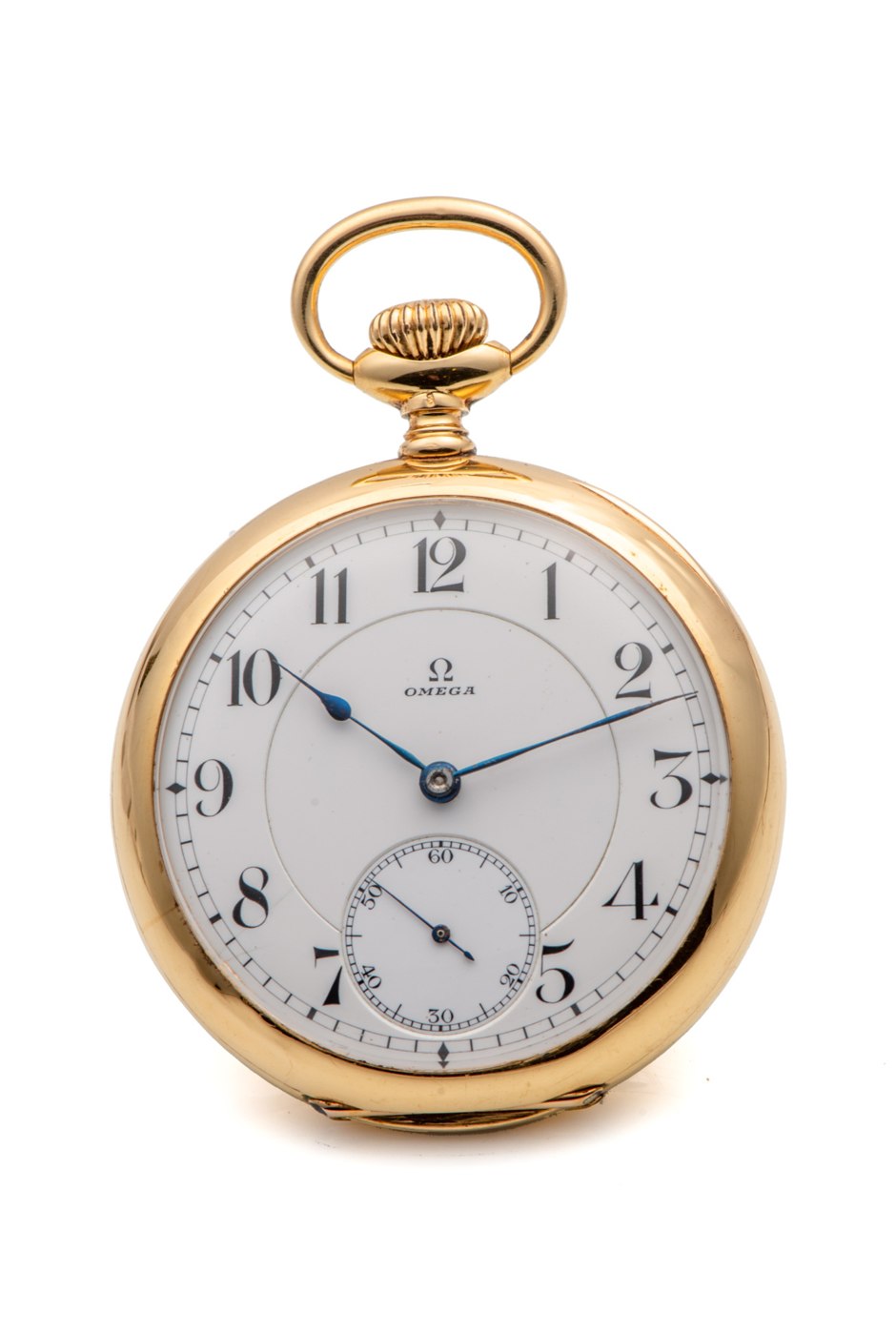
This open-face, keyless-winding pocket chronometer is housed in an 18K yellow gold case. The watch features a white enamel dial with Arabic numerals and subsidiary seconds at 6 o'clock. It is powered by a 20''' nickel-plated movement designated as Grade DDR, which includes 23 jewels, a going barrel with safety pinion, and a Guillaume balance. The mechanism is equipped with a straight-line lever escapement, diamond end-stone, and a swan-neck index regulator. The piece was adjusted by precision timer Werner A. Dubois in Bienne. This specific calibre was produced for official chronometric use, intended for astronomical observatory testing. The watch is accompanied by documentation indicating it received a First Class Bulletin de marche from the Astronomical Observatory of Neuchâtel for the years 1911, 1912, and 1913, reflecting its performance in rigorous timing competitions that assessed movements in five positions and under varying temperature conditions.

The watch face showing the white enamel dial with Arabic numerals and subsidiary seconds.
The watch face showing the white enamel dial with Arabic numerals and subsidiary seconds. — Antiquorum. Rights pending — permission not yet requested. Original source

Catalogue identity

Source
catalog.antiquorum.swiss
Category
Pocket watch · Pocket chronometer
Maker / attribution
Omega
Reference
743.20
Catalogue / lot identifier
167
Source-reported date
circa 1905-1908
Source-reported place
Switzerland
Source-reported serial
5 171 418

Source-reported attribution and specifications are not independent authentication. A listing does not establish present ownership, current display, availability or permission to reproduce.

Object description

Case and Dial Construction

The watch features an open-face, keyless-winding construction crafted from 18K yellow gold. The round-shaped case houses a white enamel dial, which displays suspended Arabic numerals and a subsidiary seconds dial positioned at 6 o'clock. The case back is polished and bears detailed decorative engravings.

The external decoration includes commemorative imagery celebrating the Grand Prix at the 1900 Paris exhibition. The overall physical condition is reported as good, though the auction description notes slight scratches on the case and hairlines on the enamel dial.

Evidence for this section
  • “18K yellow gold, open-face, keyless-winding, round-shaped, pocket chronometer”
  • “White enamel dial with suspended Arabic “Paris” numerals”
  • “Case-back polished”

Movement and Escapement

The internal mechanism is a 20''' nickel-plated movement identified as Grade DDR. This grade, introduced in 1905, was designed specifically for official chronometer use in observatories. It incorporates 23 jewels, including two diamond end-stones, and features a going barrel with a safety pinion.

Precision regulation is managed by a swan-neck spring and an eccentric snail device. The movement utilizes a Guillaume balance, which is a compensated bimetallic balance constructed from anibal and brass to minimize middle-temperature errors. The movement was adjusted by the professional precision timer Werner A. Dubois.

Evidence for this section
  • “Movement 20’’’, “Chronomètre DDR”, nickel-plated, 23 jewels”
  • “cut bimetallic compensated brass-Invar Guillaume balance”
  • “index regulator with swan-neck spring and precision-regulating device for fast / slow by means of an eccentric snail”

Chronometric Performance and History

This watch served as a high-precision instrument intended for use in formal observatory timing tests. Such tests were conducted over forty-five days, assessing movements across five positions and two distinct temperature ranges. These environments served as competition grounds for Swiss watch manufacturers.

The subject piece received First Class Bulletins de marche from the Astronomical Observatory of Neuchâtel for three consecutive years between 1911 and 1913. These certifications corroborate its performance during the era of competitive chronometry.

Evidence for this section
  • “intended for official chronometers and observatories”
  • “First Class Bulletin de marche from the Astronomical Observatory of Neuchâtel (1911, 1912 and 1913)”
  • “tests took place over a period of forty-five days and included ten separate tests”

Open research questions

  • What are the specific timing results recorded on the three bulletins from 1911-1913?
  • Does the serial number correspond to a specific production batch of the 396 units reported for the 20''' DDR caliber?

Source evidence

Recorded claims and source quotations for Omega Ref. 743.20 Pocket Chronometer
FieldSource-reported valueSource quotation
MakerOmega“Brand Omega, Bienne / Biel”
Reference743.20“Reference 743.20”
Movement number2 362 051“Movement No. 2 362 051”
Case material18K yellow gold“18K yellow gold”
Movement caliber20''' DDR“Caliber 20’’’ LO, Grade “DDR””
AdjusterWerner A. Dubois“adjusted by the Omega precision timer “régleur” Werner A. Dubois”
Observatory certificationNeuchâtel Observatory“First Class Bulletin de marche from the Astronomical Observatory of Neuchâtel (1911, 1912 and 1913)”

Visible details

  • White enamel dial with Arabic numerals
  • Movement bridges engraved 'Chronomètre DDR'
  • Case back features commemorative engraving including 'GRAND PRIX PARIS 1900'
  • Swan-neck regulator visible on movement balance bridge

Research qualifications

  • Specific production year within the 1905-1908 range is inferred
  • Weight is provided as an approximate measurement

Photograph identity and source facts were screened before import; rights clearance remains pending.