
Skip to content
The Encyclopedia of Horology

Pocket watch · Pocket chronometer

John Arnold & Son Pocket Chronometer Watch with Spring Detent Escapement

Partially verified

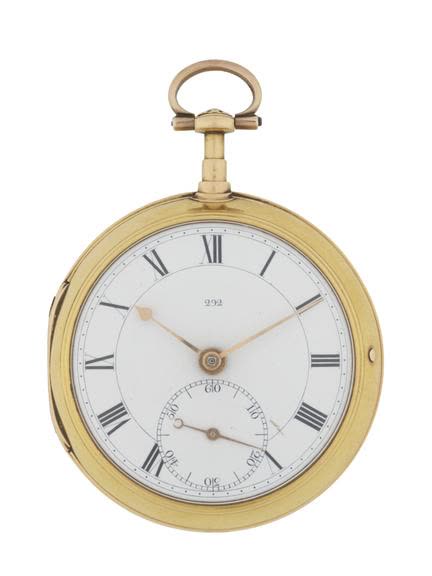
According to the Science Museum Group, this pocket chronometer watch was produced by John Arnold & Son in London and features a gold case hallmarked for 1788–1789. The case bears casemaker's mark 'TH' and stamped number 292. The white enamel dial displays Roman hour numerals, gold hands, a subsidiary seconds dial, and the inscription '292'. The movement is recorded as having a spring detent escapement, an OZ balance, and a gold helical balance spring with 4 turns. The movement is inscribed 'John Arnold & Son, London, N 292/593, Invt. et Fect'.

Front view of the pocket chronometer watch showing the white enamel dial and gold case
Front view of the pocket chronometer watch showing the white enamel dial and gold case — Science Museum Group/The Clockmakers' Museum © The Board of Trustees of the Science Museum. Rights pending — permission not yet requested. Original source

Catalogue identity

Source
collection.sciencemuseumgroup.org.uk
Category
Pocket watch · Pocket chronometer
Maker / attribution
John Arnold & Son
Reference
Not recorded
Catalogue / lot identifier
L2015-3337
Source-reported date
1788 – 1789
Country
United Kingdom
Source-reported serial
292/593

Source-reported attribution and specifications are not independent authentication. A listing does not establish present ownership, current display, availability or permission to reproduce.

Object description

Dial and Visual Presentation

The timepiece features a white enamel dial with black Roman numerals and an outer minute track, with the numeral '292' positioned on the upper portion below 12 o'clock. A subsidiary seconds dial marked with Arabic numerals is positioned at 6 o'clock.

Gold spade-style hour and minute hands radiate from a rounded central boss, framed within a smooth gold bezel and open-face case configuration.

Evidence for this section
  • “White enamel dial with subsidiary seconds dial and gold hands, dial signed '292'.”
  • “White enamel dial with black Roman numerals and an outer track.”
  • “Subsidiary seconds register at 6 o'clock marked with Arabic numerals.”
  • “Gold spade-style hour and minute hands centered with a rounded boss.”
  • “Inscribed numeral '292' visible below the 12 o'clock position on the upper dial.”

Case Construction and Stamped Markings

The gold open-face case measures 66 mm by 52.5 mm by 25 mm overall, including a pendant and rounded bow at 12 o'clock. The case bears hallmarks for 1788–1789.

According to collection documentation, the case is stamped with the number 292 and bears the casemaker's mark 'TH'.

Evidence for this section
  • “Gold open-face case with pendant and rounded bow at 12 o'clock.”
  • “overall: 66 mm x 52.5 mm x 25 mm”
  • “hallmarked for 1788 – 1789.”
  • “Gold case with casemakers mark 'TH' and stamped 292.”

Recorded Movement and Technical Specifications

The movement is not visible in the closed case photograph, but museum records document that it is signed 'John Arnold & Son, London, N 292/593, Invt. et Fect'.

The recorded mechanism features a spring detent escapement, an OZ balance, and a gold helical balance spring of four turns. Recorded materials for the watch and detent comprise gold, brass, steel, enamel, glass, and diamond.

Evidence for this section
  • “Signed ‘John Arnold & Son, London, N 292/593, Invt. et Fect’.”
  • “Movement with spring detent escapement , OZ balance and gold helical balance spring of 4 turns.”
  • “Materials: gold (metal) , brass (copper, zinc alloy) , steel (metal) , enamel , glass and diamond”

Open research questions

  • Which London casemaker is represented by the 'TH' punch mark on this 1788–1789 hallmarked case?
  • How does the dual movement number 'N 292/593' relate to the numbering conventions of John Arnold & Son pocket chronometers?
  • What specific role does diamond serve in the construction of this movement according to museum physical records?

Source evidence

Recorded claims and source quotations for John Arnold & Son Pocket Chronometer Watch with Spring Detent Escapement
FieldSource-reported valueSource quotation
Maker and LocationJohn Arnold & Son, London“Pocket chronometer watch by John Arnold & Son, London”
Hallmark Date1788 – 1789“hallmarked for 1788 – 1789”
Casemaker MarkTH“Gold case with casemakers mark 'TH' and stamped 292.”
Movement InscriptionJohn Arnold & Son, London, N 292/593, Invt. et Fect“Signed ‘John Arnold & Son, London, N 292/593, Invt. et Fect’.”
Escapement and BalanceSpring detent escapement, OZ balance, gold helical balance spring of 4 turns“Movement with spring detent escapement , OZ balance and gold helical balance spring of 4 turns.”
Dimensions66 mm x 52.5 mm x 25 mm“overall: 66 mm x 52.5 mm x 25 mm”
Museum Inventory NumberClockmakers' Museum No. 424“Clockmakers' Museum No. 424”
Lender CreditLent by the Worshipful Company of Clockmakers“credit: Lent by the Worshipful Company of Clockmakers”
Recorded MaterialsGold, brass, steel, enamel, glass, diamond“Materials: gold (metal) , brass (copper, zinc alloy) , steel (metal) , enamel , glass and diamond”

Visible details

  • White enamel dial with black Roman numerals and an outer track.
  • Subsidiary seconds register at 6 o'clock marked with Arabic numerals.
  • Gold open-face case with pendant and rounded bow at 12 o'clock.
  • Inscribed numeral '292' visible below the 12 o'clock position on the upper dial.
  • Gold spade-style hour and minute hands centered with a rounded boss.

Research qualifications

  • Movement details, hallmarks, and casemaker mark are concealed within the closed case in this photograph and rely on source documentation.

Photograph identity and source facts were screened before import; rights clearance remains pending.

Terms in this record

Glossary explanations for terms named in this object’s record.