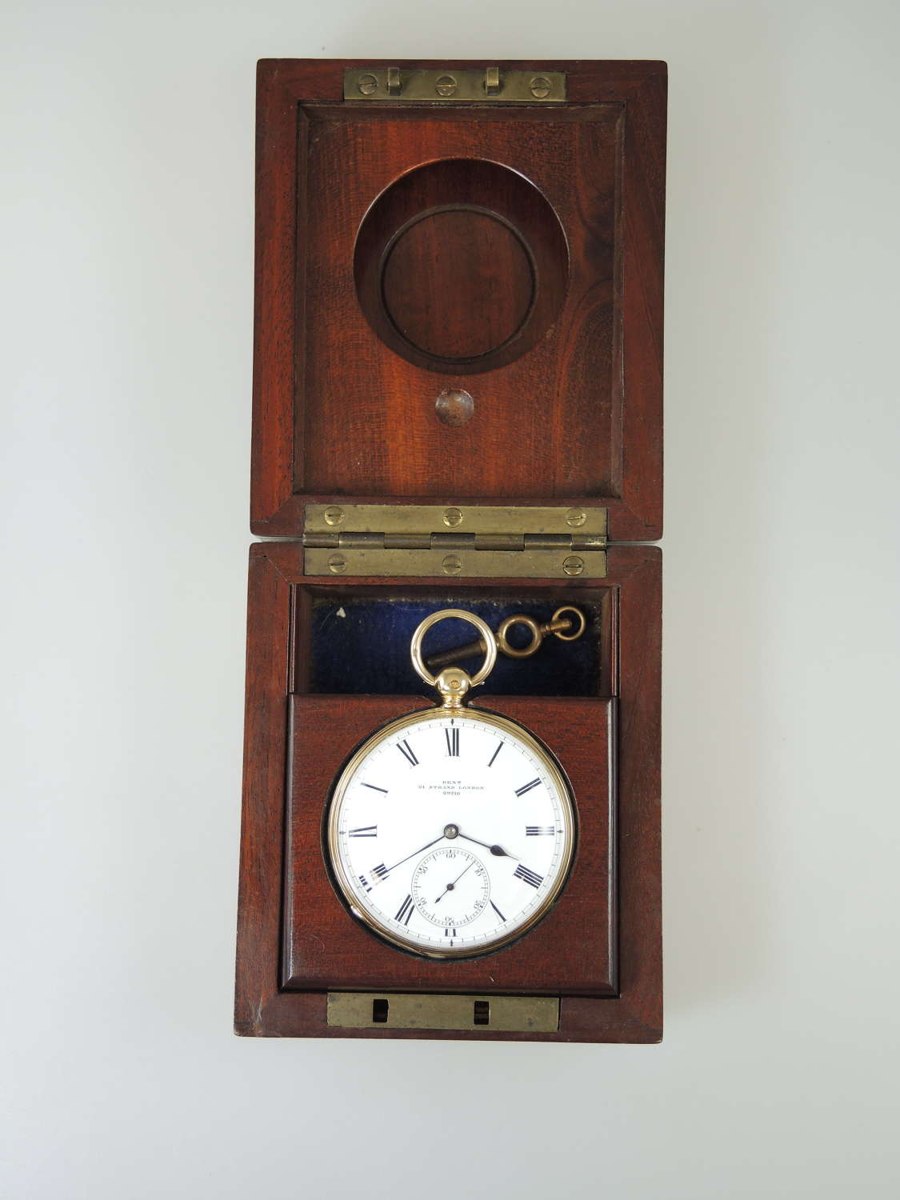
Dial and Visible Presentation
The pocket chronometer features a white enamel dial with black Roman hour numerals, an outer minute track, and blued steel hands, along with a subsidiary seconds dial positioned at 6 o'clock. The dial is signed "Dent, 61 Strand, London, 29216". The watch is fitted with a mineral glass crystal and is presented seated in the circular recess of its fitted wooden box with its winding key.
A condition issue reported by the vendor on the enamel dial is a hairline crack extending from the 11 o'clock numeral toward the center.
Evidence for this section
- “White enamel dial with black Roman numerals and an outer minute track.”
- “Subsidiary seconds dial positioned at the 6 o'clock location with a blued steel hand.”
- “the white enamel dial has a full set of blue steel hands and is signed “Dent, 61 Strand, London, 29216””
- “there is a hairline from the 11 to the centre. The watch has a mineral glass”
Case Construction and Hallmarks
The timepiece is housed in an open-face solid 18K gold case measuring 49 mm in diameter and 14 mm thick. The case structure is described as having stepped sides, light engine turning on the back, and hinged front, back, and inner covers.
The case is reported to bear London hallmarks for 1863, the maker's initials JWS, and the serial number 29216 matching the movement and dial. The interior case marks and case back are not shown in the primary photograph.
Evidence for this section
- “solid 18K gold case with hallmarks for London 1863”
- “The case has stepped sides and light engine turning on the back.”
- “makers initials for JWS and is numbered 29216”
- “The watch measures 49mm wide x 14mm”
Reported Movement and Escapement
Although the movement is not visible in the provided image, it is described as a key-wound and key-set gilt fusee chronometer movement. The mechanism is reported to feature a detent escapement, a free-sprung balance with a helical hairspring, and large gold timing weights on the balance.
The movement plate is reported to be engraved "Dent, Watchmaker to the Queen, Strand, London" and numbered 29216. A surface scratch across the word "London" is documented by the seller.
Evidence for this section
- “gilt fusee pocket watch movement has a free sprung balance with a helical hairspring and a detent escapement”
- “large gold timing weights on the balance”
- “signed “Dent, Watchmaker to the Queen, Strand, London” # 29216”
- “one scratch on the “London””
Deck Box, Packaging, and Ephemera
The watch is housed in a brass-bound three-tier wooden box measuring 103 mm by 85 mm by 52 mm, featuring a removable insert and a turned dimple in the wood inside the second-tier lid to accommodate the stem. An inlaid bone disc on the box is inscribed "Dent, 29216".
The vendor notes accompanying provenance material, including a bill of sale on the base of the wooden box dated 1863 made out to a Mr. A. G. Johnson, as well as an outer cardboard box from the retailer Hamilton & Co, Calcutta.
Evidence for this section
- “three tiered wooden box bound with brass and with a bone insert”
- “The box measures 103mm x 85mm x 52mm”
- “bone disc with “Dent, 29216””
- “bill of sale on the base dated 1863 and to a Mr A G Johnson”
- “original cardboard outer box from the original retailer, Hamilton & Co, Calcutta”