
Skip to content
The Encyclopedia of Horology

Marine chronometer · Marine chronometer

Winnerl Marine Chronometer No. 259

Partially verified

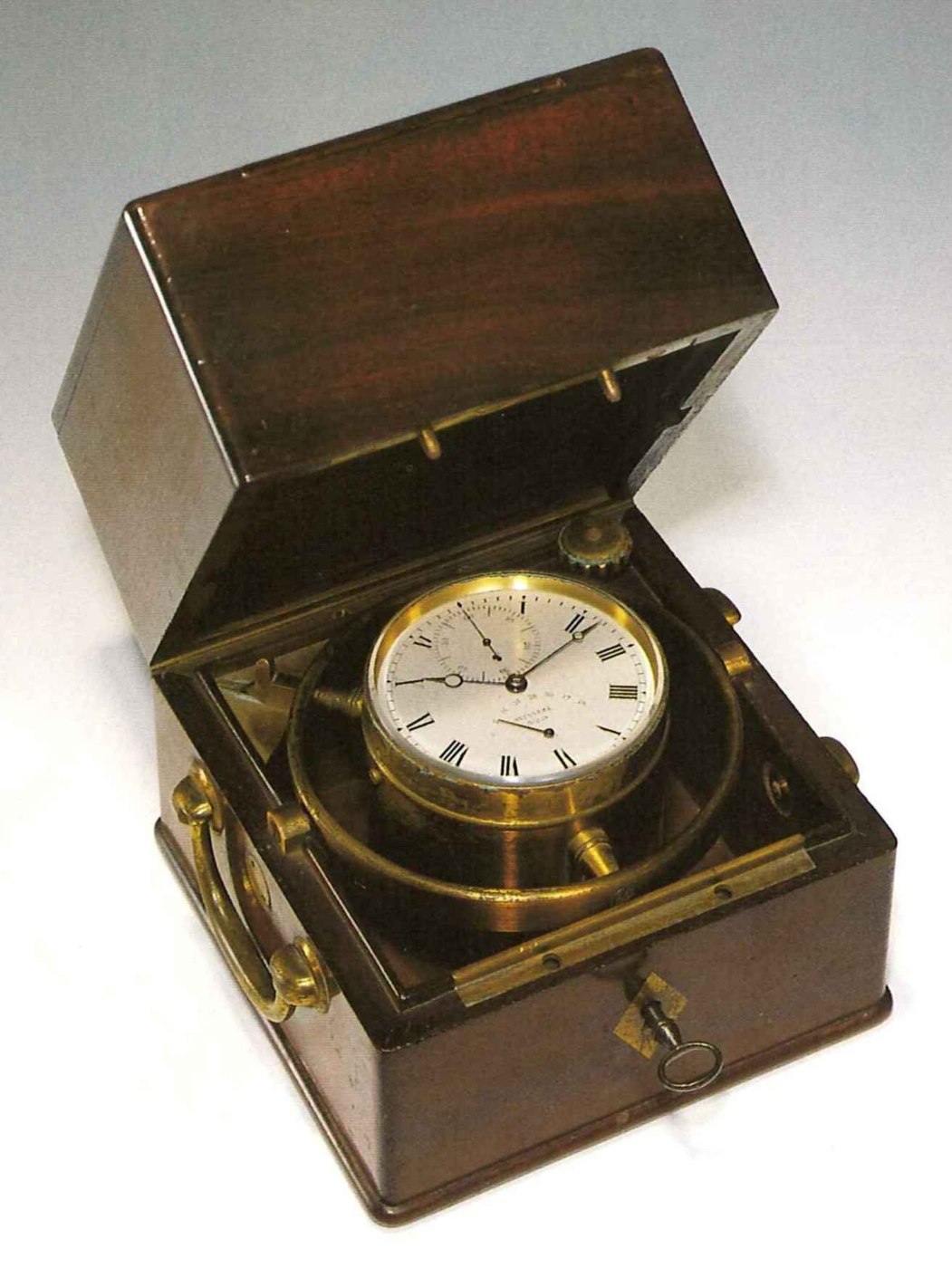
This small marine chronometer, identified as number 259, is attributed to the maker Winnerl and dated to circa 1840. The instrument features a 49-hour going movement housed within a circular gimballed suspension and a brass bowl. The exterior consists of a two-part solid mahogany box equipped with a sliding observation lid and external brass handles. The silvered dial is marked with Roman numerals and includes a subsidiary seconds register alongside an Up-and-Down power reserve scale. The movement is a brass spotted finished full plate construction, relieved for the barrel and secured with cylindrical pillars and screws. It utilizes a fusee with maintaining power, an Earnshaw-type spring detent escapement, and a two-armed bimetallic compensation balance with cylindrical weights and timing screws. The balance spring is a free-sprung blued steel helical type with terminal curves. A rate certificate issued by L. Leroy & Cie in July 1907 accompanies the object.

The Winnerl marine chronometer displayed within its mahogany box with the sliding lid removed.
The Winnerl marine chronometer displayed within its mahogany box with the sliding lid removed. — Antiquorum. Rights pending — permission not yet requested. Original source

Catalogue identity

Source
catalog.antiquorum.swiss
Category
Marine chronometer · Marine chronometer
Maker / attribution
Winnerl
Reference
Not recorded
Catalogue / lot identifier
85
Source-reported date
circa 1840
Source-reported place
France
Source-reported serial
259

Source-reported attribution and specifications are not independent authentication. A listing does not establish present ownership, current display, availability or permission to reproduce.

Object description

Case and Dial

The marine chronometer is contained within a solid mahogany box constructed in two parts. The box features a sliding lid designed for observation of the dial and is fitted with external brass handles. The chronometer bowl is held by a circular gimballed suspension system to ensure level positioning during use.

The silvered dial displays Roman numerals for hour indication. It is configured with a subsidiary seconds dial and an Up-and-Down scale, which indicates the remaining power reserve of the 49-hour going movement. The overall dimensions of the box are 14 x 14 x 14 centimeters, with the dial measuring 75 millimeters in diameter.

Evidence for this section
  • “Two part solid mahogany box with sliding observation lid and external brass handles, brass bowl and circular gimballed suspension.”
  • “Silverd dial with Roman numerals, subsidiary seconds and Up-and-Down scale.”

Movement and Escapement

The movement is a brass full plate design with a spotted finish, featuring plate relief for the barrel. It is secured by cylindrical pillars held in place by screws. Power is delivered through a fusee system equipped with maintaining power to ensure continuous operation during winding.

The timing regulation utilizes an Earnshaw-type spring detent escapement. The compensation balance is a two-armed bimetallic design featuring timing screws and cylindrical weights. The balance spring is a free-sprung blued steel helical type, which includes terminal curves to facilitate isochronism.

Evidence for this section
  • “Brass spotted finished full plate movement relieved for the barrel, with cylindrical pillars secured by screws, fusee with maintaining power, Earnshaw type spring detent escapement, two armed bimetallic compensation balance with cylindrical weights and timing screws.”
  • “Free sprung blued steel helical balance spring with terminal curves.”

Documentation and History

The object is recorded as having an associated rate certificate issued by the firm L. Leroy & Cie. This document is dated to July 1907. No further provenance or history regarding the instrument's use at sea is provided in the documentation.

The chronometer is identified as No. 259, manufactured in France. The provenance and technical records rely on the specific identification provided by the source, which characterizes the item as a small marine chronometer from the mid-19th century.

Evidence for this section
  • “rate certificate issued by L. Leroy & Cie. in July 1907.”
  • “Winnerl, France, No. 259, circa 1840.”

Open research questions

  • What is the specific nature of the 1907 rate certificate issued by L. Leroy & Cie?
  • Is there any evidence of maintenance or alteration conducted by L. Leroy & Cie in 1907?

Source evidence

Recorded claims and source quotations for Winnerl Marine Chronometer No. 259
FieldSource-reported valueSource quotation
MakerWinnerl“Winnerl, France, No. 259, circa 1840.”
Serial Number259“No. 259”
Datecirca 1840“circa 1840.”
Power Reserve49 hours“49 hour going”
Dial Diameter75 mm“Dial diam. 75 mm.”
Box Dimensions14 x 14 x 14 cm“Dim. 14x14x14 cm.”
EscapementEarnshaw type spring detent“Earnshaw type spring detent escapement”
Balance SpringFree sprung blued steel helical“Free sprung blued steel helical balance spring with terminal curves.”

Visible details

  • Silvered dial with Roman numerals
  • Circular gimballed suspension
  • Two-part solid mahogany box with brass handles
  • Up-and-Down scale on dial

Research qualifications

  • The exact chronological accuracy of the 1907 rate certificate in relation to the chronometer's operational state is not verified
  • The extent of any internal restorations to the movement is not detailed

Photograph identity and source facts were screened before import; rights clearance remains pending.

Consulted source

Winnerl, France, No. 259, circa 1840.

Reviewed 2026-10-26 · Record a92545be5c

Terms in this record

Glossary explanations for terms named in this object’s record.