
Skip to content
The Encyclopedia of Horology

Marine chronometer · Marine chronometer

Henri Motel Marine Chronometer No. 123

Partially verified

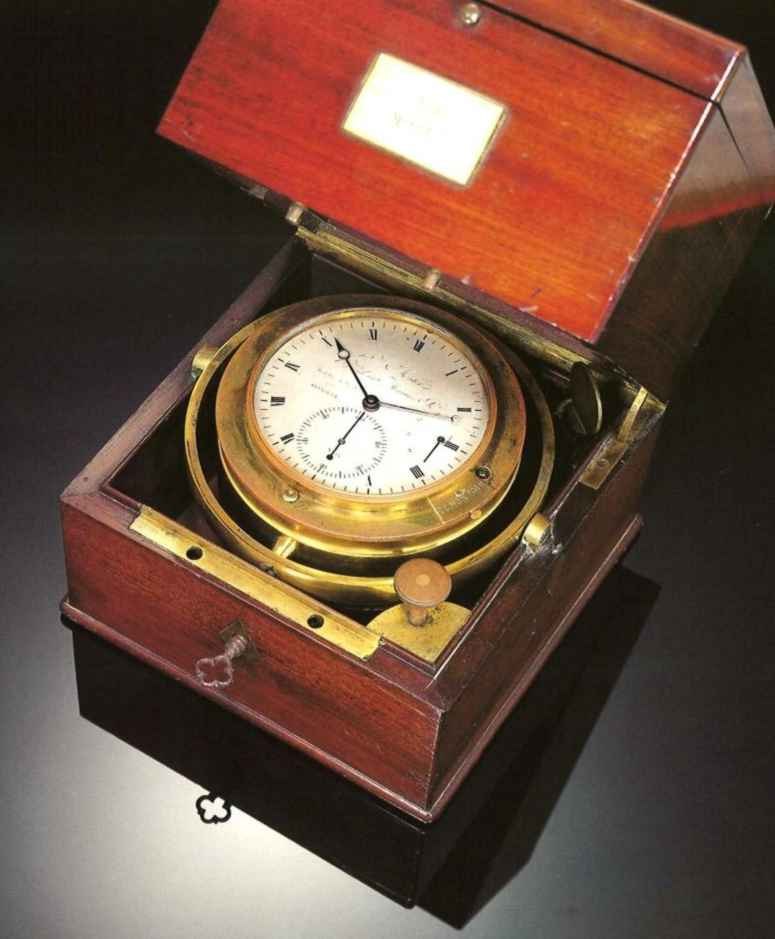
This marine chronometer, identified as No. 123, is attributed to Henri Motel, dating to approximately 1840. The instrument features a brass case designed in the "en forme de tabatière" style, reminiscent of designs used by Louis Berthoud, with a winding hole located on the bezel protected by a sliding cover. It is housed within a three-body mahogany box equipped with gimbal suspension in a velvet-lined bowl. The dial is silvered, displaying Roman numerals, a subsidiary seconds dial, and a 24-hour up-and-down power reserve sector. The movement is a brass Motel-caliber construction, featuring a fusee with a chain, a maintaining power mechanism, and a pivoted detent escapement. The escapement, balance, and helical palladium balance spring were later modifications executed by Vissière, a chronometer maker active in Le Havre during the latter half of the 19th century.

Top view of the Henri Motel marine chronometer in its mahogany box, showing the gimballed brass bowl and silvered dial.
Top view of the Henri Motel marine chronometer in its mahogany box, showing the gimballed brass bowl and silvered dial. — Antiquorum. Rights pending — permission not yet requested. Original source

Catalogue identity

Source
catalog.antiquorum.swiss
Category
Marine chronometer · Marine chronometer
Maker / attribution
Henri Motel
Reference
Not recorded
Catalogue / lot identifier
301
Source-reported date
circa 1840
Source-reported place
France
Source-reported serial
123

Source-reported attribution and specifications are not independent authentication. A listing does not establish present ownership, current display, availability or permission to reproduce.

Object description

Case and External Construction

The chronometer is housed in a three-body box constructed from mahogany, which includes a glazed upper section and a hinged lid. The housing facilitates maritime utility through brass gimbals that support a velvet-lined brass bowl containing the movement. The internal case is fashioned in a tabatière style, noted for its functional form.

A distinct design feature is the winding arrangement, which is integrated directly into the bezel. This aesthetic and functional approach is compared in historical descriptions to the chronometers produced by Louis Berthoud.

Evidence for this section
  • “Three body mahogany box with glazed upper section and hinged lid.”
  • “Brass case en forme de tabatière, similar to that used by Louis Berthoud”
  • “As on virtually all the Motel chronometers, it is wound from the bezel by me”

Dial and Timekeeping Indications

The dial is silvered and presents time through Roman numerals. It includes two subsidiary functions: a seconds dial and a 24-hour sector designed to track the power reserve, commonly referred to as an up-and-down indicator. The time is indicated by blued steel Breguet-style hands.

The power reserve indication is not an original feature of the movement but was added during a later restoration period. The dial bears an inscription explicitly documenting this intervention by Vissière, indicating the instrument was modified and regulated for improved performance.

Evidence for this section
  • “Silvered with Roman numerals, subsidiary seconds and 24 hour up-and-down sector.”
  • “Blued steel Breguet hands.”
  • “The inscription on the dial: "Modifié et réglé par Vissière", refers to the addition of the power reserve indication”

Movement and Modifications

The movement is a brass construction following the Motel caliber specifications and is fully jeweled. It utilizes a fusee and chain mechanism equipped with maintaining power. The chronometer employs a Louis Berthoud-type pivoted detent escapement for accuracy.

During the tenure of Vissière in Le Havre, the chronometer underwent significant technical upgrades. These included the installation of a new balance featuring two cylindrical weights and timing screws, paired with a helical palladium balance spring characterized by its terminal curves. These components were specifically adjusted to improve the chronometer's performance.

Evidence for this section
  • “Motel caliber, fully jeweled.”
  • “Louis Berthoud type pivoted detent escapement”
  • “two arme compensation balance, by Visière with two cylindrical weights and timing screws”
  • “helical palladium balance spring with terminal curves.”

Open research questions

  • What specific years was Vissière active in Le Havre?
  • Are there extant records detailing the original performance of Motel No. 123 prior to Vissière's modifications?

Source evidence

Recorded claims and source quotations for Henri Motel Marine Chronometer No. 123
FieldSource-reported valueSource quotation
MakerHenri Motel“Henri Motel No. 123”
Modification MakerVissière“restored and improved by Vissière”
Escapement typePivoted detent“Louis Berthoud type pivoted detent escapement”
Balance springHelical palladium“helical palladium balance spring”
Case materialMahogany“Three body mahogany box”
Dial diameter80 mm“Dial diam. 80 mm”
Winding mechanismBezel winding“wound from the bezel by me”

Visible details

  • Silvered dial with 24-hour power reserve indicator
  • Mahogany box with glazed upper section
  • Blued steel hands of Breguet type
  • Winding hole located on the bezel with sliding cover

Research qualifications

  • The exact date of the modifications by Vissière is not specified
  • The original movement parts replaced by Vissière are not documented

Photograph identity and source facts were screened before import; rights clearance remains pending.

Terms in this record

Glossary explanations for terms named in this object’s record.