
Skip to content
The Encyclopedia of Horology

Marine chronometer · Marine chronometer

Ulysse Nardin two-day marine chronometer

Partially verified

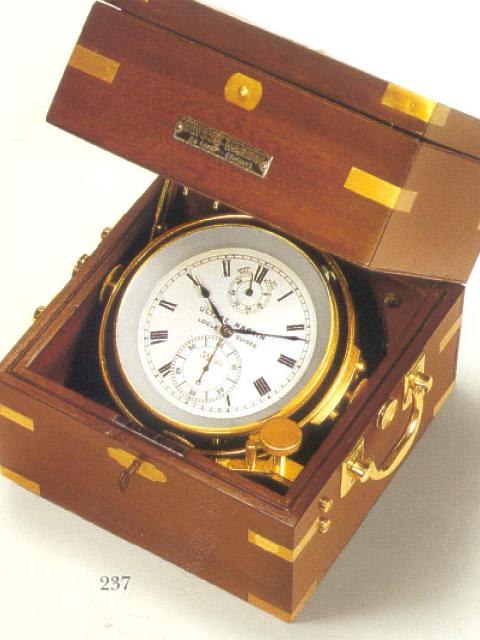
This Ulysse Nardin marine chronometer, identified by serial number 5259 and dated to circa 1947, is housed in a mahogany box measuring 19 x 19 x 19 cm. The three-body mahogany case features heavy brass inlay on all edges, brass carrying handles, and a glazed upper section with a hinged lid. The instrument is secured within a brass bowl mounted on gimbals. The silvered dial displays Roman numerals, an outer minute ring, a subsidiary seconds dial, and an up-and-down winding indicator, all paired with gold spade hands painted in black. The movement is a gilt brass full plate construction with baluster pillars, 14 jewels, and a fusee with chain and maintaining power. It utilizes a spring detent escapement and a Guillaume anibal-brass balance with weights and adjusting nuts, regulated by a free-sprung helical balance spring. The piece is signed on the dial, movement, and box.

Ulysse Nardin two-day marine chronometer in a mahogany box with brass inlay.
Ulysse Nardin two-day marine chronometer in a mahogany box with brass inlay. — Antiquorum. Rights pending — permission not yet requested. Original source

Catalogue identity

Source
catalog.antiquorum.swiss
Category
Marine chronometer · Marine chronometer
Maker / attribution
Ulysse Nardin
Reference
Not recorded
Catalogue / lot identifier
237
Source-reported date
circa 1947
Source-reported place
Switzerland
Source-reported serial
5259

Source-reported attribution and specifications are not independent authentication. A listing does not establish present ownership, current display, availability or permission to reproduce.

Object description

Case and External Presentation

The chronometer is enclosed in a mahogany box with dimensions of 19 by 19 by 19 centimeters. The construction features a three-body design with brass handles attached to the exterior for transport. To ensure the durability of the wooden structure, all edges are reinforced with heavy brass inlay.

The top of the box includes a glazed section covered by a hinged lid, allowing for viewing of the dial without exposure to environmental elements. The brass bowl housing the movement is suspended within a gimballed system, which maintains the horizontal position of the chronometer on a moving vessel.

Evidence for this section
  • “Three body, with brass brass handles, all the edges protected by heavy brass inlay, the glazed upper section with hinged lid.”
  • “Brass bowl and gimballed suspension.”

Dial and Timekeeping Display

The display is presented on a silvered dial, which features Roman numeral hour markers and a precise outer minute ring.

Additionally, the dial includes an up-and-down scale, also known as a power reserve or winding indicator, which provides information regarding the state of the mainspring.

Evidence for this section
  • “Silvered with Roman numerals, outer minute ring, subsidiary seconds and up-and-down scale.”
  • “Gold "spade" hands painted in black.”

Movement and Mechanical Details

The movement is a gilt brass full plate mechanism. It utilizes baluster pillars secured by screws to maintain the structural integrity of the plates. The power train incorporates a fusee with a chain, which provides constant force, and a maintaining power mechanism to keep the device running during the winding process.

Precision is achieved through a spring detent escapement and a two-arm Guillaume anibal-brass balance. The balance is equipped with cylindrical weights and two mean time adjusting nuts. Regulation is governed by a free-sprung, polished helical balance spring that features terminal curves. The object is signed on the dial, the movement, and the external box.

Evidence for this section
  • “Gilt brass full plate with baluster pillars secured by screws, 14 jewels, fusee with chain and maintaining power, spring detent escapement, two-arm Guillaume anibal-brass balance”
  • “Signed on dial, movement and box.”

Open research questions

  • What is the specific history of the Guillaume anibal-brass balance design in Ulysse Nardin production during the 1940s?
  • Are there archival records indicating which vessel this chronometer was originally assigned to?

Source evidence

Recorded claims and source quotations for Ulysse Nardin two-day marine chronometer
FieldSource-reported valueSource quotation
MakerUlysse Nardin“Ulysse Nardin, Locle, Suisse”
Serial Number5259“No. 5259”
Datecirca 1947“circa 1947”
DimensionsBowl 113 mm, box 19 x 19 x 19 cm“Dim. Bowl 113 mm., box 19 x 19 x 19 cm.”
EscapementSpring detent“spring detent escapement”
Jewels14“14 jewels”
BalanceGuillaume anibal-brass balance“two-arm Guillaume anibal-brass balance”
Box materialMahogany“Fine mahogany two-day marine chronometer”

Visible details

  • Silvered dial with Roman numerals
  • Up-and-down winding indicator positioned at 12 o'clock
  • Heavy brass corner inlay on the mahogany box
  • Brass gimbal system for the bowl

Research qualifications

  • The condition of the hands is reported as poor
  • The movement is noted to require an overhaul

Photograph identity and source facts were screened before import; rights clearance remains pending.

Terms in this record

Glossary explanations for terms named in this object’s record.