
Skip to content
The Encyclopedia of Horology

Pocket watch · Regulator pocket watch

Sarton Silver Pocket Watch with Regulator Dial

Partially verified

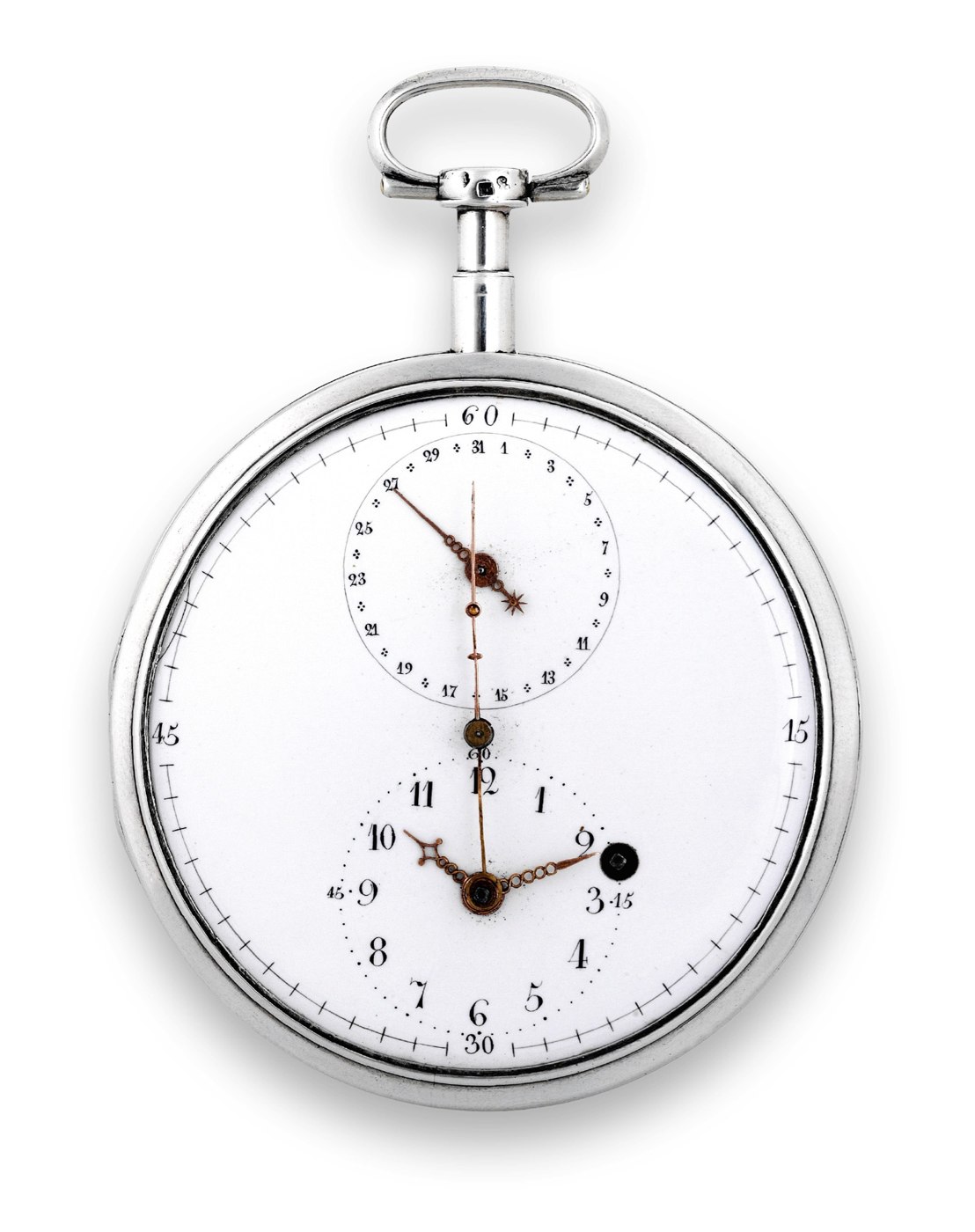
This large silver pocket watch was made by Hubert Sarton, a clockmaker who settled in Liège, approximately in 1795. The timepiece is characterized by its regulator-type white enamel dial, which indicates the meantime with a small chapter ring featuring Arabic numerals, along with outer dot minute divisions. The dial also includes indications for the days of the week and a peripheral track for seconds with Arabic five-second numerals. The watch is housed in a polished, double-body Directoire silver case with a concealed hinge. Internally, it features a 55 mm hinged gilt brass full-plate movement with cylindrical pillars. The watch is powered by a fusee and chain mechanism equipped with a verge escapement featuring micrometric potence adjustment. It utilizes a plain brass three-arm balance and a flat balance spring. The movement is finished with a gilt brass continental cock containing a polished steel endplate and a silver regulation dial.

View of the white enamel regulator-style dial and silver case.
View of the white enamel regulator-style dial and silver case. — Antiquorum. Rights pending — permission not yet requested. Original source

Catalogue identity

Source
catalog.antiquorum.swiss
Category
Pocket watch · Regulator pocket watch
Maker / attribution
Hubert Sarton
Reference
Not recorded
Catalogue / lot identifier
304
Source-reported date
circa 1795
Source-reported place
Liège
Source-reported serial
3520

Source-reported attribution and specifications are not independent authentication. A listing does not establish present ownership, current display, availability or permission to reproduce.

Object description

Case and Dial

The timepiece is housed in a large, polished silver case constructed with a double-body design and a concealed hinge.

The dial is executed in white enamel and follows a regulator layout. It incorporates a smaller chapter ring for the meantime display, marked with Arabic numerals and accompanied by outer dot minute divisions. Additionally, the dial records the days of the week and features an outermost ring specifically for seconds, graduated with Arabic numerals at five-second intervals.

Evidence for this section
  • “C. Double-body, "Directoire" with concealed hinge, polished.”
  • “D. White enamel, regulator-type, small chapter ring for the meantime with Arabic numerals and outer dot minute divisions, dial for days of the week, outermost seconds divisions with Arabic five-seconds numerals.”

Movement and Escapement

The watch is powered by a hinged, gilt brass full-plate movement measuring 55 mm in diameter. The construction utilizes cylindrical pillars to secure the plates. The energy transmission is managed by a traditional fusee and chain mechanism.

Precision in the timekeeping is provided by a verge escapement that incorporates a micrometric potence adjustment. The oscillating system consists of a plain brass three-arm balance paired with a flat balance spring. Further regulation is facilitated by a gilt brass continental cock, which includes a polished steel endplate and an integrated silver regulation dial.

Evidence for this section
  • “hinged gilt brass full plate with cylindrical pillars, fusee with chain, verge escapement with micrometric potence adjustment”
  • “plain brass three-arm balance, flat balance spring, gilt brass continental cock with polished steel endplate, silver regulation dial.”

Signatures and Provenance

The watch is signed by Hubert Sarton, a clockmaker originally born in Paris in 1748 who later established his practice in Liège.

The auction description confirms that the movement is signed. The case is identified with the serial number 3520.

Evidence for this section
  • “Sarton à Liège, case No. 3520.”
  • “Movement signed.”
  • “Hubert Sarton was born in Paris in 1748. Around 1772 he became a pupil of J. Le Roy. Sarton settled in Liège”

Open research questions

  • What is the specific mechanical function of the 'silver regulation dial' mentioned in the movement description?
  • Can the date of circa 1795 be narrowed down through surviving records of Hubert Sarton’s case numbering system?

Source evidence

Recorded claims and source quotations for Sarton Silver Pocket Watch with Regulator Dial
FieldSource-reported valueSource quotation
MakerHubert Sarton“Sarton à Liège”
Case Number3520“case No. 3520”
Datecirca 1795“Made circa 1795”
Case StyleDirectoire“C. Double-body, "Directoire" with concealed hinge, polished.”
Movement Diameter55 mm“M. 55 mm”
EscapementVerge with micrometric potence adjustment“verge escapement with micrometric potence adjustment”
Condition: DialHairline present“Hairline”

Visible details

  • White enamel dial with regulator layout
  • Polished silver case with concealed hinge
  • Visible seconds track on the outermost dial circumference
  • Gilt brass continental balance cock

Research qualifications

  • The auction description reports a hairline in the enamel dial
  • Overhaul of the movement is recommended by the auction house

Photograph identity and source facts were screened before import; rights clearance remains pending.

Terms in this record

Glossary explanations for terms named in this object’s record.