
Skip to content
The Encyclopedia of Horology

Pocket watch · Minute repeating pocket watch

Louis Audemars Russian Imperial Presentation Pocket Watch No. 14062

Partially verified

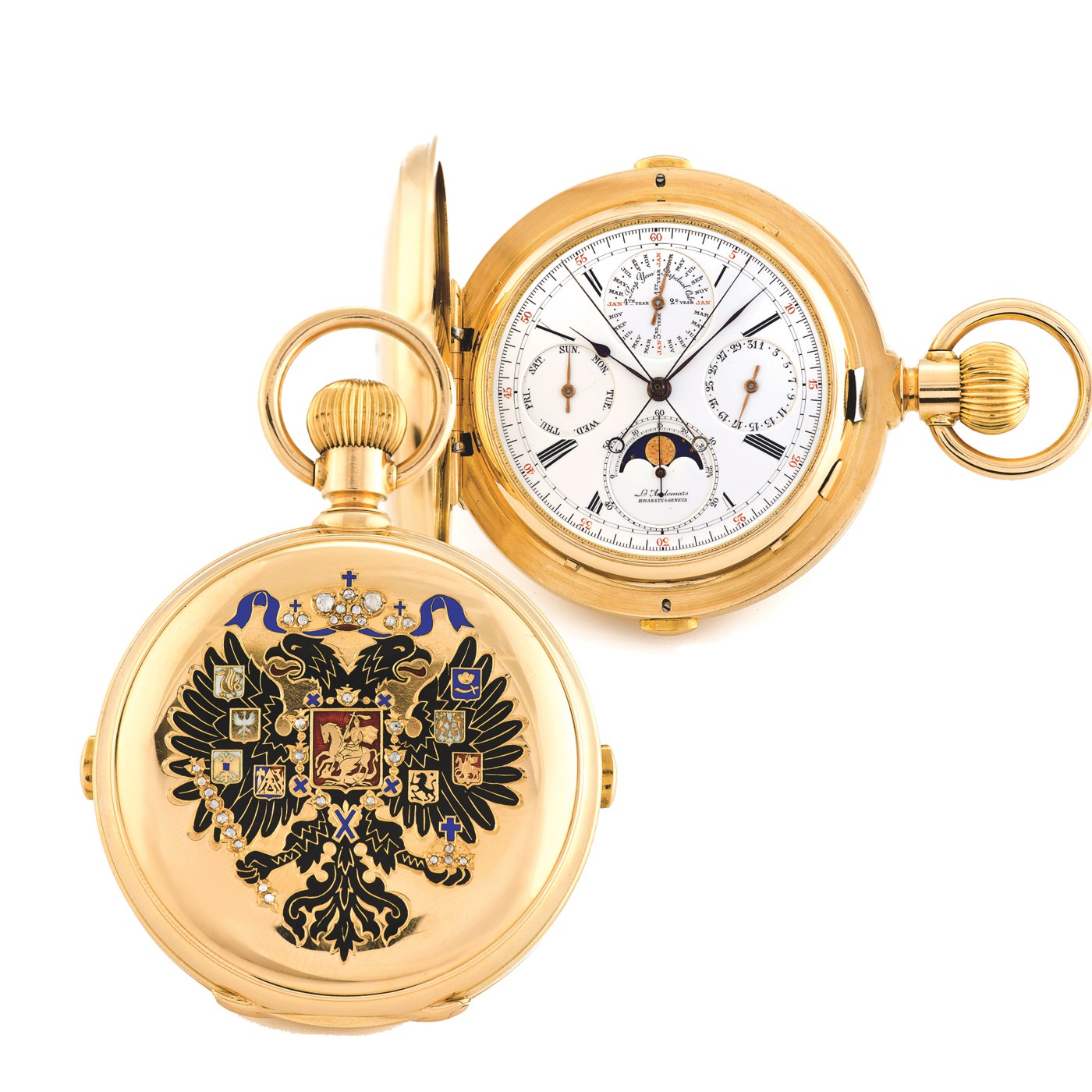
This Louis Audemars keyless hunting-cased pocket watch, serial number 14062, was produced circa 1895 for Russian Imperial presentation. The watch features an 18K gold case with a diameter of 58 mm, decorated on the front cover with the Russian Imperial arms in champlevé enamel and rose-cut diamonds. The white enamel dial incorporates radial Roman numerals with an outer minute track and four subsidiary dials for the perpetual calendar, including day, date, month for the leap cycle, and a subsidiary seconds dial combined with lunar phases and age. Internally, the 19-ligne movement is rhodium-plated with fausses cotes decoration and includes an antimagnetic straight-line lever escapement, cut bimetallic compensation balance, and a patented split-seconds chronograph system. The piece is fully signed by the maker on the dial, case, cuvette, and movement.

Front view of the hunting case showing the Russian Imperial arms enamel decoration and the interior dial layout.
Front view of the hunting case showing the Russian Imperial arms enamel decoration and the interior dial layout. — Antiquorum. Rights pending — permission not yet requested. Original source

Catalogue identity

Source
catalog.antiquorum.swiss
Category
Pocket watch · Minute repeating pocket watch
Maker / attribution
Louis Audemars
Reference
Not recorded
Catalogue / lot identifier
413
Source-reported date
circa 1895
Source-reported place
Switzerland
Source-reported serial
14062

Source-reported attribution and specifications are not independent authentication. A listing does not establish present ownership, current display, availability or permission to reproduce.

Object description

Case and Dial Design

The watch is housed in an 18K gold four-body, 'bassine et filets' case. The front cover is intricately decorated with the Russian Imperial arms rendered in black, blue, and red champlevé enamel, accented with rose-cut diamonds. Gold setting levers are integrated into the design, protruding from beneath the bezel for adjusting the perpetual calendar functions.

The white enamel dial features radial Roman numerals and an outer minute track, with the outermost seconds division marked in fifths. Five-minute intervals and seconds are indicated by red Arabic numerals. Four subsidiary sunk dials display the perpetual calendar information, including day, date, and month, as well as a subsidiary seconds register that incorporates the moon phase aperture and lunar age display.

Evidence for this section
  • “C. Four-body, bassine et filets, polished, the front cover decorated with the Russian Imperial arms in black, blue and red champlevé enamel and set with rose-cut diamonds”
  • “gold levers for calendar setting protruding from under the bezel.”
  • “D. White enamel, radial Roman numerals, outer minute track, outermost seconds divided into fifths”

Movement and Mechanics

Measuring 19 lignes, the rhodium-plated movement is finished with fausses cotes decoration and features 25 jewels. It is equipped with an antimagnetic straight-line calibrated lever escapement and a cut bimetallic compensation balance with platinum temperature adjustment screws. A special alloy Breguet balance spring with overcoil and a rack and pinion micrometer regulator ensure precision.

The movement includes a complex split-seconds chronograph system activated by buttons in the band. This specific mechanism, patented by Charles H. Audemars, utilizes a clutch coupling wheel designed for reliable operation. The watch is fully signed across the dial, case, cuvette, and movement.

Evidence for this section
  • “M. 43 mm. (19???), ?superior adjustment?, rhodium plated, fausses cotes decoration, 25 jewels”
  • “The special split-seconds chronograph system was patented by Charles H. Audemars (US patent 253338 of February 7, 1882, filed on June 23, 1891).”
  • “Dial, case, cuvette and movement signed.”

Provenance and Context

The auction description identifies the watch as having been created for Russian Imperial presentation around 1895.

The watch is noted for its full signature by Louis Audemars, an attribute described as unusual for such a piece.

Evidence for this section
  • “Made for Russian Imperial presentation, circa 1895.”
  • “It is extremely highly finished and very complicated for a presentation watch and must therefore have been intended for a very important recipient.”
  • “It is also, unusually, fully signed by Louis Audemars.”

Open research questions

  • What specific records exist within the Audemars company archives regarding the original commission for this serial number?
  • Are there extant lists of recipients for Russian Imperial presentation watches that might identify the intended recipient of this specific timepiece?

Source evidence

Recorded claims and source quotations for Louis Audemars Russian Imperial Presentation Pocket Watch No. 14062
FieldSource-reported valueSource quotation
MakerLouis Audemars, Brassus & Geneva“Louis Audemars, Brassus & Geneva, No. 14062.”
Case material18K gold“18K gold, enamel and rose-cut diamond-set, hunting-cased, keyless pocket watch”
Movement details25 jewels, rhodium plated“rhodium plated, fausses cotes decoration, 25 jewels”
PatentsSplit-seconds chronograph“The special split-seconds chronograph system was patented by Charles H. Audemars (US patent 253338 of February 7, 1882, filed on June 23, 1891).”
Complications7 complications including perpetual calendar, lunar phases, and split-seconds chronograph“perpetual calendar, phases and age of the moon, special patented split-seconds chronograph and antimagnetic escapement.”
Dimensions58 mm diameter“DIAM. 58 mm”
ConditionOverhaul recommended“Overhaul recommended, at buyer's expense”

Visible details

  • Case front displays champlevé enamel Imperial Russian arms set with rose-cut diamonds
  • White enamel dial features four sunk subsidiary calendar and lunar registers
  • Gold setting levers for the calendar are positioned beneath the bezel
  • Movement is rhodium-plated with fausses cotes finish

Research qualifications

  • The specific identity of the original Imperial recipient is not confirmed by the source
  • While labeled 'antimagnetic', the performance capacity under modern conditions is not specified

Photograph identity and source facts were screened before import; rights clearance remains pending.