
Skip to content
The Encyclopedia of Horology

Marine chronometer · Box marine chronometer

Eardley Norton marine chronometer no. 2322

Partially verified

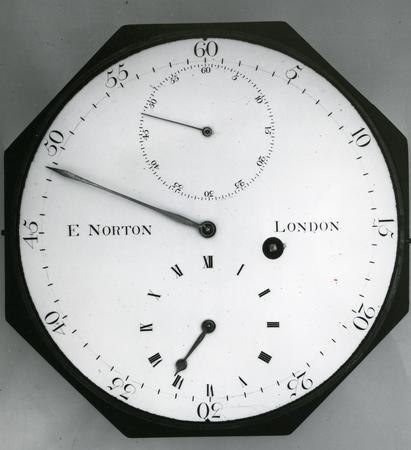
This marine chronometer by Eardley Norton dates to circa 1785–1795 and is housed in a brass drum set within an octagonal mahogany base. The white enamel regulator dial features central minutes with Arabic numerals, an upper subsidiary seconds dial, and a lower subsidiary hour dial with Roman numerals. The dial is signed 'E NORTON LONDON', and the back plate is numbered '2322'. The twenty-four-hour movement includes an Earnshaw-type spring detent escapement, a reversed fusee with maintaining power, and a two-armed bimetallic balance.

Top-down view of the dial of the Eardley Norton marine chronometer no. 2322.
Top-down view of the dial of the Eardley Norton marine chronometer no. 2322. — British Museum. Rights pending — permission not yet requested. Original source

Catalogue identity

Source
www.britishmuseum.org
Category
Marine chronometer · Box marine chronometer
Maker / attribution
Eardley Norton
Reference
Not recorded
Catalogue / lot identifier
Source URL identifies the listing
Source-reported date
1785-1795
Country
United Kingdom
Source-reported serial
2322

Source-reported attribution and specifications are not independent authentication. A listing does not establish present ownership, current display, availability or permission to reproduce.

Object description

Case and External Construction

The movement is contained within a brass drum which is rigidly fixed inside an octagonal mahogany base measuring 148 mm across the flats. A brass bezel with bevel-edged glass overlaps the base and is secured bayonet fashion.

Though the drum is now immovable, tapped holes in the base sides may have served as pivot points for a gimbal ring. The base also features two brass securing screws, and the dial plate is fitted with a positioning peg.

Evidence for this section
  • “The movement contained in a brass drum rigidly fixed inside an octagonal mahogany base.”
  • “A brass bezel overlapping the base fits on the outside of the drum and is secured bayonet fashion, it has a bevel-edged flat glass.”
  • “Box 148 mm across the flats, h. 78 mm overall.”
  • “tapped holes coming through the side of the latter may have been for the pivoting points of a gimbal ring.”

Dial and Indication

The timepiece features a slightly domed enamel regulator dial signed 'E NORTON LONDON' and secured to the dial plate by two small screws on the edge. It contains an outer minute track and two subsidiary dials for seconds and hours.

The hour hand is not original. It is noted that there is no sign of scribed divisions under the enamel of the minute and seconds markings.

Evidence for this section
  • “Slightly domed enamel regulator dial attached to the dial plate by the two small screws on the edge.”
  • “Signature: On the dial 'E NORTON LONDON'.”
  • “Gold hands, hour hand not original.”
  • “There is no sign of scribed divisions under the enamel of the minute and seconds markings.”

Movement and Mechanism

The movement features a full plate construction with four baluster pillars. It employs a reversed fusee with stop-work and maintaining power. The barrel is of large diameter, made from a bent and soldered strip.

The escapement is of the Earnshaw spring detent type and is described as having massive proportions. The bimetallic two-armed balance is similar to the Arnold 'z' type and includes steel timing screws.

Evidence for this section
  • “Full plate construction with four baluster pillars”
  • “Reversed fusee fitted with the usual stop-work and maintaining power.”
  • “Spring detent escapement of Earnshaw type but of massive proportions.”
  • “Bimetallic two-armed balance similar to the Arnold 'z' type”

Evidence of Modification

The dial plate is of larger diameter than the front plate and retains holes from a former case catch and hinge. The movement frame contains various unused holes, including a threaded pillar and a pair of holes near the fourth wheel, possibly for a balance stop or train device.

Adjustments to the detent mechanism were modified as an adjusting screw has broken off, and the arm is currently fixed with two screws.

Evidence for this section
  • “It is of much larger diameter than the front plate and appears once to have been fitted with a case catch and hinge, various holes remaining.”
  • “There are a number of unused holes, including a corresponding pair in the plates near their edge, beside the fourth wheel, with a cock on the front plate, possibly for a train or balance stop device, and one in a pillar which is threaded.”
  • “There was once an adjusting screw set in a slot in the edge of the back plate acting on the brass arm to move the detent towards or away from the balance axis. This screw has broken off and the arm is now fixed with two screws.”

Open research questions

  • What was the specific function of the unused holes in the pillar and plates?
  • Does the current housing represent the original intended case or a secondary mounting?
  • What are the implications of the 'crude' jewel settings for the maintenance history of the movement?

Source evidence

Recorded claims and source quotations for Eardley Norton marine chronometer no. 2322
FieldSource-reported valueSource quotation
Museum number1958,1006.1940“Museum number 1958,1006.1940”
EscapementEarnshaw spring detent“Escapement earnshaw spring detent”
Dial signatureE NORTON LONDON“Signature: On the dial 'E NORTON LONDON'.”
Back plate number2322“On the back plate '2322'.”
Production placeLondon (St John Street)“Production place Made in: London (England) (St John Street)”
Case materialMahogany“Materials mahogany (clock-case)”
Production Date1785-1795 (c. 1790)“Made by Eardley Norton, c. 1790”
Beats per hour14,400“Beats per hour: 14,400”
ProvenanceIlbert collection; donated by Gilbert Edgar in 1958“Provenance: Ilbert collection; Ilbert states that he acquired this chronometer from Clowes in 1937. Presented by Mr Gilbert Edgar C.B.E. in 1958.”

Visible details

  • Circular white enamel regulator dial showing central minute hand and outer track with Arabic numerals at five-minute intervals.
  • Upper subsidiary seconds dial and lower subsidiary hour dial marked with Roman numerals.
  • Signed 'E NORTON' to the left and 'LONDON' to the right of the central hand arbor.
  • Winding aperture located to the right below the 'LONDON' signature.
  • Movement and dial mounted within a dark polygonal (octagonal) surround.

Research qualifications

  • Source notes the hour hand is not original.
  • The internal movement, back plate, and lower case structure are not visible in the provided top-down photograph.

Photograph identity and source facts were screened before import; rights clearance remains pending.

Consulted source

marine chronometer; clock-case | British Museum

Reviewed 2026-10-25 · Record 941fc97e39

Terms in this record

Glossary explanations for terms named in this object’s record.