
Skip to content
The Encyclopedia of Horology

Marine chronometer · Box marine chronometer

John Arnold & Son eight-day marine chronometer No. 56

Partially verified

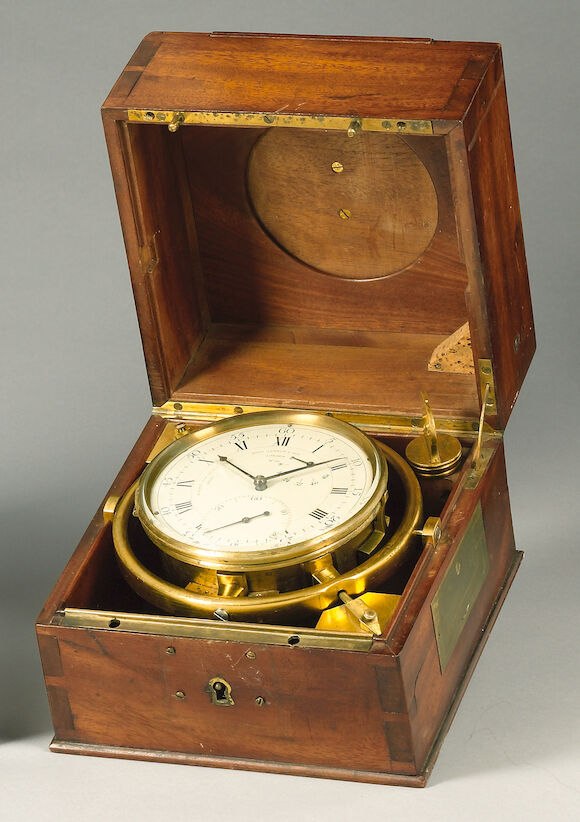
This eight-day marine chronometer is catalogued by Bonhams as made by John Arnold & Son, London, bearing number 56. The source reports the instrument was one of four timekeepers carried aboard HMS Providence in 1794 for an astronomical Pacific expedition led by Commander William Robert Broughton. It was transferred to the Governor of Monterey in 1796 and later documented in the 1804 will of Spanish Fleet Commander D. Thomas de Ugarte, who bequeathed it to King Fernando VII. Housed in a wooden box with brass gimbal suspension, the chronometer features a circular silvered dial with Roman numerals and an auxiliary register.

John Arnold & Son eight-day marine chronometer No. 56 in open wooden box
John Arnold & Son eight-day marine chronometer No. 56 in open wooden box — Bonhams. Rights pending — permission not yet requested. Original source

Catalogue identity

Source
www.bonhams.com
Category
Marine chronometer · Box marine chronometer
Maker / attribution
John Arnold & Son
Reference
Not recorded
Catalogue / lot identifier
273
Source-reported date
early 19th century
Country
United Kingdom
Source-reported serial
56

Source-reported attribution and specifications are not independent authentication. A listing does not establish present ownership, current display, availability or permission to reproduce.

Object description

Identity and Documented Provenance

Catalogued by Bonhams as a rare early 19th century eight-day marine chronometer by John Arnold & Son, London, bearing number 56, the instrument is documented in expedition journals and wills. The source records that it was one of four precision timekeepers taken aboard HMS Providence in 1794 for an astronomical survey of the northern Pacific led by Commander William Robert Broughton.

According to a journal kept by John Crosby, late of the Royal Observatory, chronometer No. 56 was delivered to the Governor of Monterey, Don Diego Barica, on June 15, 1796. The 1804 will of Spanish Fleet Commander D. Thomas de Ugarte, written in Montevideo, records the instrument as one of his most treasured possessions and notes that he bequeathed his chronometer to King Fernando VII of Spain. Under royal direction, the auction house reports that it saw service in the Spanish Navy until at least the 1830s.

Evidence for this section
  • “This chronometer was one of the four precision timekeepers taken aboard HMS Providence in 1794.”
  • “Delivered to the Governor of Monterey, Don Diego Barica the two timekeepers No 2 and No 56 being the property of the late Governor of St. Blass.”
  • “he bequeathed what he described as his “excellent chronometer” to King Fernando VII of Spain.”

Case and Gimbal Construction

The chronometer is housed in a dovetailed wooden case recorded as 19.5 cm wide. Direct observation shows an open top lid featuring a circular clearance recess on its inner underside, with keyhole and brass latch fittings visible along the front face and upper rim.

The instrument is mounted in a brass gimbal ring fitted with lateral pivot mounts and a locking arm designed to secure the gimbal suspension.

Evidence for this section
  • “the case 19.5cms wide”
  • “Dovetailed wooden case with open top lid showing a circular recess on the inner underside”
  • “Brass gimbal ring with pivot mounts and locking arm”

Dial Presentation and Physical Alterations

Observations confirm a circular silvered dial displaying Roman numeral hour markers, an outer minutes track, and a lower subsidiary register. Internal mechanical components, including the escapement and train wheels, are not described in the cataloguing or shown in the lot imagery.

Bonhams notes several physical points concerning condition that suggest the chronometer spent time in France during the 19th century, specifically pointing out that the long hinge on the case and the silvering of the dial are typically French.

Evidence for this section
  • “Silvered dial with Roman numeral hour markers, minutes outer track, and lower subsidiary register”
  • “the silvering of the dial is typically French, as is the long hinge to the case.”

Open research questions

  • Does the movement retain its original John Arnold spring detent escapement and balance components, or were these altered during its reported 19th-century French servicing?
  • Are there archival documents clarifying how chronometer No. 56 passed between the Governor of Monterey and D. Thomas de Ugarte between 1796 and 1804?
  • What specific repair or maker inscriptions are present on the movement pillar plates or bowl interior?

Source evidence

Recorded claims and source quotations for John Arnold & Son eight-day marine chronometer No. 56
FieldSource-reported valueSource quotation
Maker and LocationJohn Arnold & Son, London“John Arnold & Son, London, No56”
Case Width19.5 cm wide“the case 19.5cms wide”
Expedition RecordTaken aboard HMS Providence in 1794“This chronometer was one of the four precision timekeepers taken aboard HMS Providence in 1794.”
Transfer in MontereyDelivered to Don Diego Barica on June 15, 1796“Delivered to the Governor of Monterey, Don Diego Barica the two timekeepers No 2 and No 56 being the property of the late Governor of St. Blass.”
Spanish Royal BequestBequeathed by D. Thomas de Ugarte to King Fernando VII of Spain“he bequeathed what he described as his “excellent chronometer” to King Fernando VII of Spain.”
HMS Providence Embarkation Date9th October 1794“Crosby took receipt of “Box Timekeeper” number 56 on 9th October 1794”
1794 Greenwich Rating54 seconds fast of meantime, gained 2 seconds a day“The current lot was 54 seconds fast of meantime and gained 2 seconds a day.”
Spanish Naval UseUsed in the Navy until at least the 1830s“Under the Kings direction, the chronometer was put to use within the Navy until at least the 1830’s.”

Visible details

  • Dovetailed wooden case with open top lid showing a circular recess on the inner underside
  • Brass gimbal ring with pivot mounts and locking arm
  • Silvered dial with Roman numeral hour markers, minutes outer track, and lower subsidiary register
  • Keyhole on the front face of the wooden box and brass latch fittings along the top rim

Research qualifications

  • Internal escapement and mechanical components are not depicted or detailed in the cataloguing
  • Source notes the silvering of the dial and long hinge are typically French, indicating later nineteenth-century intervention

Photograph identity and source facts were screened before import; rights clearance remains pending.

Terms in this record

Glossary explanations for terms named in this object’s record.