
Skip to content
The Encyclopedia of Horology

Marine chronometer · Box marine chronometer

Marine chronometer by Vissière, No. 121

Partially verified

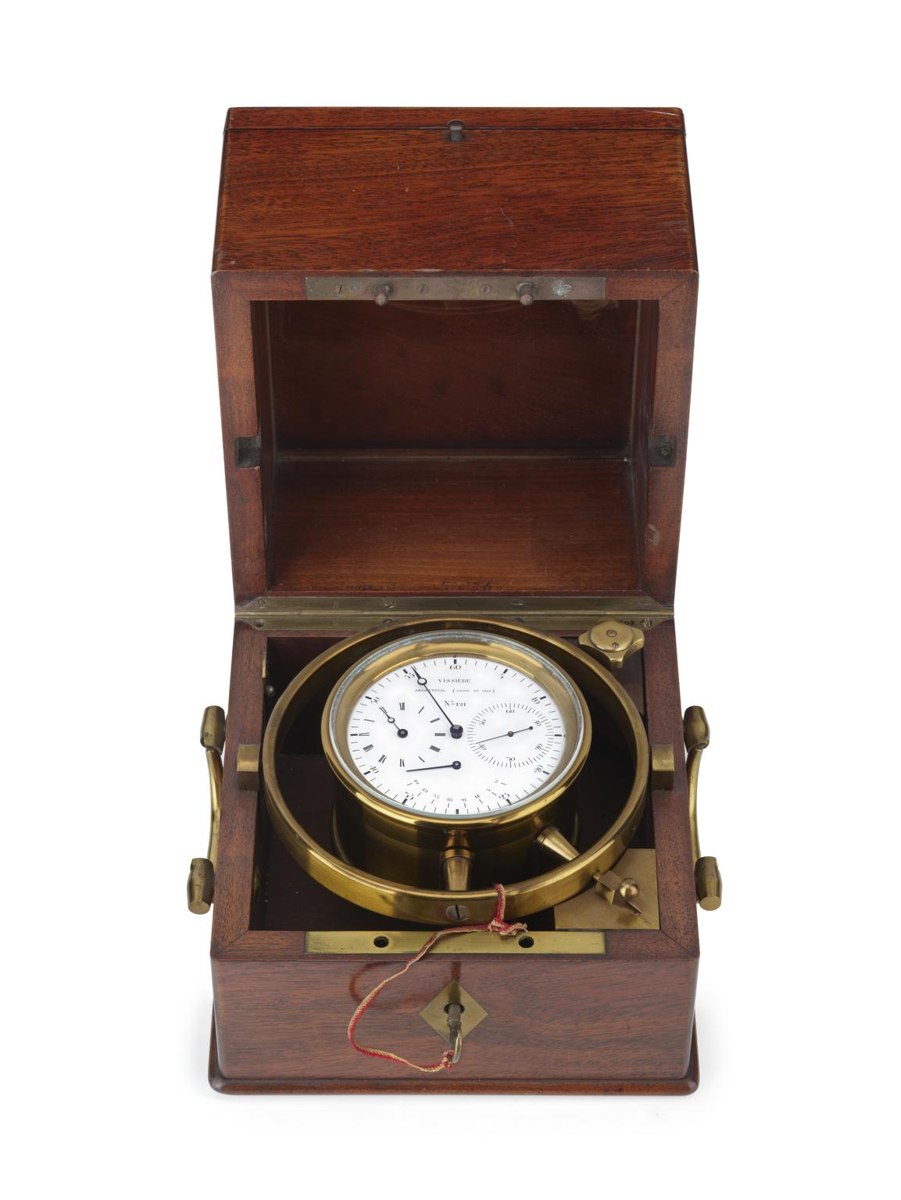
This marine chronometer was made by Vissière in Argenteuil, France, dated by the museum to between 1780 and 1799 (or 1780–1800 in the catalogue text). Housed in a brass bowl mounted inside a gimballed wooden transport box, the instrument features a weighted base. Its white enamel dial displays a central seconds hand, subsidiary dials for hours and minutes, and a lower up-and-down power reserve indicator. The dial is signed 'Vissière Argenteuil (Seine et Oise) No. 121'. According to source records, the movement is powered by a fusee mechanism with a spring detent escapement, two-arm compensation balance, and helical balance spring, and originally formed part of the collection of the Reverend Henry Nelthropp.

Top-down view of the Vissière marine chronometer resting in its brass gimbal within the wooden box
Top-down view of the Vissière marine chronometer resting in its brass gimbal within the wooden box — Science Museum Group/The Clockmakers' Museum. Rights pending — permission not yet requested. Original source

Catalogue identity

Source
collection.sciencemuseumgroup.org.uk
Category
Marine chronometer · Box marine chronometer
Maker / attribution
Vissière
Reference
Not recorded
Catalogue / lot identifier
Source URL identifies the listing
Source-reported date
1780-1799
Country
France
Source-reported serial
121

Source-reported attribution and specifications are not independent authentication. A listing does not establish present ownership, current display, availability or permission to reproduce.

Object description

Construction and Housing

The instrument is housed in a wooden transport box featuring a brass bowl suspended within a circular brass gimbal ring. The bottom of the brass casing is weighted.

Exterior fittings include brass drop handles on the sides of the wooden case and a brass key escutcheon on the front. A cord attached to the gimbal ring is threaded forward through the case.

Evidence for this section
  • “Gimballed wooden box, of which the bottom of the brass casing is weighted.”
  • “Brass drop handles mounted on the sides of the wooden case and a brass key escutcheon on the front face.”
  • “A cord attached to the gimbal ring is threaded forward through the case.”

Dial Configuration

The white enamel dial measures 78 mm in diameter. It features a centre seconds hand, separate hour and minute rings, and an up-and-down indicator at the base.

The dial is signed 'Vissière Argenteuil (Seine et Oise) No. 121'.

Evidence for this section
  • “Enamel dial, with a centre seconds hand, separate hour and minute rings and up-and-down indicator at the base.”
  • “Signed 'Vissière Argenteuil (Seine et Oise) No. 121'.”

Movement and Mechanism

The movement is a fusee type featuring a spring detent escapement. It utilizes a two-arm compensation balance and a helical balance-spring described as having no terminal curves.

The movement is marked with the signature 'Vissière, No. 121'.

Evidence for this section
  • “Fusee movement with spring detent escapement, two-arm compensation balance and helical balance-spring without terminal curves.”
  • “Movement signed 'Vissière, No. 121'.”

Provenance and Documentation

The chronometer was historically part of the collection of the Reverend Henry Nelthropp.

The source documentation provides conflicting date ranges of 1780-1799 and 1780-1800 for the object's manufacture.

Evidence for this section
  • “This chronometer originally formed part of the collection of the Reverand Henry Nelthropp.”
  • “Marine chronometer by Vissière Made: 1780-1799”
  • “Marine chronometer by Vissière, Argenteuil, France, 1780-1800.”

Open research questions

  • What explains the discrepancy between the 1780-1799 and 1780-1800 dating within the source record?
  • Does the absence of terminal curves on the helical balance spring carry technical significance for this model?

Source evidence

Recorded claims and source quotations for Marine chronometer by Vissière, No. 121
FieldSource-reported valueSource quotation
Maker and originVissière, Argenteuil, France“Marine chronometer by Vissière, Argenteuil, France, 1780-1800.”
Dial inscriptionVissière Argenteuil (Seine et Oise) No. 121“Signed 'Vissière Argenteuil (Seine et Oise) No. 121'.”
Movement signatureVissière, No. 121“Movement signed 'Vissière, No. 121'.”
Escapement and movementFusee movement with spring detent escapement“Fusee movement with spring detent escapement, two-arm compensation balance and helical balance-spring without terminal curves.”
DimensionsOverall: 170 mm x 175 mm x 165 mm, dial: 78 mm“Measurements: overall: 170 mm x 175 mm x 165 mm, dial: 78 mm”
Object numberL2015-3490“Object Number: L2015-3490”
Provenance noteReverend Henry Nelthropp collection“This chronometer originally formed part of the collection of the Reverand Henry Nelthropp.”
Overall Dimensions170 mm x 175 mm x 165 mm“Measurements: overall: 170 mm x 175 mm x 165 mm”
Museum Inventory NumberL2015-3490“Object Number: L2015-3490”

Visible details

  • White enamel dial with central seconds hand, subsidiary dials for hours and minutes, and an up-and-down indicator near the base.
  • Brass bowl suspended in a circular brass gimbal ring within an open, hinged wooden box.
  • Brass drop handles mounted on the sides of the wooden case and a brass key escutcheon on the front face.
  • A cord attached to the gimbal ring is threaded forward through the case.

Research qualifications

  • Internal movement mechanisms (fusee, spring detent escapement, and helical balance spring) are enclosed within the brass casing and not visible in the photograph.
  • The source text provides slightly differing date ranges of 1780-1799 in the metadata and 1780-1800 in the narrative text.

Photograph identity and source facts were screened before import; rights clearance remains pending.

Consulted source

Marine chronometer by Vissière | Science Museum Group Collection

Reviewed 2026-10-22 · Record 020722a6dd

Terms in this record

Glossary explanations for terms named in this object’s record.