
Skip to content
The Encyclopedia of Horology

Clock · Carriage clock

Breguet Carriage Clock

Partially verified

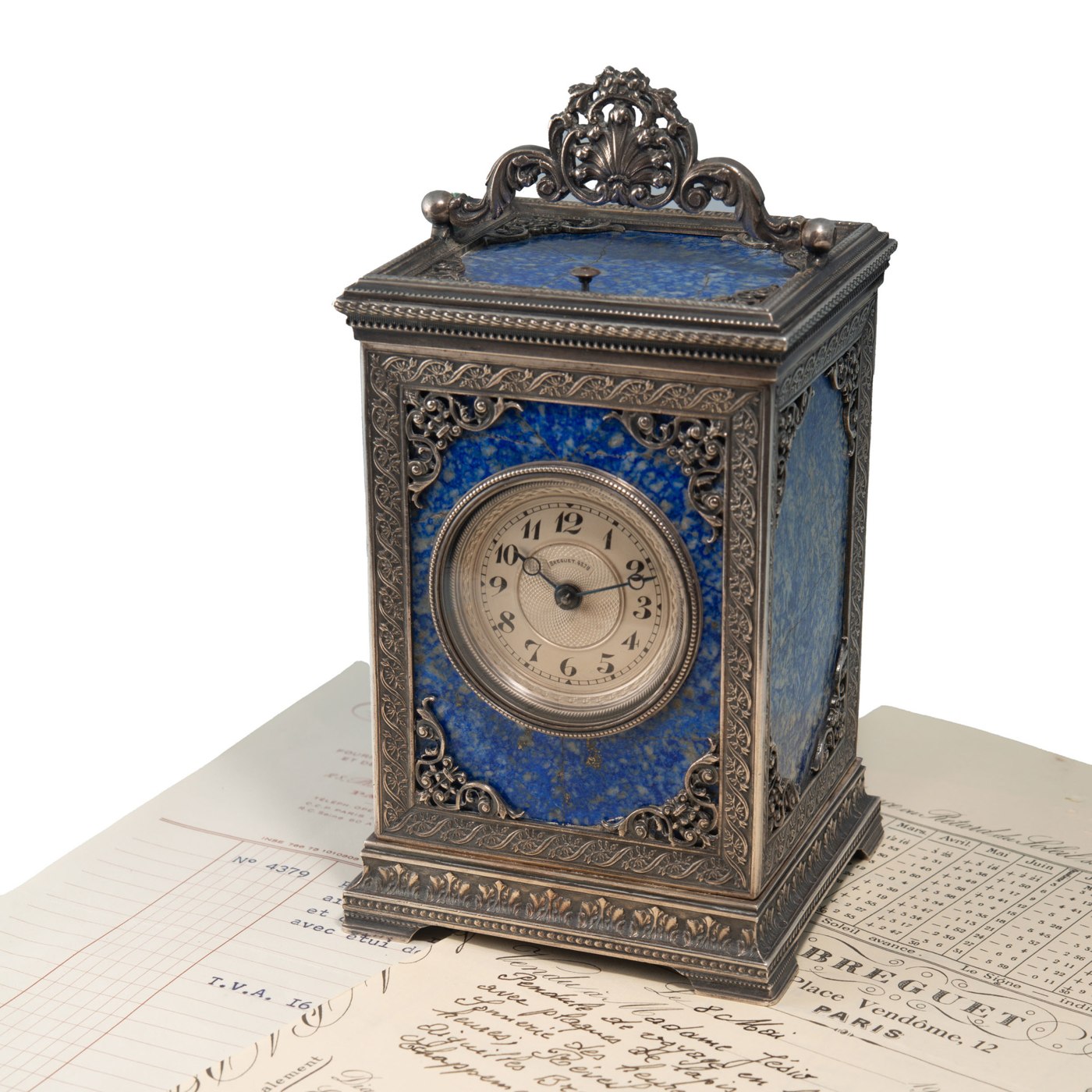
This eight-day going carriage clock, manufactured in France and sold in May 1924, features a vertical rectangular case constructed of silvered bronze and inset lapis-lazuli panels. The exterior displays chiselled decorative elements, with a silver engine-turned guilloché dial accented by suspended Breguet numerals and blued steel hands. The movement is a manual-wind calibre measuring 85 by 55 mm, identified as ebauche number 7 554. It operates with two going barrels and a platform escapement featuring a straight-line lever, a compensated balance with poising screws, a flat hairspring, and a polished steel index-regulator. The clock includes three complications: an hour and half-hour striking mechanism, an hour-repeater activated by a top-mounted button, and an alarm function operated by a small hammer on the movement's reverse, indicated by a subsidiary dial at the 6 o'clock position. The object is accompanied by a brass winding key.

Breguet eight-day carriage clock with silvered bronze and lapis-lazuli case, featuring striking, repeater, and alarm complications.
Breguet eight-day carriage clock with silvered bronze and lapis-lazuli case, featuring striking, repeater, and alarm complications. — Antiquorum. Rights pending — permission not yet requested. Original source

Catalogue identity

Source
catalog.antiquorum.swiss
Category
Clock · Carriage clock
Maker / attribution
Breguet
Reference
Not recorded
Catalogue / lot identifier
269
Source-reported date
1924
Source-reported place
France
Source-reported serial
4379

Source-reported attribution and specifications are not independent authentication. A listing does not establish present ownership, current display, availability or permission to reproduce.

Object description

Case and Dial Design

The clock is designed as a vertical rectangular carriage clock, utilizing a structure of silvered bronze. The architectural composition is enhanced by chiselled décor throughout the frame, providing a textured contrast to the smooth, inlaid lapis-lazuli panels integrated into the sides and top of the cabinet. The top of the case features a decorative carrying handle.

The dial is rendered in silver with an engine-turned guilloché finish. It is marked with suspended Breguet-style numerals and utilizes blued steel hands for time indication. The overall aesthetic combines metallic ornamentation with the deep blue tones of the stone panels.

Evidence for this section
  • “Case with chiselled décor and lapis-lazuli panels.”
  • “Silver guilloché (engine-turned) dial with suspended “Breguet” numerals; blued steel “Breguet” hands.”

Movement and Complications

The eight-day movement, identified by ebauche number 7 554, is powered by two going barrels. The timing mechanism incorporates a platform escapement with a straight-line lever, a compensated balance equipped with poising screws, and a flat hairspring. A polished steel index-regulator is used for regulation.

Three horological complications are integrated: an hour and half-hour striking system that sounds on a gong, an hour-repeater activated by a button on the top of the cabinet, and an alarm. The alarm is operated by a hammer located on the reverse of the movement, which triggers on the same gong as the striking train. A subsidiary dial located at the 6 o'clock position serves the alarm function.

Evidence for this section
  • “eight-day going, carriage-clock, with three horological complications”
  • “Alarm on the same gong via a small hammer (on the reverse of the movement; subsidiary dial at 6 o’clock)”
  • “plat-form escapement with straight-line lever escapement, compensated balance with poising screws and flat hairspring, polished steel index-regulator.”

Provenance and Documentation

The clock was originally sold by Breguet in Paris on May 8, 1924, to a Mrs. Jésio for 2,200 Francs. It was later sold on June 7, 1968, to Mr. S. O. Stromberg of Helsinki, Finland, for 2,500 Francs. The records include a Breguet invoice dated June 7, 1968.

Further documentation consists of a Certificate of Authenticity (No. 3 774) issued by Breguet in Paris on December 15, 1982. This certificate and a corresponding letter were provided to the owner at the time, related to the 1968 purchaser. The lot includes a brass winding key identified as No. 394 / 2.

Evidence for this section
  • “originally sold on May 8, 1924, to Mrs. Jésio”
  • “sold on June 7, 1968, to Mr. S. O. Stromberg, Helsinki, Finland”
  • “Certificate of Authenticity (No. 3 774), dated December 15, 1982”

Open research questions

  • Determine if the lapis-lazuli panels are original to the 1924 production date.
  • Clarify the mechanical condition of the repeater and alarm mechanisms beyond the general 'overhaul recommended' note.

Source evidence

Recorded claims and source quotations for Breguet Carriage Clock
FieldSource-reported valueSource quotation
MakerBreguet“BREGUET, FRANCE, CARRIAGE CLOCK”
Serial Number4379“Movement No. 4379”
Date SoldMay 1924“Year Sold in May 1924”
Movement DetailsTwo going barrels, platform escapement, straight-line lever, compensated balance“two going barrels, plat-form escapement with straight-line lever escapement, compensated balance with poising screws and flat hairspring”
Dimensions85 x 140 x 78 mm“Length 85 Height 140 Width 78”
MaterialsSilvered bronze and lapis-lazuli“silvered bronze and lapis-lazuli”

Visible details

  • Chiselled metallic frame decor
  • Lapis-lazuli inlay on case
  • Subsidiary alarm dial on movement back
  • Button on top for repeater activation

Research qualifications

  • Overhaul recommended by auction description
  • Exact contemporary working state of the mechanical complications is unverified

Photograph identity and source facts were screened before import; rights clearance remains pending.

Terms in this record

Glossary explanations for terms named in this object’s record.