
Skip to content
The Encyclopedia of Horology

Clock · Carriage clock

Edward John Dent Gilt-Brass Chronometer Carriage Timepiece, No. 693

Partially verified

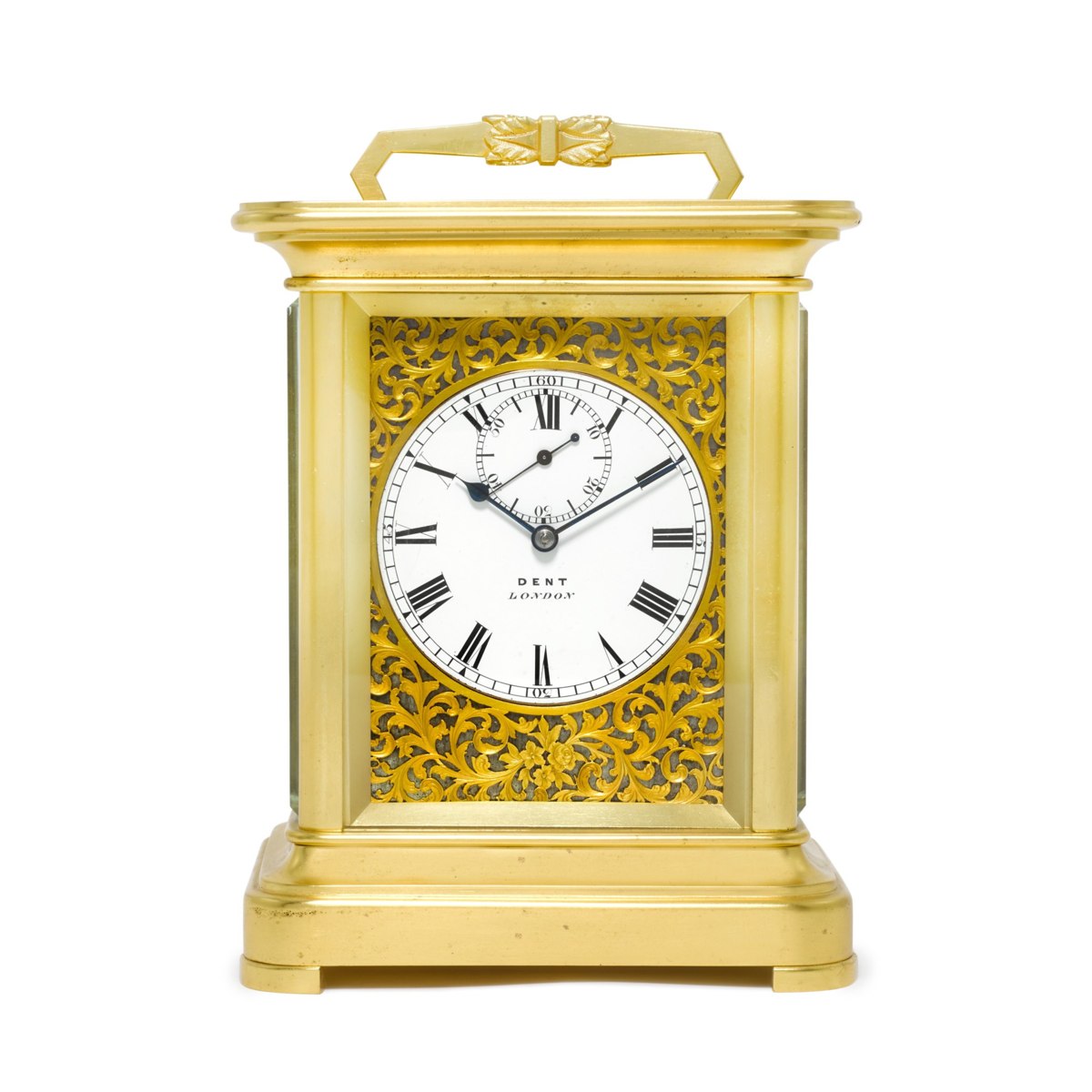
This mid-19th-century English carriage timepiece by Edward John Dent is housed in a gilt-brass moulded case featuring bevel-glazed panels, a sunk top, and a hinged carrying handle. The white enamel dial measures 3 inches across and displays Roman hour numerals, an upper subsidiary seconds dial, and the inscription 'DENT LONDON', framed by a foliate pierced and engraved gilt mask. According to the auction catalogue, the movement features a chain fusee, Harrison's maintaining power, and a gilt platform with an underslung Earnshaw spring detent escapement, staple balance, and blued helical spring. The plain backplate is signed and numbered 693.

Front view of the gilt-brass carriage timepiece showing the enamel dial and engraved mask
Front view of the gilt-brass carriage timepiece showing the enamel dial and engraved mask — Sotheby's. Rights pending — permission not yet requested. Original source

Catalogue identity

Source
www.sothebys.com
Category
Clock · Carriage clock
Maker / attribution
Edward John Dent
Reference
Not recorded
Catalogue / lot identifier
70
Source-reported date
circa 1850
Country
United Kingdom
Source-reported serial
693

Source-reported attribution and specifications are not independent authentication. A listing does not establish present ownership, current display, availability or permission to reproduce.

Object description

Dial and Case Construction

The timepiece is housed in a gilt-brass moulded case featuring bevel-glazed panels, a plinth base, and a sunk top fitted with a hinged carrying handle decorated with a central tied-ribbon motif. The front presents a 3-inch white enamel dial set into a dense, foliate pierced and engraved gilt mask. The dial displays black Roman hour numerals, blued spade hands, an upper subsidiary seconds dial, and is signed 'Dent London'.

The complete height of the case is recorded as 18 cm (7 inches). Through the bevelled glass side panel, internal brass clock movement components remain partially visible.

Evidence for this section
  • “Front view displays a white enamel dial with blued spade hands and a secondary seconds indicator set into a dense openwork floral gilt mask.”
  • “Gilt-brass case features a moulded cornice, plinth base, and a hinged carrying handle decorated with a central tied-ribbon motif.”
  • “3-inch white enamel dial with subsidiary seconds dial and signed Dent London”
  • “foliate pierced and engraved gilt mask”
  • “the moulded case with sunk top, hinged carrying handle and bevel-glazed panels”
  • “18cm 7in high”
  • “Bevelled glass side panel reveals internal brass clock movement components.”

Reported Movement and Chronometer Mechanism

According to the auction catalogue description, the movement is constructed with a chain fusee equipped with Harrison's maintaining power. The platform is described as gilt and fitted with an underslung spring detent escapement (printed in the catalogue text with an apparent misspelling as 'Earshaw's spring detent escapement').

The catalogue description further states that the escapement utilizes a staple balance with a blued helical spring, and that the plain backplate is signed 'Dent, London, 693'. These internal mechanism features and backplate markings are catalogued by the source but are not directly visible in the front photograph.

Evidence for this section
  • “the movement with chain fusee and Harrison's maintaining power, gilt platform with underslung Earshaw's spring detent escapement”
  • “staple balance with blued helical spring”
  • “the plain backplate signed Dent, London, 693”

Attribution and Source Context

The timepiece was catalogued as lot 70 in Sotheby's sale 'A Gentleman’s Cabinet of Curiosities | The Collection of the late Naim Attallah, CBE'. The auction house records the maker as Edward John Dent, located in London, dating the piece to 'circa 1850' under number 693.

An estimate of 8,000 to 12,000 GBP was provided by the auctioneer. Specific condition notes were not recorded in the public source text without logging in.

Evidence for this section
  • “Edward John Dent, No.693, London, circa 1850”
  • “Lot 70 A Gentleman’s Cabinet of Curiosities | The Collection of the late Naim Attallah, CBE”
  • “Estimate 8,000 - 12,000 GBP”
  • “Condition report Please log in”

Open research questions

  • What exact layout and script style are used for the signature and number on the plain backplate?
  • Does direct physical inspection confirm the presence and condition of the Earnshaw spring detent platform and staple balance?
  • Does the timepiece survive with an original fitted traveling box or winding key?

Source evidence

Recorded claims and source quotations for Edward John Dent Gilt-Brass Chronometer Carriage Timepiece, No. 693
FieldSource-reported valueSource quotation
Maker and Serial NumberEdward John Dent, No. 693“Edward John Dent, No.693, London, circa 1850”
Dial Description3-inch white enamel dial with subsidiary seconds dial and signed Dent London“3-inch white enamel dial with subsidiary seconds dial and signed Dent London”
Movement MechanismChain fusee with Harrison's maintaining power and underslung spring detent escapement“the movement with chain fusee and Harrison's maintaining power, gilt platform with underslung Earshaw's spring detent escapement”
Balance and SpringStaple balance with blued helical spring“staple balance with blued helical spring”
Backplate InscriptionSigned Dent, London, 693“the plain backplate signed Dent, London, 693”
Dimensions18 cm (7 inches) high“18cm 7in high”
Auction Estimate8,000 - 12,000 GBP“Estimate 8,000 - 12,000 GBP”
Collection ContextThe Collection of the late Naim Attallah, CBE“The Collection of the late Naim Attallah, CBE”
Catalogued Dimensions18 cm (7 inches) high“18cm 7in high”

Visible details

  • Front view displays a white enamel dial with blued spade hands and a secondary seconds indicator set into a dense openwork floral gilt mask.
  • Gilt-brass case features a moulded cornice, plinth base, and a hinged carrying handle decorated with a central tied-ribbon motif.
  • Bevelled glass side panel reveals internal brass clock movement components.

Research qualifications

  • The rear backplate inscription, movement platform, and escapement described in the catalogue are not directly visible in the provided primary photograph.
  • The source text contains an apparent misspelling ('Earshaw's') for the Earnshaw spring detent escapement.

Photograph identity and source facts were screened before import; rights clearance remains pending.

Consulted source

A gilt-brass chronometer carriage timepiece, Edward John Dent,

Reviewed 2026-10-21 · Record 4025e0b085

Terms in this record

Glossary explanations for terms named in this object’s record.