Skip to content
The Encyclopedia of Horology

Marine chronometer · Two-day marine chronometer

Victorian two-day marine chronometer signed for Joseph Sewill with Poole movement

Partially verified

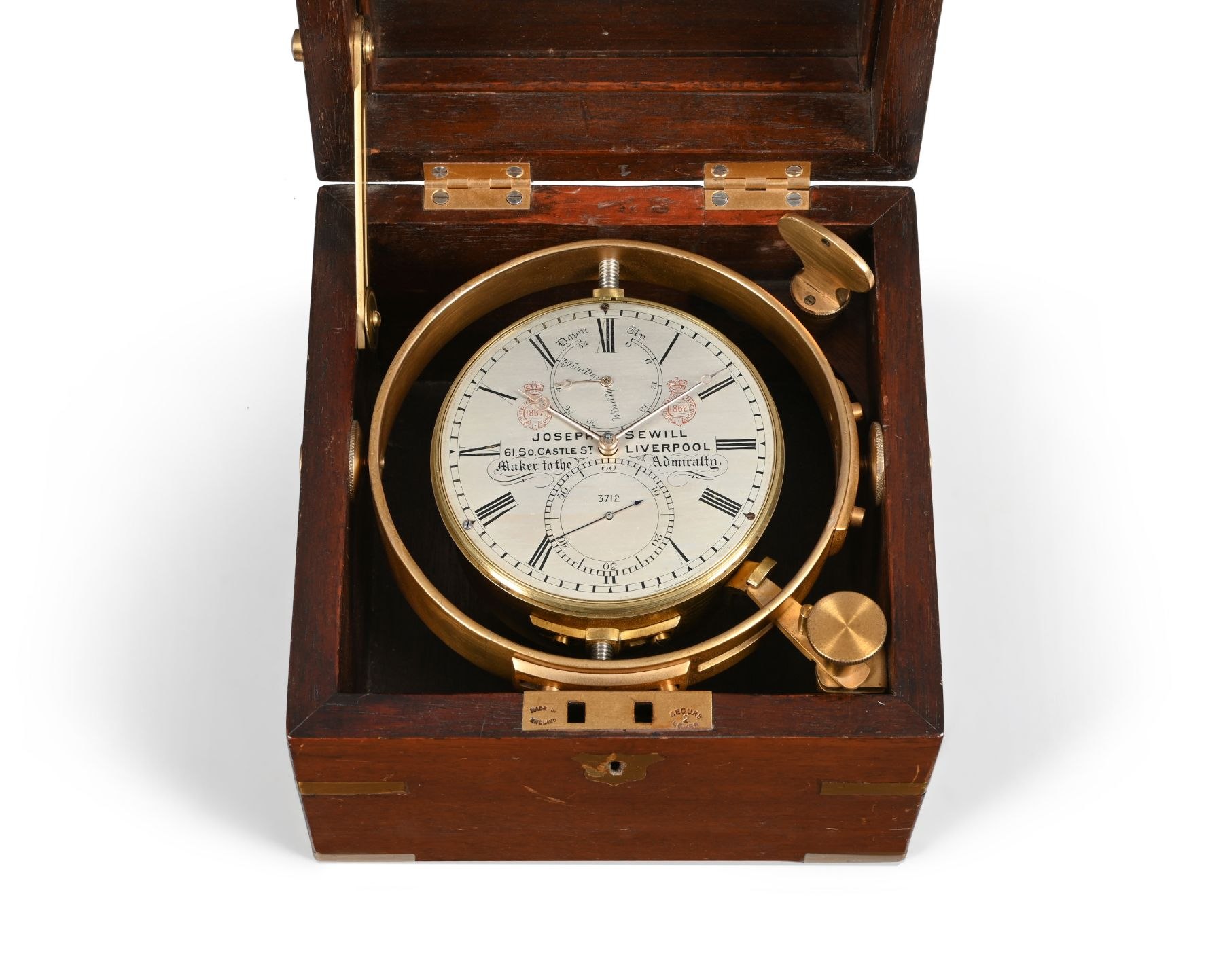
This Victorian two-day marine chronometer combines a movement by John Poole of London with a silvered dial signed by Joseph Sewill of Liverpool. The circular four-pillar single-chain fusee movement features spotted plates, Harrison's maintaining power, jewelled escape wheel pivots, and an Earnshaw-type spring detent escapement with a split bimetallic balance and helical spring. The movement backplate is inscribed 'Poole, London, No. 707'. The silvered dial bears Roman numerals, gold moon hands, a 54-hour state-of-wind indicator flanked by red 1862 and 1867 exhibition medallions, and a subsidiary seconds dial numbered 3712. The source notes the gimbals and three-tier mahogany box are later replacements.

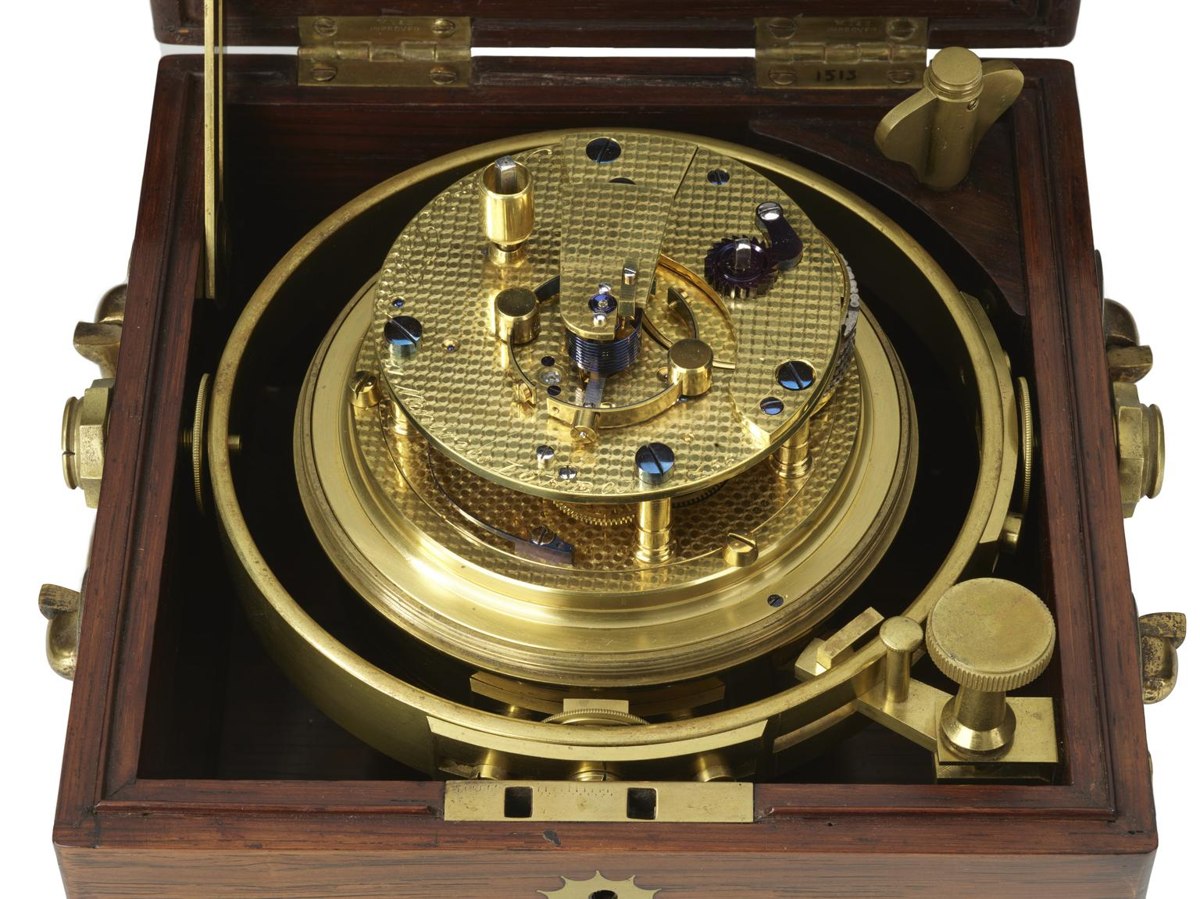
Top-down view of the silvered chronometer dial mounted in its brass bowl and gimbal within the open mahogany box
Top-down view of the silvered chronometer dial mounted in its brass bowl and gimbal within the open mahogany box — Dreweatts. Rights pending — permission not yet requested. Original source

Catalogue identity

Source
auctions.dreweatts.com
Category
Marine chronometer · Two-day marine chronometer
Maker / attribution
Joseph Sewill; John Poole
Reference
Not recorded
Catalogue / lot identifier
644
Source-reported date
circa 1840/70
Source-reported place
United Kingdom
Source-reported serial
3712 (dial); 707 (movement)

Source-reported attribution and specifications are not independent authentication. A listing does not establish present ownership, current display, availability or permission to reproduce.

Object description

Movement Construction

The chronometer features a circular four columnar pillar, single-chain fusee movement. Specific components include spotted plates, five-spoke wheel crossings, Harrison's maintaining power, and an Earnshaw-type spring detent escapement. The movement is regulated by a split bimetallic balance with wedge-shaped weights and a blued helical balance spring.

The backplate includes a separate mainspring pivot plate, a spring set-up ratchet, blued pillar securing screws, and a faceted diamond endstone. The movement is inscribed 'Poole, London, No. 707' on the circumference.

Evidence for this section
  • “The circular four columnar pillar single chain fusee movement with, spotted plates, five-spoke wheel crossings, Harrison`s maintaining power, jewelled pivots for the escape wheel and Earnshaw type spring detent escapement”
  • “signed Poole, London, No. 707 to circumference”
Dial and Visual Features

The circular silvered dial features Roman numerals, gold moon hands, and a subsidiary seconds dial numbered 3712. A 'Down/Up' state-of-wind indicator is present, inscribed 'Wind UP/Two Day' and calibrated 0-54.

The state-of-wind indicator is flanked by two red medallions: 'PRIZE MEDAL AWARDED 1867' and 'INTERNATIONAL EXHIB. 1862'. The center of the dial is signed 'JOSEPH SEWILL, 61 SO. CASTLE ST., LIVERPOOL., Maker to the Admiralty'.

Evidence for this section
  • “the circular silvered Roman numeral dial with subsidiary seconds dial numbered 3712 beneath signature JOSEPH SEWILL, 61 SO. CASTLE ST., LIVERPOOL., Maker to the Admiralty across the centre”
  • “Down/Up state of wind dial inscribed Wind UP/Two Day flanked by red PRIZE MEDAL AWARDED 1867 and INTERNATIONAL EXHIB. 1862 medallions”

Mounting and Housing

The movement is secured by a slender moulded convex-glazed screw-down bezel into a lacquered brass bowl, which features a pivoted dust-cap covered winding hole on the underside. The assembly is mounted via later gimbals into a later mahogany three-tier box.

The box includes brass strap reinforced edges, corner caps on the top tier, a shield-shaped escutcheon plate, and side carrying handles. The set includes a typsy winding key and a padded baize-lined mahogany guard box.

Evidence for this section
  • “secured by a slender moulded convex-glazed screw-down bezel into a lacquered brass bowl with pivoted dust-cap covered winding hole to underside”
  • “mounted via later gimbals into a later mahogany three tier box”

Open research questions

  • What specific archival evidence differentiates the Poole movement production from the Sewill redialing period?
  • Are there physical indicators on the brass bowl or gimbals that confirm them as 'later' additions, as stated by the source?
  • Do records for serial number 3712 in the Joseph Sewill ledgers exist to confirm the history of this specific dial?

Source evidence

Recorded claims and source quotations for Victorian two-day marine chronometer signed for Joseph Sewill with Poole movement
FieldSource-reported valueSource quotation
Dial SignatureJOSEPH SEWILL, 61 SO. CASTLE ST., LIVERPOOL., Maker to the Admiralty“JOSEPH SEWILL, 61 SO. CASTLE ST., LIVERPOOL., Maker to the Admiralty across the centre”
Movement InscriptionPoole, London, No. 707“signed Poole, London, No. 707 to circumference”
Movement FeaturesSingle chain fusee, spotted plates, Earnshaw type spring detent escapement“circular four columnar pillar single chain fusee movement with, spotted plates, five-spoke wheel crossings, Harrison`s maintaining power, jewelled pivots for the escape wheel and Earnshaw type spring detent escapement”
Dimensions18cm cubed“18cm (7ins) cubed.”
Dial DetailsDown/Up state of wind dial inscribed Wind UP/Two Day flanked by exhibition medallions“Down/Up state of wind dial inscribed Wind UP/Two Day flanked by red PRIZE MEDAL AWARDED 1867 and INTERNATIONAL EXHIB. 1862 medallions”
Reported OriginComposite movement and dial“The present lot is an interesting example of a chronometer maker re-using an earlier movement by a different maker.”

Visible details

  • Silvered dial with Roman hour numerals, subsidiary seconds dial, and state-of-wind indicator at 12 o'clock.
  • Brass gimbal mount with locking mechanism set inside a dark wooden box.
  • Winding key mounted in the upper right interior corner of the box.

Research qualifications

  • Source notes the gimbals and mahogany three-tier box are later replacements.
  • The chronometer combines an earlier movement by John Poole with a later dial and signature by Joseph Sewill.

Photograph identity and source facts were screened before import; rights clearance remains pending.

Consulted source

AN INTERESTING VICTORIAN TWO-DAY MARINE CHRONOMETER

Reviewed 2026-10-22 · Record 203ae06280

Terms in this record

Glossary explanations for terms named in this object’s record.