
Skip to content
The Encyclopedia of Horology

Marine chronometer · Two-day marine chronometer

Victorian brass mounted mahogany cased two-day marine chronometer, Richard Hornby

Partially verified

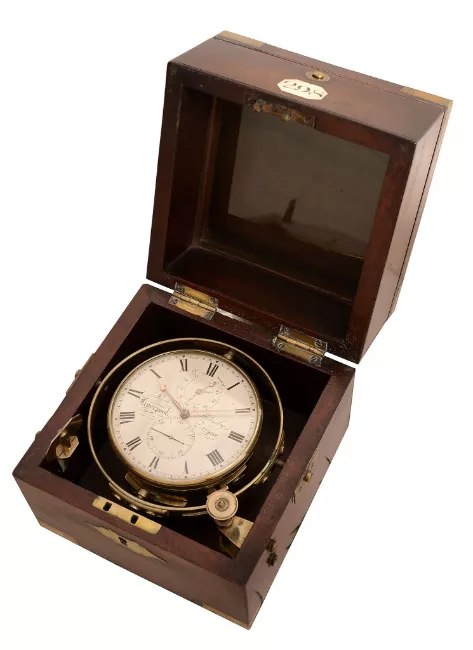
This Victorian two-day marine chronometer is source-attributed to maker Richard Hornby of Liverpool, dating to circa 1870. The chronometer is mounted in a brass-bound three-tier mahogany box featuring brass corner reinforcements and an octagonal ivory plaque numbered 298. The gimbal-mounted brass bowl houses a 3.875-inch silvered Roman numeral dial with an up/down winding indicator and a subsidiary seconds dial. According to the auction description, the movement features a single chain fusee with Harrison's maintaining power, four circular pillars, an Earnshaw-type spring detent escapement, a helical balance spring, and a split bimetallic balance with wedge-shaped weights.

Three-quarter elevated view of the Richard Hornby marine chronometer in an open mahogany box
Three-quarter elevated view of the Richard Hornby marine chronometer in an open mahogany box — Dreweatts. Rights pending — permission not yet requested. Original source

Catalogue identity

Source
auctions.dreweatts.com
Category
Marine chronometer · Two-day marine chronometer
Maker / attribution
Richard Hornby
Reference
Not recorded
Catalogue / lot identifier
100
Source-reported date
circa 1870
Country
United Kingdom
Source-reported serial
298

Source-reported attribution and specifications are not independent authentication. A listing does not establish present ownership, current display, availability or permission to reproduce.

Object description

Case and Housing

The chronometer is enclosed in a three-tier mahogany box. The exterior features brass corner caps on the top tier and additional brass reinforcement straps on the lower angles.

A gimbal system mounts the brass bowl within the box. An octagonal ivory plate on the upper tier is engraved with the serial number '298'.

Evidence for this section
  • “brass bound mahogany wood three tier box with shaped inset brass corner caps to top tier”
  • “the lower angles with further brass reinforcement straps”
  • “mounted via gimbals into the brass bound mahogany wood three tier box”
  • “long octagonal ivory plate engraved with repeat serial number 298”

Dial and Indication

The 3.875-inch circular silvered dial displays Roman numerals and includes a subsidiary seconds dial. A 'WIND DOWN/UP' indicator is positioned in the center of the dial.

The dial is secured to the lacquered brass bowl by a slender screw-down bezel.

Evidence for this section
  • “3.875 inch circular silvered Roman numeral dial with subsidiary seconds dial”
  • “WIND DOWN/UP dial to centre”
  • “secured by a slender screw-down bezel into a lacquered brass bowl”

Movement and Technical Specifications

The movement is described as a four-pillar, single chain fusee type with Harrison's maintaining power. It features an Earnshaw-type spring detent escapement, a split bimetallic balance with wedge-shaped weights, and a helical balance spring.

The backplate includes a blued steel spring set-up ratchet, and the underside of the brass bowl features a winding hole shutter.

Evidence for this section
  • “circular four pillar single chain fusee movement with Harrison's maintaining power”
  • “Earnshaw type spring detent escapement and split bimetallic balance with wedge-shaped principal compensating weights and helical balance spring”
  • “backplate with blued steel spring set-up ratchet”
  • “circular winding hole shutter to underside”

Provenance and Markings

The piece is signed 'Rich'd Hornby, Liverpool. No. 298'. Admiralty records indicate the chronometer was held on loan between April 1944 and May 1945 but was not issued to a vessel.

The underside of the brass bowl is stamped with 'H.S.' and an 'M.O.D.' arrow device.

Evidence for this section
  • “Rich'd Hornby, Liverpool. No. 298”
  • “circular winding hole shutter to underside stamped with H.S. and M.O.D. arrow device”
  • “Admiralty records (Hydrographic Department ledger) indicate that the current lot was taken on charge as a loan on the 8th April 1944 but appears not to have been issued for use on a vessel, and was returned to the owner on the 22nd of May 1945.”

Open research questions

  • Does the 'H.S.' mark signify 'Hydrographic Service' or a specific type of Admiralty inventory?
  • How does the recorded dates of the maker's life (1789–1849) relate to the dating of the chronometer (circa 1870) and the firm 'Richard Hornby & Son'?

Source evidence

Recorded claims and source quotations for Victorian brass mounted mahogany cased two-day marine chronometer, Richard Hornby
FieldSource-reported valueSource quotation
Maker and DateRichard Hornby, Liverpool, circa 1870“Richard Hornby, Liverpool, circa 1870”
Dial Signature and NumberRich'd Hornby, Liverpool. No. 298“Rich'd Hornby, Liverpool. No. 298”
Movement MechanismSingle chain fusee movement with Harrison's maintaining power“circular four pillar single chain fusee movement with Harrison's maintaining power”
EscapementEarnshaw type spring detent escapement“Earnshaw type spring detent escapement and split bimetallic balance”
Dial Diameter3.875 inches“3.875 inch circular silvered Roman numeral dial”
Case Width15.5cm (6ins)“15.5cm (6ins) wide”
Attributed MakerRichard Hornby, Liverpool“Richard Hornby, Liverpool, circa 1870”

Visible details

  • Gimbal-mounted brass bowl seated inside an open three-tier mahogany box.
  • Silvered dial with Roman numerals, central winding indicator, and subsidiary seconds dial.
  • Octagonal ivory plaque on the front of the upper box tier inscribed with serial number 298.
  • Brass corner mounts and strap reinforcements visible on the mahogany casing.

Research qualifications

  • The internal movement components, maintaining power, and escapement details are source-reported and not visible through the dial view.
  • The circular winding hole shutter and M.O.D. stamping on the underside are not depicted in this image.

Photograph identity and source facts were screened before import; rights clearance remains pending.

Terms in this record

Glossary explanations for terms named in this object’s record.