
Skip to content
The Encyclopedia of Horology

Marine chronometer · Deck chronometer

Victor Kullberg Spring Detent Deck Chronometer

Partially verified

This manual-wind deck chronometer by Victor Kullberg features a split-seconds chronograph and an up-and-down 30-hour power reserve indication. Housed in a gilded brass case within a fitted glazed mahogany box, the timepiece features a white enamel dial with Roman numerals and blued steel Breguet hands. The source describes the movement as a 20-ligne gilt brass three-quarter plate caliber with fusee and maintaining power, an Earnshaw-type spring detent chronometer escapement, a cut bimetallic balance, a helical blued balance spring, and a diamond endstone. Guildhall Museum ledgers record its manufacture for Major Rivers on August 14, 1923.

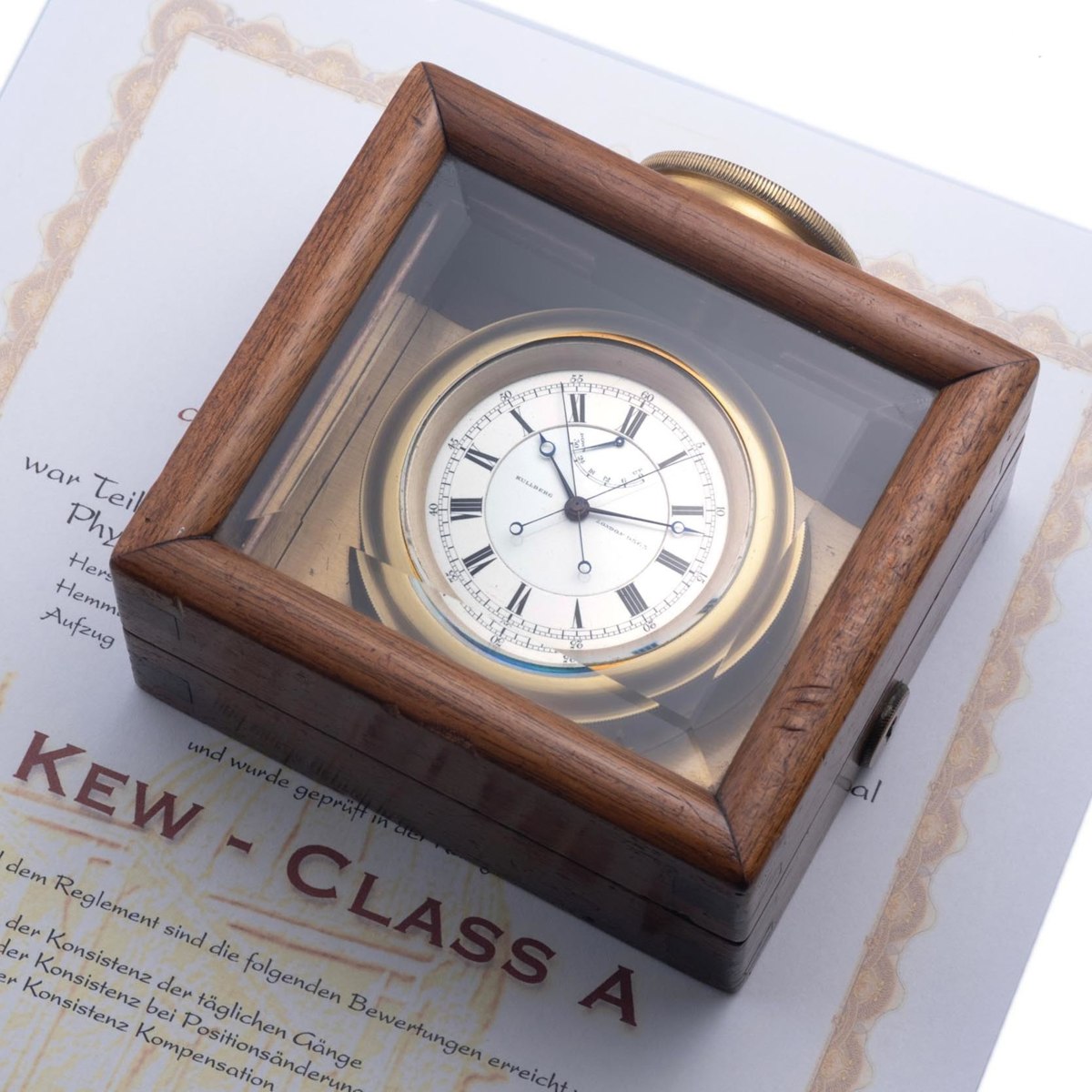
Victor Kullberg deck chronometer housed in its mahogany glazed box atop Kew Class A documentation
Victor Kullberg deck chronometer housed in its mahogany glazed box atop Kew Class A documentation — Antiquorum. Rights pending — permission not yet requested. Original source

Catalogue identity

Source
catalog.antiquorum.swiss
Category
Marine chronometer · Deck chronometer
Maker / attribution
Victor Kullberg
Reference
Not recorded
Catalogue / lot identifier
407
Source-reported date
1923-08-14
Country
England
Source-reported serial
9563

Source-reported attribution and specifications are not independent authentication. A listing does not establish present ownership, current display, availability or permission to reproduce.

Object description

Identity and Archival Ledger Record

Movement and case number 9563 identify this manual-wind spring detent deck chronometer attributed to Victor Kullberg. The catalog notes that both the dial and movement bear the maker's signature.

According to catalog notes citing the Kullberg ledgers held at the Guildhall Museum, entry No. 9563 records that the watch was made for Major Rivers on August 14th, 1923. Accompanying items listed in the lot include an original fitted mahogany lockable box and a copy of Kew Class A Kew/Teddington Observatory Trials documentation.

Evidence for this section
  • “Movement No. 9563”
  • “Case No. 9563”
  • “Signature Dial and movement”
  • “Listed under No.9563 it states the watch was made for Major Rivers on August 14th 1923.”
  • “original fitted mahogany lockable box and a copy of the Kew class A Kew/Teddington Observatory Trials”

Dial Presentation and Observed Condition

The instrument displays a white enamel dial with Roman numeral hour markers, an up/down power reserve register under 12 o'clock, and central split-seconds hands. Photographic observation confirms the Kullberg brand inscription across the dial face, housed within a glazed mahogany box.

Catalog condition grading records a hairline crack within the enamel dial and notes original hands. The source condition assessment also advises that an overhaul is recommended at the buyer's expense.

Evidence for this section
  • “White enamel dial with Roman numeral hour markers, an up/down power reserve register under 12 o'clock, and central split-seconds hands.”
  • “Kullberg brand inscription visible on the dial face.”
  • “Hairline”
  • “HANDS Original”
  • “Overhaul recommended, at buyer's expense”

Reported Movement and Construction Specifications

The catalog describes the movement as a 20-ligne gilt brass three-quarter plate caliber with fusee and maintaining power. The complication includes a split-seconds chronograph and a 30-hour power reserve indication.

Technical specifications provided by the auction house report an Earnshaw-type spring detent chronometer escapement, a cut bimetallic compensation balance, a free-sprung helical balance spring with terminal curves, and a cock fitted with a diamond endstone.

Evidence for this section
  • “GiIt brass three quarter plate 20''' movement, the fusee with maintaining power.”
  • “split second chronograph and 30 hours power reserve indication, Breguet steel hands”
  • “Earnshaw-type spring detent chronometer escapement, cut bimetallic compensation balance, free-sprung helical balance spring with terminal curves, cock with diamond end stone”

Open research questions

  • What specific score, trial dates, and details are recorded on the copy of the Kew Class A Kew/Teddington Observatory Trials document?
  • Where is the noted enamel hairline crack located on the dial surface?
  • Can archival records clarify the full identity or military service of Major Rivers mentioned in the Guildhall ledgers under August 14, 1923?

Source evidence

Recorded claims and source quotations for Victor Kullberg Spring Detent Deck Chronometer
FieldSource-reported valueSource quotation
Movement Number9563“Movement No. 9563”
Case Number9563“Case No. 9563”
Caliber DescriptionGiIt brass three quarter plate 20''' movement“GiIt brass three quarter plate 20''' movement, the fusee with maintaining power.”
EscapementEarnshaw-type spring detent chronometer escapement“Earnshaw-type spring detent chronometer escapement, cut bimetallic compensation balance, free-sprung helical balance spring with terminal curves”
Production RecordRecorded as made for Major Rivers on August 14th 1923“Listed under No.9563 it states the watch was made for Major Rivers on August 14th 1923.”
Case and Box MaterialsMahogany and gilded brass“mahogany and gilded brass, manual wind deck chronometer”
Hands TypeBreguet steel hands“Breguet steel hands”
Accompanying DocumentationCopy of Kew Class A Kew/Teddington Observatory Trials“a copy of the Kew class A Kew/Teddington Observatory Trials”

Visible details

  • Glazed mahogany presentation box housing the brass-cased chronometer resting over a German-language Kew Class A certificate reproduction.
  • White enamel dial with Roman numeral hour markers, an up/down power reserve register under 12 o'clock, and central split-seconds hands.
  • Kullberg brand inscription visible on the dial face.

Research qualifications

  • Source notes an overhaul is recommended at buyer's expense.
  • Source condition report notes a hairline crack on the enamel dial.

Photograph identity and source facts were screened before import; rights clearance remains pending.