
Skip to content
The Encyclopedia of Horology

Marine chronometer · Eight-day marine chronometer

Thomas Mudge Marine Timekeeper No. 1

Partially verified

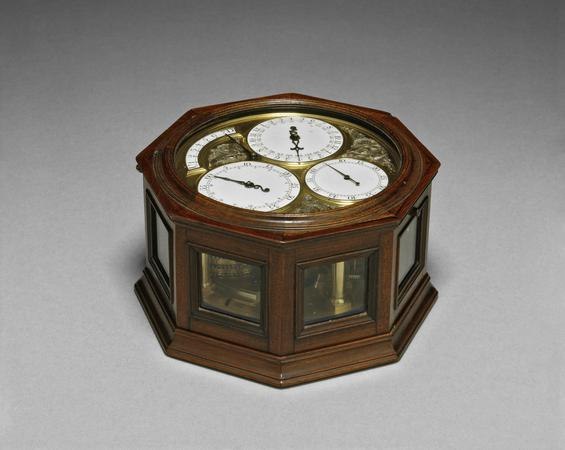
Thomas Mudge created this eight-day marine timekeeper between 1771 and 1774, known as his Marine Timekeeper No. 1. According to the British Museum, it was constructed in Plymouth though inscribed London on the back plate. The movement is powered by two separate mainsprings housed in a single barrel driving a fusee fitted with Harrison's maintaining power. It features Mudge's constant-force escapement and thermal compensation utilizing two bimetallic strips. The gilded brass dial plate contains three white enamel subsidiary dials calibrated in time and degrees, alongside an arc-shaped up-and-down indicator calibrated from 1 to 7 days. The timekeeper is housed within an octagonal glazed mahogany inner case.

High-angle view of Thomas Mudge's Marine Timekeeper No. 1 in its glazed octagonal mahogany case showing dial layout and movement side apertures
High-angle view of Thomas Mudge's Marine Timekeeper No. 1 in its glazed octagonal mahogany case showing dial layout and movement side apertures — British Museum. Rights pending — permission not yet requested. Original source

Catalogue identity

Source
www.britishmuseum.org
Category
Marine chronometer · Eight-day marine chronometer
Maker / attribution
Thomas Mudge
Reference
1958,1006.2119
Catalogue / lot identifier
Source URL identifies the listing
Source-reported date
1771-1774
Country
United Kingdom

Source-reported attribution and specifications are not independent authentication. A listing does not establish present ownership, current display, availability or permission to reproduce.

Object description

Case and Exterior Construction

The timepiece is housed in an octagonal inner mahogany box, described by the maker as wood instead of brass for economic reasons. The inner box features glazed panels in each facet and is reinforced by internal brass rings; it is designed to be dust-tight with overlapped joints.

A separate mahogany outer carrying box exists, which contains padded side panels lined with faded red velvet. The inner box utilizes a seven-knuckle hinge, a push-piece catch, and a pierced bottom that allows access to the winding mechanism via an escutcheon plate.

Evidence for this section
  • “octagonal mahogany box with glazed top, bottom and sides”
  • “My only reason for making it of wood, was to save money”
  • “The octagonal inner box (containing movement) is composed of many pieces of mahogany”
  • “The side panels are lined inside with faded red velvet and padded.”
  • “The seven-knuckle hinge has a steel taper pin retained by brass screws.”

Dial and Indication

The gilded-brass dial plate hosts three subsidiary white enamel dials displaying hours, minutes, and seconds. The dials are calibrated in time units and degrees, intended for longitudinal calculations.

An arc-shaped indicator sector at the top, numbered 1-7 and flanked by 'U' and 'D', displays the state of winding. The hands are fashioned from blued steel, and the assembly is secured by silver scrolled spandrels.

Evidence for this section
  • “separate enamel dials: minutes of time and equivalent in degrees to left, hours of time and degrees to right, seconds to bottom, 'up-and-down' to top”
  • “sector numbered 1-7 flanked by the letters U and D for up and down”
  • “Hands of blued steel.”

Mechanism and Escapement

The movement features a single-barrel configuration containing two separate mainsprings driving a fusee with Harrison's maintaining power. The constant-force escapement incorporates two spiral springs and pivoted pallet arms, isolating the balance from the going train.

Thermal compensation is achieved via two bimetallic strips. The balance staff pivots on a diamond endstone and is supported by four anti-friction rollers, though inspection indicates prior mechanical issues, including a nicked roller, pallet score marks, and balance pivot wear.

Evidence for this section
  • “powered by two separate mainsprings housed in single barrel”
  • “Mudge's constant force escapement”
  • “temperature compensation achieved by use of two bimetallic strips”
  • “One of the upper set of anti-friction rollers has a pronounced nick in its edge”
  • “Each of these pallets has a deep score mark where the escape teeth have rubbed.”

Open research questions

  • Are the deep score marks on the escape pallets considered an inherent design limitation or a consequence of the recorded mainspring breakage issues?
  • Is the 'blue' paint found inside the middle section of the inner box original to the 1771-1774 production period?
  • Do the discrepancies in pivot planting described in the observations indicate historical repair attempts or original assembly variance?

Source evidence

Recorded claims and source quotations for Thomas Mudge Marine Timekeeper No. 1
FieldSource-reported valueSource quotation
Museum Number1958,1006.2119“Museum number 1958,1006.2119”
MakerThomas Mudge“Made by: Thomas Mudge”
EscapementMudge's constant force escapement“Mudge's constant force escapement”
Movement DurationEight-day movement“eight-day movement”
Mainspring ConfigurationTwo separate mainsprings housed in single barrel“powered by two separate mainsprings housed in single barrel”
SignatureThos Mudge Invt et fect London“On the back plate 'Thos Mudge Invt et fect London'.”
Maker's SignatureThos Mudge Invt et fect London“On the back plate 'Thos Mudge Invt et fect London'.”
Production LocationPlymouth, Devon“Made in: Plymouth (Devon)”

Visible details

  • Octagonal mahogany case with rectangular glazed viewing windows set into each facet.
  • Gilded dial plate displaying three white enamel subsidiary circular dials and an arc-shaped up-and-down indicator sector.
  • Blued steel hands on the circular sub-dials and reserve indicator.
  • Pillar and gear train components visible through the side glass apertures.

Research qualifications

  • The outer octagonal carrying box described in the source is not shown in this photograph.
  • The source notes production was claimed to be London on the signature plate but made in Plymouth.

Photograph identity and source facts were screened before import; rights clearance remains pending.

Consulted source

marine chronometer; spring-driven clock; clock-case | British Museum

Reviewed 2026-10-25 · Record 014cccfdae

Terms in this record

Glossary explanations for terms named in this object’s record.