
Skip to content
The Encyclopedia of Horology

Marine chronometer · Eight-day marine chronometer

John Arnold & Son Marine Chronometer No. 14/104

Partially verified

This eight-day marine chronometer is catalogued by the British Museum as made in 1790 in London by John Arnold & Son. It is signed on the dial 'John Arnold and Son London, No. 14' and on the back plate 'John Arnold and Son London No 14/104 Invt et Fect.' The source notes that chronometer No. 14 was later improved and re-numbered 104. The movement incorporates a spring-detent escapement, a free-sprung gold helical balance spring, and Arnold's 'YZ' bimetallic temperature-compensation balance. Housed in an octagonal mahogany box, the instrument accompanied Captain George Vancouver between 1791 and 1795 on voyages surveying the Pacific coastline of North America.

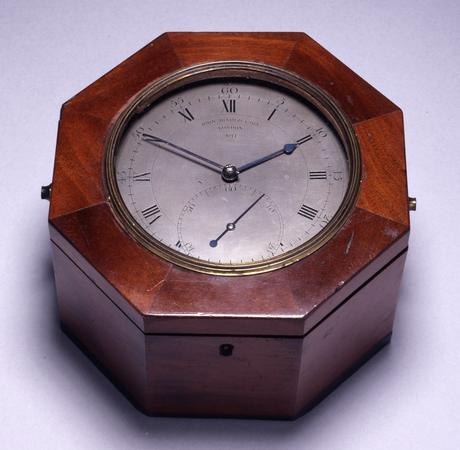
Top-down view of the John Arnold & Son marine chronometer in its octagonal mahogany box
Top-down view of the John Arnold & Son marine chronometer in its octagonal mahogany box — British Museum. Rights pending — permission not yet requested. Original source

Catalogue identity

Source
www.britishmuseum.org
Category
Marine chronometer · Eight-day marine chronometer
Maker / attribution
John Arnold & Son
Reference
Not recorded
Catalogue / lot identifier
Source URL identifies the listing
Source-reported date
1790
Country
United Kingdom
Source-reported serial
14/104

Source-reported attribution and specifications are not independent authentication. A listing does not establish present ownership, current display, availability or permission to reproduce.

Object description

Identity and Provenance

The instrument is signed on the back plate as 'John Arnold and Son London No 14/104 Invt et Fect.' and on the dial as 'John Arnold and Son London, No. 14'. Documentation suggests the dual numbering indicates the chronometer was later improved and re-numbered 104.

The chronometer is documented as having accompanied Captain George Vancouver on his expedition to the Pacific coastline of North America between 1791 and 1795. It was part of the Ilbert collection, donated to the British Museum in 1958 by Gilbert Edgar after being purchased by Courtenay Adrian Ilbert in 1932.

Evidence for this section
  • “Signature: On the back plate 'John Arnold and Son London No 14/104 Invt et Fect.' On the dial: 'John Arnold and Son London, No. 14'.”
  • “The movement is signed on the back plate 'John Arnold & Son, London N° 14/104', indicating that this chronometer, number 14, was later improved by Arnold and at that time re-numbered 104.”
  • “Between 1791 and 1795, along with four other timekeepers, Arnold's No.14 played an essential part in establishing longitude and carrying out detailed surveying of the Pacific coastline of North America.”

Construction and Housing

The movement is housed in an octagonal mahogany box with a hinged glazed lid and a lock. The box contains brass pivots on the exterior, indicating it was at some time suspended in gimbals. The winding hole in the bottom is brass-lined with a rotatable escutcheon plate.

The movement features full-plate construction with a massive front plate, double-recessed under the dial. The brass components are decorated with hand-applied spotting.

Evidence for this section
  • “The movement contained in an octagonal mahogany box with a hinged glazed lid, and with a lock to secure the lid.”
  • “The box has at some time been suspended in gimbals, the brass pivoting pieces remaining on the outside of the box.”
  • “The brass parts decorated with spotting applied by hand.”

Mechanism and Components

The chronometer utilizes a fusee with Harrison's maintaining power and an Arnold spring-detent escapement. The 'YZ' type balance comprises three bimetallic segments screwed to radiating brass arms, with the segments consisting of an inner rim of platinum and an outer rim of a silver, copper, and zinc alloy.

A free-sprung gold helical balance spring of 7½ turns is fitted undersprung between the balance and the back plate. The going train pivots run in pierced jewels, with endstones on all back plate settings, including a diamond for the balance staff.

Evidence for this section
  • “It has a fusee, a going train of four wheels and an Arnold spring-detent escapement with a temperature compensation balance of Arnold's design, known from its shape as the 'YZ' type.”
  • “Free sprung gold helical spring of 7½ turns, with terminal curves, undersprung”
  • “All the pivots of the going train arbors run in pierced jewels except those of the fusee arbor. On the back plate all the jewel settings include an endstone.”

Open research questions

  • What is the significance of the inscription 'John Glover December 4th 1790' on the great wheel in relation to the chronometer's production date and assembly?
  • Does the physical evidence of 'improvements' mentioned in the documentation align with standard shop practices for John Arnold & Son during this period?

Source evidence

Recorded claims and source quotations for John Arnold & Son Marine Chronometer No. 14/104
FieldSource-reported valueSource quotation
Museum number1958,1006.2069“Museum number 1958,1006.2069”
MakersJohn Arnold & Son“Made by: John Arnold & Son”
Dial inscriptionJohn Arnold and Son London, No. 14“On the dial: 'John Arnold and Son London, No. 14'.”
Back plate inscriptionJohn Arnold and Son London No 14/104 Invt et Fect.“On the back plate 'John Arnold and Son London No 14/104 Invt et Fect.'”
EscapementSpring detent“Escapement spring detent”
BalanceJohn Arnold 'YZ' balance“John Arnold 'YZ' balance.”
Historical expeditionCaptain George Vancouver voyage (1791–1795)“Between 1791 and 1795, along with four other timekeepers, Arnold's No.14 played an essential part in establishing longitude and carrying out detailed surveying of the Pacific coastline of North America.”
Great wheel inscriptionJohn Glover December 4th 1790“The inside of the great wheel signed ' John Glover December 4th 1790 '.”
Escape wheel conditionCycloidal face wear noted“the teeth of the brass escape wheel notched on their acting cycloidal faces as a result of wear on the corner of the impulse jewel.”

Visible details

  • Octagonal mahogany casing with brass side pivots and keyhole on the front.
  • Glazed circular brass bezel enclosing a silvered dial.
  • Engraved Roman numerals for the hours with Arabic five-minute markings.
  • Large subsidiary seconds dial positioned at the lower half of the dial.
  • Blued steel hour, minute, and counterpoised seconds hands.

Research qualifications

  • Source notes conflicting dates in commentary headings (c.1778 versus 1790), though the catalogued production date is 1790 and the great wheel bears a 1790 inscription.
  • Internal movement details, escapement, and balance assembly are concealed within the closed casing in the displayed photograph.

Photograph identity and source facts were screened before import; rights clearance remains pending.

Consulted source

marine chronometer; eight-day clock; clock-case | British Museum

Reviewed 2026-10-25 · Record 6e1b2934c1

Terms in this record

Glossary explanations for terms named in this object’s record.