
Skip to content
The Encyclopedia of Horology

Marine chronometer · Eight-day marine chronometer

Morris Tobias Eight-Day Marine Chronometer No. 326

Partially verified

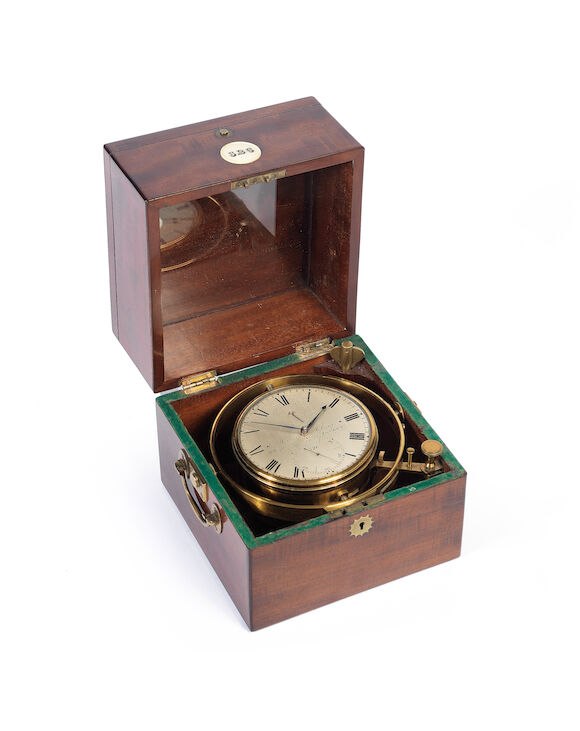
This early 19th-century eight-day marine chronometer, numbered 326, is source-attributed to Morris Tobias of 31 Minories, London, circa 1820. The instrument features a 4.25-inch silvered Roman dial displaying blued-steel hands, a subsidiary seconds dial, and an 8-day state-of-wind indicator. It is mounted in a gimballed brass bowl within a three-part wooden box fitted with brass handles and a numbered circular plaque. According to the auction source, the chain fusee movement includes a crescent-shaped backplate, three turned pillars, and an Earnshaw detent escapement on a sub-plate. Documentation traces ownership to Captain Henry Jones Hanson of the SS Nautilus.

Morris Tobias eight-day marine chronometer No. 326 in gimballed wooden box
Morris Tobias eight-day marine chronometer No. 326 in gimballed wooden box — Bonhams. Rights pending — permission not yet requested. Original source

Catalogue identity

Source
www.bonhams.com
Category
Marine chronometer · Eight-day marine chronometer
Maker / attribution
Morris Tobias
Reference
Not recorded
Catalogue / lot identifier
17
Source-reported date
Circa 1820
Country
United Kingdom
Source-reported serial
326

Source-reported attribution and specifications are not independent authentication. A listing does not establish present ownership, current display, availability or permission to reproduce.

Object description

Construction and Housing

The marine chronometer is housed in a three-part wooden case featuring a solid top, a central numeral plaque, and brass side handles on a felt base.

The instrument itself is suspended within a gimballed brass bowl equipped with a locking lever. The lot also includes a padded travelling case and keys.

Evidence for this section
  • “The three part case with solid top, numeral plaque to the centre, and brass side handles on a felt base”
  • “suspended in a gimballed brass bowl with locking lever.”
  • “Sold with a padded travelling case, tipsy key, hand setting key and case key”

Dial and Mechanism

The 4.25-inch silvered dial features a minute band and Roman numerals. It includes blued-steel hands, a subsidiary seconds dial, and a power reserve dial graduated from 1 to 8 days.

The movement is a chain fusee type with a crescent-shaped backplate and three turned pillars. The escapement is set on a sub-plate and features a freesprung blued steel spring, a diamond endstone, and an Earnshaw detent escapement with a cut and compensated bimetallic balance.

Evidence for this section
  • “4.25 inch signed silvered Roman dial with minute band enclosing the blued-steel hands, large subsidiary seconds dial and power reserve dial marked in days, 1-8”
  • “the large chain fusee movement with crescent shaped backplate and three large turned pillars”
  • “the escapement set on a sub plate with freesprung blued steel spring with diamond endstone to an Earnshaw detent escapement with cut and compensated bimetallic balance”

Provenance and Documentation

The chronometer is signed by Morris Tobias of 31 Minories, London, and dated circa 1820. Documentation provided with the lot links the item to Captain Henry Jones Hanson of the SS Nautilus.

Internal box labels and accompanying historical records, including copies of maritime certificates and a hand-written rate card from 1898, identify the provenance to Captain Hanson and his family.

Evidence for this section
  • “Morris Tobias, 31 Minories, London, No. 326. Circa 1820.”
  • “The guard box carries a handwritten label to the interior "Captain H J Hanson, SS Nautlius, Cape Town".”
  • “together with a rate card in his own hand for 1898 and other personal information.”

Open research questions

  • Are there surviving production registers for Morris Tobias that record chronometer No. 326?
  • What is the historical significance of the 'crescent-shaped backplate' in early 19th-century marine chronometer manufacture?
  • Can the personal maritime service records of Captain Henry Jones Hanson be further verified against external ship registry databases?

Source evidence

Recorded claims and source quotations for Morris Tobias Eight-Day Marine Chronometer No. 326
FieldSource-reported valueSource quotation
Maker and SerialMorris Tobias, No. 326“Morris Tobias, 31 Minories, London, No. 326.”
Date of ManufactureCirca 1820“Circa 1820.”
Dial Description4.25-inch silvered Roman dial“the 4.25 inch signed silvered Roman dial with minute band enclosing the blued-steel hands, large subsidiary seconds dial and power reserve dial marked in days, 1-8”
Movement ConstructionEight-day chain fusee movement“the large chain fusee movement with crescent shaped backplate and three large turned pillars”
EscapementEarnshaw detent escapement“an Earnshaw detent escapement with cut and compensated bimetallic balance”
ProvenanceCaptain Henry Jones Hanson“The guard box carries a handwritten label to the interior "Captain H J Hanson, SS Nautlius, Cape Town".”
MakerMorris Tobias“Morris Tobias, 31 Minories, London”
Dimensions20 cm“20cm (7 1/2ins)”

Visible details

  • Chronometer mounted in a brass gimballed bowl inside an open wooden box with glazed middle section and upper lid.
  • Silvered dial displays black Roman numerals, blued steel hands, a subsidiary seconds track, and an up/down state-of-wind indicator.
  • Circular plaque set into the box lid rim inscribed with '326'.
  • Fitted with brass drop handles on the sides, a front keyhole escutcheon, and a gimbal locking mechanism.

Research qualifications

  • Internal movement features including the chain fusee, crescent-shaped backplate, and Earnshaw escapement are housed inside the brass bowl and not visible in the primary image.
  • Provenance to Captain Henry Jones Hanson and historical dates rely on auction catalog documentation and certificates accompanying the lot.

Photograph identity and source facts were screened before import; rights clearance remains pending.

Terms in this record

Glossary explanations for terms named in this object’s record.