
Skip to content
The Encyclopedia of Horology

Marine chronometer · Two-day marine chronometer

Sir John Bennett 2-day fusee marine chronometer no. 12861

Partially verified

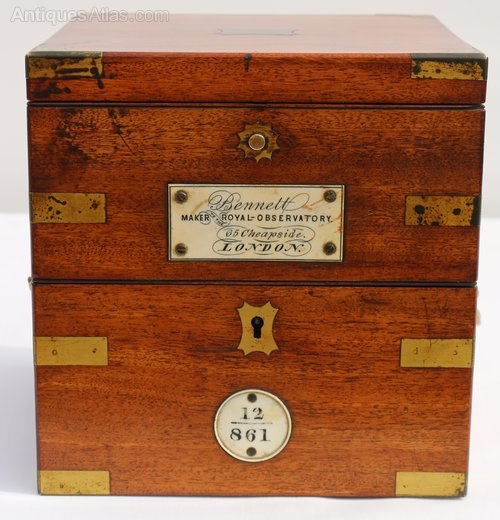
This two-day marine chronometer by Sir John Bennett is housed in a brass-bound, three-tier rosewood box measuring 190 mm high by 190 mm wide and 185 mm deep. The exterior features flush brass corner brackets, a brass key escutcheon, a rectangular engraved plaque inscribed 'Bennett Maker to the Royal-Observatory 65 Cheapside London', and an ivory-coloured circular disc numbered '12/861'. The dealer states that the instrument is gimballed in a brass bowl with an offset revolving shutter. The dealer further reports a two-day full-plate fusee movement with Harrison's maintaining power, four turned pillars, Earnshaw spring detent escapement, helical balance spring, and compensation balance. The dial reportedly features Roman numerals, a sub-seconds dial, and an up-and-down indicator.

Front view of the closed three-tier rosewood box of Sir John Bennett marine chronometer no. 12861 showing brass mountings and plaques
Front view of the closed three-tier rosewood box of Sir John Bennett marine chronometer no. 12861 showing brass mountings and plaques — Tyne Antiques via Antiques Atlas. Rights pending — permission not yet requested. Original source

Catalogue identity

Source
antiques-atlas.com
Category
Marine chronometer · Two-day marine chronometer
Maker / attribution
Sir John Bennett
Reference
Not recorded
Catalogue / lot identifier
as915a024
Source-reported date
circa 1840
Country
United Kingdom
Source-reported serial
12861

Source-reported attribution and specifications are not independent authentication. A listing does not establish present ownership, current display, availability or permission to reproduce.

Object description

Casing and External Features

The chronometer is housed in a three-tier, brass-bound, rosewood box measuring 190 mm high, 190 mm wide, and 185 mm deep. External features include an inlaid brass, waisted-lozenge escutcheon on the front, a matching inlay in the lid, and brass drop handles on the sides.

The box includes a rectangular nameplate inscribed 'Bennett MAKER TO THE ROYAL-OBSERVATORY 65 Cheapside, LONDON.' A circular disc near the keyway bears the serial number '12 / 861'.

Evidence for this section
  • “three tier, brass-bound, rosewood box, 190mms high, 190mms wide and 185mms deep”
  • “inlaid, brass, waisted-lozenge escutcheon on front”
  • “Rectangular bone or ivory-coloured nameplate secured by four screws reading 'Bennett MAKER TO THE ROYAL-OBSERVATORY 65 Cheapside, LONDON.'”
  • “Circular circular disc below the keyway marked with the fractionally arranged serial number '12 / 861'.”

Dial and Indicators

The dial features Roman hour numerals and a sub-seconds dial with Arabic ten-second markers. The center of the dial is signed: 'John Bennett/ MAKER TO THE ADMIRALTY, / London No.12861'.

An up-and-down indicator is located below the XII marker, marked with Arabic numerals in six-hour intervals (0 to 54) and labels for 'UP', 'WIND', and 'DOWN'.

Evidence for this section
  • “The dial is signed across the centre: ‘John Bennett/ MAKER TO THE ADMIRALTY, / London No.12861’”
  • “The up and down dial, below XII, is marked in Arabic numerals in six hour intervals: ‘0…54’ and is marked ‘~UP~’ by 0, ‘WIND’ by 24, and ‘DOWN’ by 54.”

Movement Construction

The instrument contains a two-day full-plate fusee movement with Harrison’s maintaining power, featuring four turned pillars and an Earnshaw spring detent escapement. The movement is fitted with a helical balance spring, compensation balance, and jewel endstones.

The dealer reports the brass work is highly polished, with components including a four-wheel train, a gold passing spring, and a red impulse jewel.

Evidence for this section
  • “two-day full plate fusee movement with four turned pillars”
  • “It has a typical Earnshaw spring detent escapement”
  • “The finely polished, blued steel helical balance spring has terminals on both ends”
  • “The jewelling extends to the balance (diamond upper endstone in a blued steel setting) and escape wheel”

Open research questions

  • Are the varying inscriptions ('Maker to the Royal Observatory' on the box plate vs. 'Maker to the Admiralty' on the dial) consistent with the known branding history of John Bennett?
  • Does the serial number 12861 correlate with any verified chronometer production registers for this maker?

Source evidence

Recorded claims and source quotations for Sir John Bennett 2-day fusee marine chronometer no. 12861
FieldSource-reported valueSource quotation
MakerSir John Bennett“Sir John Bennett Maker To The observatory”
Movement type2 Day Fusee Marine Chronometer“2 Day Fusee Marine Chronometer”
Serial number12861“Number 12861 Matching Number To The Case”
DateCirca 1840“Circa 1840”
Box dimensions190 mm high, 190 mm wide, 185 mm deep“rosewood box, 190mms high, 190mms wide and 185mms deep”
EscapementEarnshaw spring detent“It has a typical Earnshaw spring detent escapement”
Dealer reported performanceDoes not lose a second“This Tells Perfect Time Does Not Lose A second Over The Duration”

Visible details

  • Three-tier rosewood marine chronometer box with flush brass corner brackets and brass key escutcheon.
  • Rectangular bone or ivory-coloured nameplate secured by four screws reading 'Bennett MAKER TO THE ROYAL-OBSERVATORY 65 Cheapside, LONDON.'
  • Circular circular disc below the keyway marked with the fractionally arranged serial number '12 / 861'.
  • Brass pushbutton catch fitted on the middle tier.

Research qualifications

  • The interior movement, dial, hands, and gimbals are described in the source listing but are not visible in the supplied closed-box photograph.

Photograph identity and source facts were screened before import; rights clearance remains pending.

Consulted source

Antiques Atlas - Fusee Marine Chronometer Sir John Bennett London as915a024

Reviewed 2026-10-25 · Record 440cdbd7cc

Terms in this record

Glossary explanations for terms named in this object’s record.