
Skip to content
The Encyclopedia of Horology

Marine chronometer · Two-day marine chronometer

Charles Frodsham two-day marine chronometer No. 0040

Partially verified

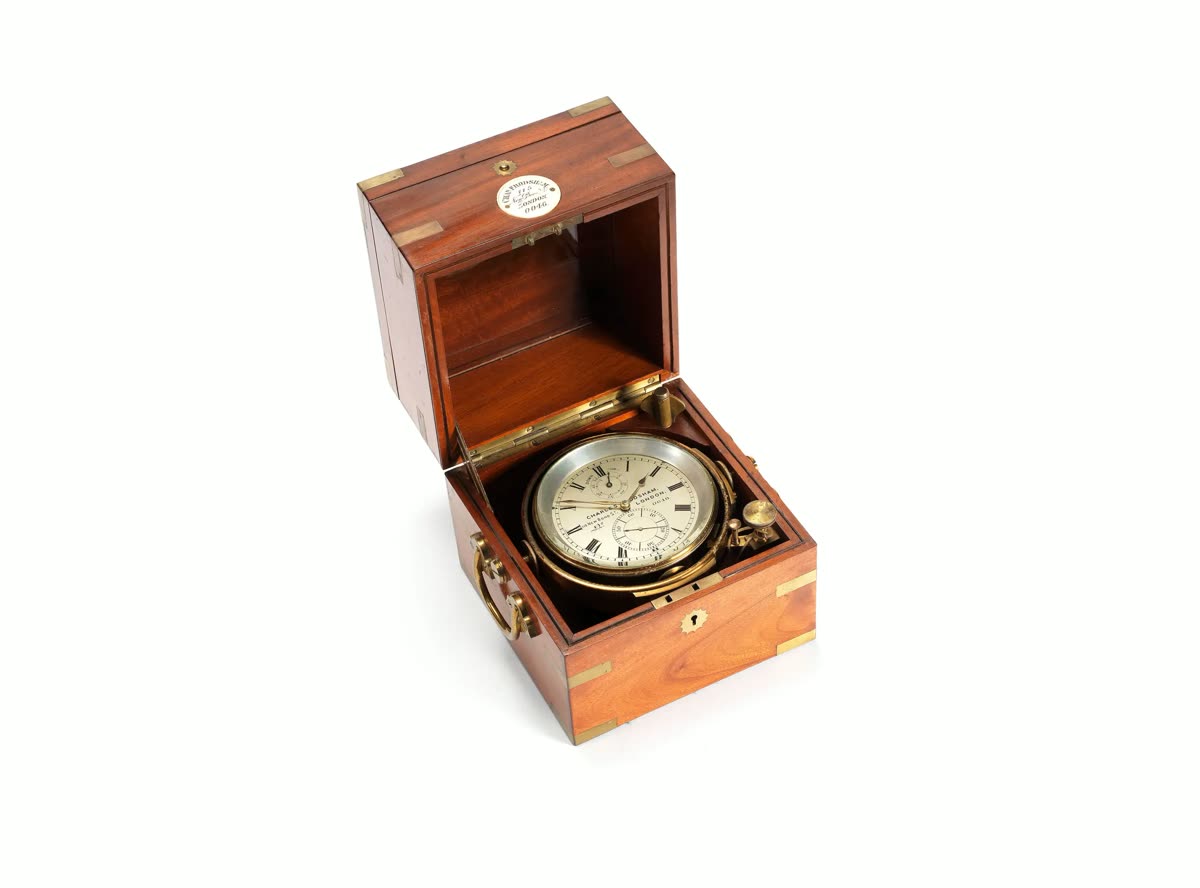
This late nineteenth-century marine chronometer is attributed by the source to Charles Frodsham, 15 New Bond Street, London, and marked No. 0040. The instrument features a four-inch silvered dial with Roman numerals, subsidiary seconds, and a wind indicator, suspended in gimbals within a three-part mahogany box. According to the source, the single-fusee movement runs for two days and incorporates spotted plates, an Earnshaw-type detent escapement, maintaining power, a blued helical spring, and a bimetallic balance featuring Victor Kullberg's auxiliary compensation.

Charles Frodsham two-day marine chronometer No. 0040 in open mahogany case
Charles Frodsham two-day marine chronometer No. 0040 in open mahogany case — Bonhams. Rights pending — permission not yet requested. Original source

Catalogue identity

Source
www.bonhams.com
Category
Marine chronometer · Two-day marine chronometer
Maker / attribution
Charles Frodsham
Reference
Not recorded
Catalogue / lot identifier
115
Source-reported date
late 19th century
Country
United Kingdom
Source-reported serial
0040

Source-reported attribution and specifications are not independent authentication. A listing does not establish present ownership, current display, availability or permission to reproduce.

Object description

Case and Mounting

The marine chronometer is housed within a three-part mahogany case described as being of characteristic form, measuring 19 cm (7.5 in) in height. Visible observations record exterior drop handles, corner fittings, and a key escutcheon in lacquered brass, with the chronometer itself mounted inside a brass gimbal assembly.

Mounted to the second cover is an inset circular plaque noted by the cataloguer as ivory, bearing maker and number markings. Auction notices classify the item under wildlife and CITES regulations due to this ivory content.

Evidence for this section
  • “three part mahogany case of characteristic form with signed and numbered inset ivory plaque to the second cover, with lacquered brass furniture”
  • “Height 19cm (7.5in)”
  • “Lacquered brass corner fittings, a key escutcheon, and exterior drop handles fitted to the wooden case.”
  • “Chronometer mounted in a brass gimbal assembly within a three-part mahogany case.”
  • “This lot contains or is made of ivory and cannot be imported into the USA or any country within the EU.”

Dial and Indications

The instrument features a 4-inch silvered dial that is signed and numbered. Hour indications are given by black Roman numerals.

Visible dial layout observations identify an upper subsidiary dial for the state-of-wind indicator and a lower subsidiary dial for continuous seconds.

Evidence for this section
  • “signed and numbered 4inch Roman silvered dial”
  • “Silvered dial displays black Roman hour numerals, an upper subsidiary state-of-wind dial, and a lower subsidiary seconds dial.”

Reported Movement and Mechanism

The mechanical specifications are documented from the auctioneer's cataloguing rather than external observation, as the movement sits inside the brass bowl. The mechanism is described as a two-day movement powered by a single fusee with spotted plates and maintaining power.

The escapement is catalogued as an Earnshaw-type detent paired with a blued helical spring. Temperature regulation is provided by a bimetallic balance featuring Victor Kullberg's later-type auxiliary compensation.

Evidence for this section
  • “two day marine chronometer with Kullberg type auxiliary compensation”
  • “the single fusee movement with spotted plates, Earnshaw type detent escapement, maintaining power, the bimetallic balance with Kullberg's later type auxiliary compensation and blued helical spring.”

Open research questions

  • What specific text and numbering sequence is engraved across the inset ivory plaque on the second cover?
  • Does movement plate numbering match the 'No. 0040' dial marking, and does this serial sequence align with Charles Frodsham's standard marine numbering records?

Source evidence

Recorded claims and source quotations for Charles Frodsham two-day marine chronometer No. 0040
FieldSource-reported valueSource quotation
Maker and LocationCharles Frodsham, 15 New Bond Street, London“Charles Frodsham, 15 New Bond Street, London, No.0040”
Movement DurationTwo day“two day marine chronometer”
Auxiliary CompensationKullberg type auxiliary compensation“bimetallic balance with Kullberg's later type auxiliary compensation”
EscapementEarnshaw type detent escapement“Earnshaw type detent escapement”
Case ConstructionThree part mahogany case with brass furniture“three part mahogany case of characteristic form with signed and numbered inset ivory plaque to the second cover, with lacquered brass furniture”
Dial Diameter4 inches“4inch Roman silvered dial”
Height19cm (7.5in)“Height 19cm (7.5in)”
Spring TypeBlued helical spring“blued helical spring”
Movement DriveSingle fusee with maintaining power“single fusee movement with spotted plates, Earnshaw type detent escapement, maintaining power”
Case Plaque MaterialIvory“signed and numbered inset ivory plaque to the second cover”

Visible details

  • Chronometer mounted in a brass gimbal assembly within a three-part mahogany case.
  • Silvered dial displays black Roman hour numerals, an upper subsidiary state-of-wind dial, and a lower subsidiary seconds dial.
  • Circular inset plaque, noted by the source as ivory, mounted on the inside face of the upper cover.
  • Lacquered brass corner fittings, a key escutcheon, and exterior drop handles fitted to the wooden case.

Research qualifications

  • Movement details, including the single fusee, spotted plates, Earnshaw escapement, and Kullberg balance, are obscured inside the brass bowl and rely on auction documentation.
  • The presence of an ivory plaque subjects the item to CITES trade restrictions and export bans.

Photograph identity and source facts were screened before import; rights clearance remains pending.

Terms in this record

Glossary explanations for terms named in this object’s record.