
Skip to content
The Encyclopedia of Horology

Pocket watch · Open-face pocket chronometer

Patek Philippe 18k pink gold pocket chronometer with cylindrical hairspring

Partially verified

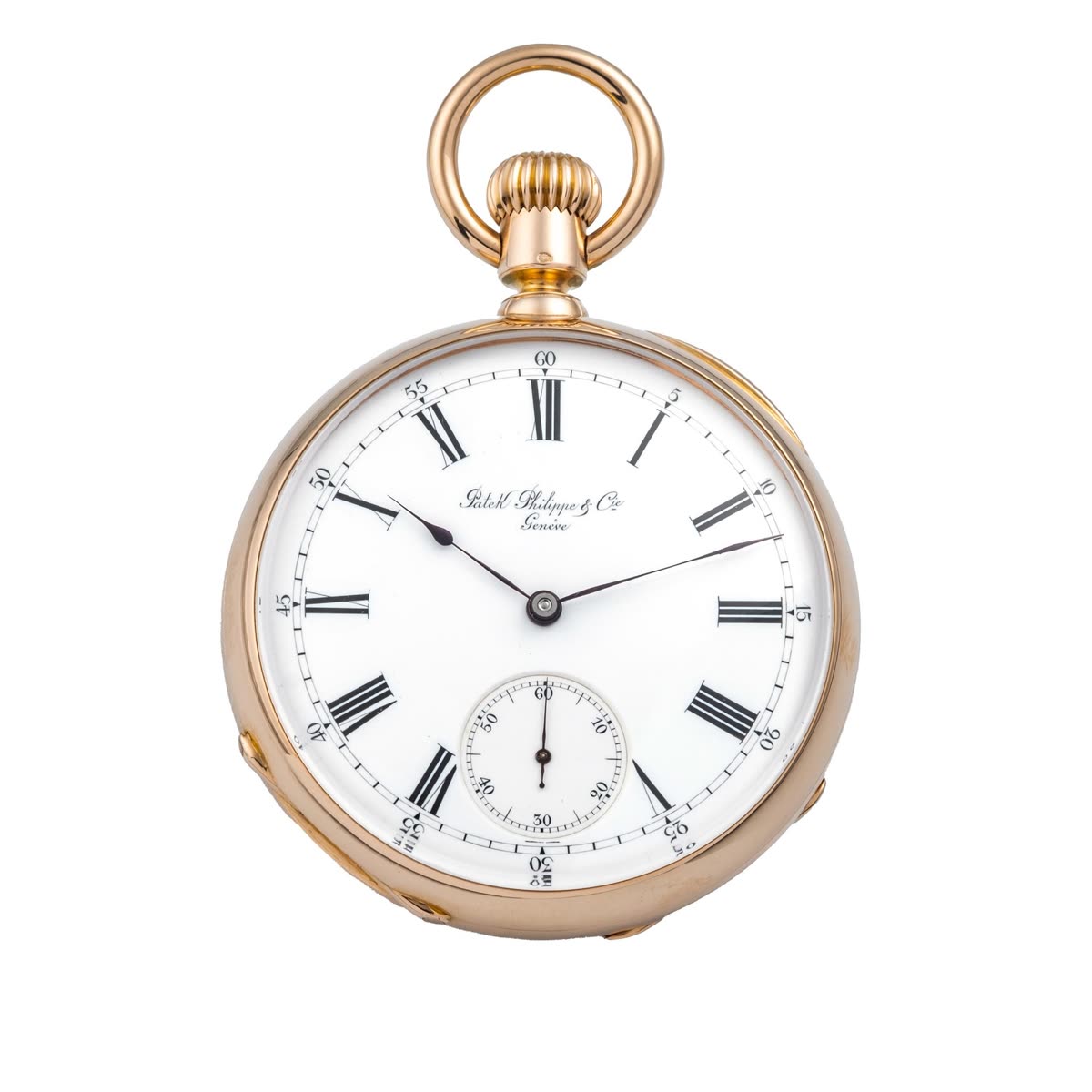
This open-face keyless-winding pocket chronometer in 18k pink gold is signed by Patek Philippe and dates to circa 1880. With a 53 mm diameter case, it features a white enamel dial with Roman numerals, an outer minute track with Arabic five-minute numerals, and a subsidiary seconds dial at 6 o'clock. According to the auction source, the 21''' gilded brass movement is based on an ébauche likely produced by Ambroise Duret of Geneva. It incorporates a going barrel, straight-line moustache lever escapement, compensated crank balance, and a blued steel free-sprung cylindrical hairspring with terminal curves.

Dial view of the Patek Philippe 18k pink gold pocket chronometer
Dial view of the Patek Philippe 18k pink gold pocket chronometer — Antiquorum. Rights pending — permission not yet requested. Original source

Catalogue identity

Source
catalog.antiquorum.swiss
Category
Pocket watch · Open-face pocket chronometer
Maker / attribution
Patek Philippe
Reference
Not recorded
Catalogue / lot identifier
274
Source-reported date
Circa 1880
Country
Switzerland
Source-reported serial
47756

Source-reported attribution and specifications are not independent authentication. A listing does not establish present ownership, current display, availability or permission to reproduce.

Object description

Dial and Case Presentation

The pocket chronometer features an open-face 18k pink gold case measuring 53 mm in diameter, with a fluted crown and hinged bow positioned at 12 o'clock. The white enamel dial is executed with suspended Roman numerals and blued steel spade hands.

A subsidiary seconds display is located at 6 o'clock with Arabic ten-second numerals and a blued steel hand. The dial is signed 'Patek Philippe & Cie Genève' below the 12 o'clock position.

Evidence for this section
  • “Diameter 53 mm.”
  • “White enamel dial with suspended Roman numerals; blued steel “Spade” hands.”
  • “White enamel dial signed 'Patek Philippe & Cie Genève' below the 12 o'clock marker.”
  • “Hinged gold bow and fluted crown at 12 o'clock on an open-face case.”
  • “Sub-seconds dial positioned above the 6 o'clock position with Arabic ten-second numerals.”

Movement Architecture and Regulating Organ

The movement is recorded by the catalog as a 21''' gilded brass caliber with a going barrel and gold screwed-chaton settings. The escapement is cataloged as a straight-line equilibrated lever escapement, noted in the description as 'a moustache'.

The regulating organ is described by the auction house as a compensated crank balance with offset arms, fitted with gold and platinum poising screws and a blued steel free-sprung cylindrical hairspring with terminal curves. Both the movement and case are listed with number 47756.

Evidence for this section
  • “Caliber 21’’’, (ebauche probably by Ambroise Duret, Geneva) gilded brass, with going barrel, gold screwed-chatons (setting), straight-line equilibrated lever escapement (a moustache), compensated crank (offset arms) balance with gold and platinum poising screws and blued steel free-sprung cylindrical hairspring with terminal curves.”
  • “Movement No. 47756”
  • “Case No. 47756”

Attribution and Archival Status

The auction catalog assigns the piece a date of circa 1880 and records signatures across the dial, case, and movement. The ébauche source is not definitively established in the record, which states 'ebauche probably by Ambroise Duret, Geneva'.

The catalog explicitly notes that an extract from the Patek Philippe archives is not available because the watch does not match their information, leaving manufacture documentation unresolved in the provided record.

Evidence for this section
  • “Year Circa 1880”
  • “Signature Dial, case and movement”
  • “(ebauche probably by Ambroise Duret, Geneva)”
  • “Please note that an extract from the archives is not available as not matching to their information”

Open research questions

  • What specific details or serial records caused Patek Philippe's archives to reject the issuance of an Extract from the Archives for number 47756?
  • What physical hallmarks, maker's marks, or ébauche stamps are present under the dial or on the movement plates to evaluate the attribution to Ambroise Duret?
  • What hallmarks and casemaker stamps are present inside the case back and cuvette to independently clarify the circa 1880 dating?

Source evidence

Recorded claims and source quotations for Patek Philippe 18k pink gold pocket chronometer with cylindrical hairspring
FieldSource-reported valueSource quotation
Case material18k pink gold“18k pink gold, manual wind open-face, keyless-winding”
Movement number47756“Movement No. 47756”
Case number47756“Case No. 47756”
Caliber size21'''“Caliber 21’’’”
Case diameter53 mm“Diameter 53 mm.”
EscapementStraight-line equilibrated lever escapement (a moustache)“straight-line equilibrated lever escapement (a moustache)”
Archive extract statusNot available due to non-matching manufacture information“Please note that an extract from the archives is not available as not matching to their information”

Visible details

  • White enamel dial signed 'Patek Philippe & Cie Genève' below the 12 o'clock marker.
  • Blued steel spade hour and minute hands paired with a blued steel sub-seconds hand.
  • Hinged gold bow and fluted crown at 12 o'clock on an open-face case.
  • Sub-seconds dial positioned above the 6 o'clock position with Arabic ten-second numerals.

Research qualifications

  • The auction catalog explicitly notes that an extract from the Patek Philippe archives is not available because the watch does not match their information.
  • The ébauche maker attribution to Ambroise Duret is described by the catalog as probable rather than confirmed.

Photograph identity and source facts were screened before import; rights clearance remains pending.