
Skip to content
The Encyclopedia of Horology

Wristwatch · Tourbillon wrist chronometer

Omega Observatory Tourbillon Wrist Chronometer

Partially verified

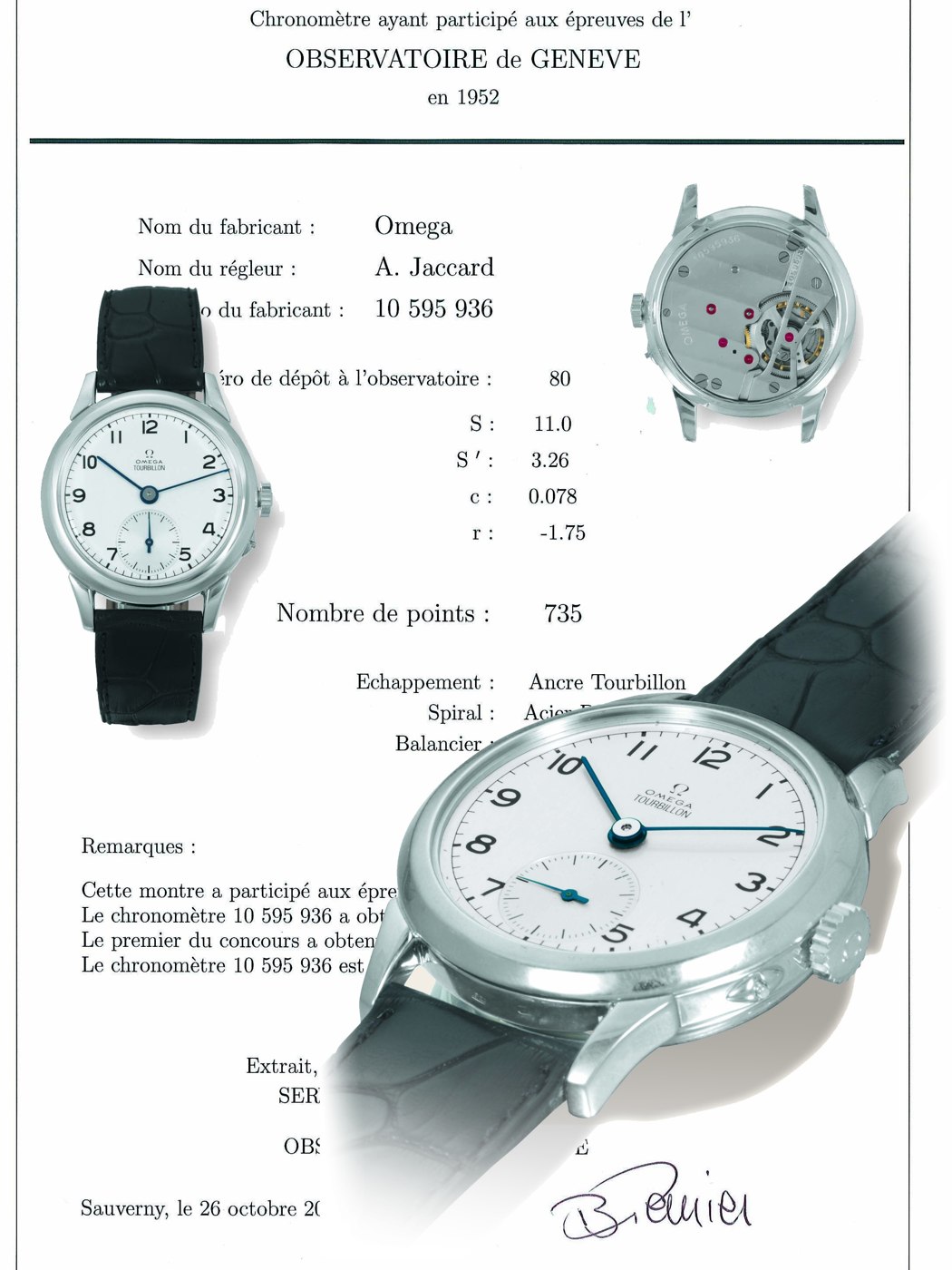
This Omega wrist chronometer, numbered 10595936, is built with a Caliber 30 I movement, which was one of 12 produced in 1947 for Geneva Observatory trials. The movement participated in the 1948 and 1952 observatory competitions, achieving scores of 806 and 735 points respectively. It is one of seven examples that were cased and sold commercially in 1987. The watch features a sterling silver, three-body polished case with a transparent back, lapidated bezel, and concave lugs. Hand-setting is controlled via a push-button located on the band at the 4 o'clock position. The matte silver dial displays black painted Dauphine numerals with outer minute divisions and a subsidiary seconds indicator, complemented by blued steel baton hands. Internally, the 2/3 plate movement includes 25 jewels, a 7.5-minute tourbillon regulator, and a Guillaume balance with a Breguet overcoil, beating at 18,000 vibrations per hour.

The Omega wrist chronometer displayed alongside its observatory trial documentation.
The Omega wrist chronometer displayed alongside its observatory trial documentation. — Antiquorum. Rights pending — permission not yet requested. Original source

Catalogue identity

Source
catalog.antiquorum.swiss
Category
Wristwatch · Tourbillon wrist chronometer
Maker / attribution
Omega
Reference
Not recorded
Catalogue / lot identifier
110
Source-reported date
1947
Source-reported place
Switzerland
Source-reported serial
10595936

Source-reported attribution and specifications are not independent authentication. A listing does not establish present ownership, current display, availability or permission to reproduce.

Object description

Case and Dial

The watch is housed in a solid, three-body sterling silver case featuring a polished finish. The design incorporates a lapidated bezel and concave lugs. A notable functional feature is the inclusion of a push-button positioned on the case band at 4 o'clock, which facilitates the setting of the hands.

The dial is finished in a matte silver tone and is styled with painted black Dauphine numerals. It includes a dedicated subsidiary seconds dial and outer minute track markers. The time is indicated by blued steel baton-style hands,

Evidence for this section
  • “C. Three-body, solid, polished, transparent back, lapidated bezel, concave lugs on the band at 4 o'clock a push-button for hand-setting.”
  • “D. Matte silver with painted black Dauphine numerals, outer minute divisions and subsidiary seconds dial. Blued steel ?baton? hands.”

Movement and Regulator

The internal mechanism is the Omega Caliber 30 I, a 2/3 plate movement constructed in 1947. It is equipped with 25 jewels and features a 7.5-minute tourbillon regulator. The two-part rhodium-plated brass cage is secured by three case screws.

The movement utilizes a Guillaume balance and a Breguet overcoil, operating at a frequency of 18,000 vibrations per hour. An index regulator is positioned on one of the cage arms to allow for adjustments to the timing performance.

Evidence for this section
  • “M. Cal. 30.I.1947, 2/3 plate, maillechort, 25 jewels, 7.5 minute "tourbillon" regulator”
  • “two-part rhodium plated brass cage held by three case-screws, Guillaume balance, Breguet overcoil, 18,000 vibration/hour, index regulator on one of the cage's arms”

Provenance and Trials

This movement is identified as the 4th of 12 examples manufactured by Omega's Geneva factory in 1947. These movements were specifically intended for testing in the Geneva Observatory trials. The records indicate this movement was submitted twice, scoring 806 points in 1948 and 735 points in 1952.

Although produced for trials, the movement remained uncased for several decades. It was eventually integrated into one of seven completed watches offered for commercial sale in 1987.

Evidence for this section
  • “The 4th of 12 movements made in 1947, then entered in the 1948 Geneva Observatory trials”
  • “One of seven movements cased and sold in 1987.”

Open research questions

  • What was the specific provenance of the seven cased movements prior to their 1987 release?
  • Are there technical variations between the 12 originally produced movements?

Source evidence

Recorded claims and source quotations for Omega Observatory Tourbillon Wrist Chronometer
FieldSource-reported valueSource quotation
Movement number10595936“No. 10595936”
Caliber30 I“Cal. 30 I”
Case materialSterling silver“sterling silver gentleman's wrist chronometer”
Escapement7.5 minute tourbillon“7 1/2 minute Tourbillon regulator”
Balance typeGuillaume balance“Guillaume balance”
Diameter36 mm“Diam. 36 mm.”
Production quantityOne of seven cased and sold in 1987“One of seven movements cased and sold in 1987.”

Visible details

  • Transparent case back revealing the movement
  • Push-button hand-setting mechanism at 4 o'clock
  • Matte silver dial with painted Dauphine numerals
  • Blued steel baton hands

Research qualifications

  • The source attributes the movement construction to 1947, but the commercial sale occurred later in 1987
  • Specific attribution of the 1987 casing process details remains limited

Photograph identity and source facts were screened before import; rights clearance remains pending.

Terms in this record

Glossary explanations for terms named in this object’s record.