
Skip to content
The Encyclopedia of Horology

Pocket watch · Minute-repeating chronograph

Longines Minute Repeating Chronograph

Partially verified

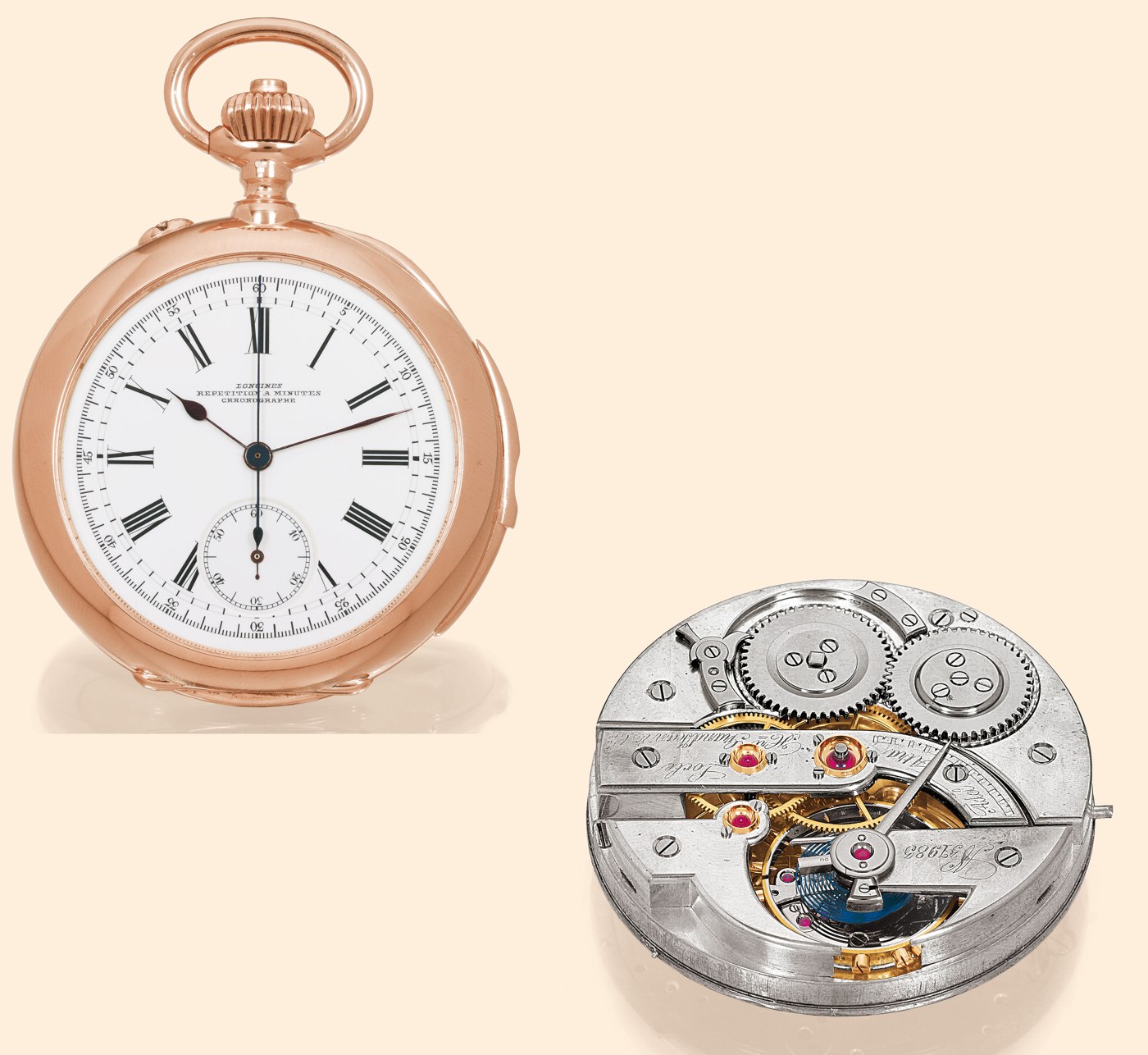
This Longines pocket watch, identified by serial number 31966 and dated circa 1905, is an 18K pink gold keyless minute-repeating chronograph. The watch features a polished "bassine" four-body case, with the inside back cover featuring an engraved dedication and the gold hinged cuvette displaying medals from the 1900 Grand Prix Paris. The white enamel dial is configured with radial Roman numerals, an outer minute track, and an extreme outer seconds track with Arabic five-second numerals and fifth-of-a-second divisions. It retains its original blued steel "Spade" hands. The movement is a 20 ligne rhodium-plated calibre with 27 jewels, incorporating a straight-line lever escapement, a cut bimetallic compensation balance with a blued steel Breguet balance spring, an index regulator, and a patented silent centrifugal governor for the minute repeater, which is operated by a slide in the case band.

The Longines Minute Repeating Chronograph (left) and its 20-ligne movement (right).
The Longines Minute Repeating Chronograph (left) and its 20-ligne movement (right). — Antiquorum. Rights pending — permission not yet requested. Original source

Catalogue identity

Source
catalog.antiquorum.swiss
Category
Pocket watch · Minute-repeating chronograph
Maker / attribution
Longines
Reference
Not recorded
Catalogue / lot identifier
370
Source-reported date
circa 1905
Source-reported place
Switzerland
Source-reported serial
31966

Source-reported attribution and specifications are not independent authentication. A listing does not establish present ownership, current display, availability or permission to reproduce.

Object description

Case and Dial Design

The watch is housed in an 18K pink gold, four-body case described as "bassine" style with a polished finish. The case features an engraved dedication on the interior of the back cover and a gold hinged cuvette that lists medals awarded at the Grand Prix Paris in 1900.

The dial is white enamel and utilizes radial Roman numerals for the hour markers. It is equipped with an outer minute track and an additional extreme outer track for the chronograph, which features fifth-of-a-second divisions and Arabic numerals at five-second intervals. Subsidiary seconds are present, and the time is read via original blued steel Spade-style hands.

Evidence for this section
  • “Four-body, "bassine", polished, the inside back cover with engraved dedication.”
  • “Gold hinged cuvette engraved with medals awarded at the Grand Prix Paris, 1900.”
  • “White enamel, radial Roman numerals, outer minute track, extreme outer seconds track with fifth of a second divisions and Arabic five second numerals, subsidiary seconds.”

Movement and Complications

The movement is a rhodium-plated 20 ligne calibre featuring 27 jewels. It is built with a straight-line lever escapement and includes a cut bimetallic compensation balance equipped with a blued steel Breguet-type balance spring. Regulation is achieved through an index regulator.

The watch serves as a chronograph and a minute repeater. The repeating mechanism operates on gongs activated by a slide located in the case band. This system incorporates a patented silent centrifugal governor to regulate the speed of the striking train.

Evidence for this section
  • “20???, rhodium plated, 27 jewels, straight line lever escapement, cut bimetallic compensation balance with blued steel Breguet balance spring, index regulator, repeating on gongs activated by a slide in the band, patented silent centrifugal governor.”

Provenance and Condition

The timepiece is attributed to the Hispanic market and dates to circa 1905. The auction description includes specific grading for the various components of the watch, noting the case as fair condition due to patination and the movement as good but slightly oxidized.

The auction house recommends that the movement undergo an overhaul. All provided descriptions regarding the condition are sourced directly from the auction house records.

Evidence for this section
  • “Made for the Hispanic market, circa 1905.”
  • “Case: 4-10 Fair Patinated”
  • “Movement: 3-6* Good Slightly oxidized Overhaul recommended, at buyer's expense”

Open research questions

  • What is the specific text of the engraved dedication inside the back cover?
  • Which specific medals from the 1900 Grand Prix Paris are listed on the cuvette?

Source evidence

Recorded claims and source quotations for Longines Minute Repeating Chronograph
FieldSource-reported valueSource quotation
MakerLongines“Longines”
Material18K pink gold“18K pink gold”
Serial Number31966“No. 31966”
Jewel Count27“27 jewels”
Case TypeFour-body bassine“Four-body, "bassine”
Datecirca 1905“circa 1905”

Visible details

  • The dial displays a subsidiary seconds register at the six o'clock position.
  • The movement is finished with rhodium plating.
  • The watch includes a repeating function activated by a slide mechanism in the case band.
  • The cuvette is engraved with details of awards from the Grand Prix Paris 1900.

Research qualifications

  • The exact text of the dedication inside the back cover is not transcribed in the source description.
  • The source notes that the movement is 'Slightly oxidized' and recommends an overhaul.

Photograph identity and source facts were screened before import; rights clearance remains pending.