
Skip to content
The Encyclopedia of Horology

Clock · Long case clock

Long case clock by Benjamin Gray and Just Vulliamy

Partially verified

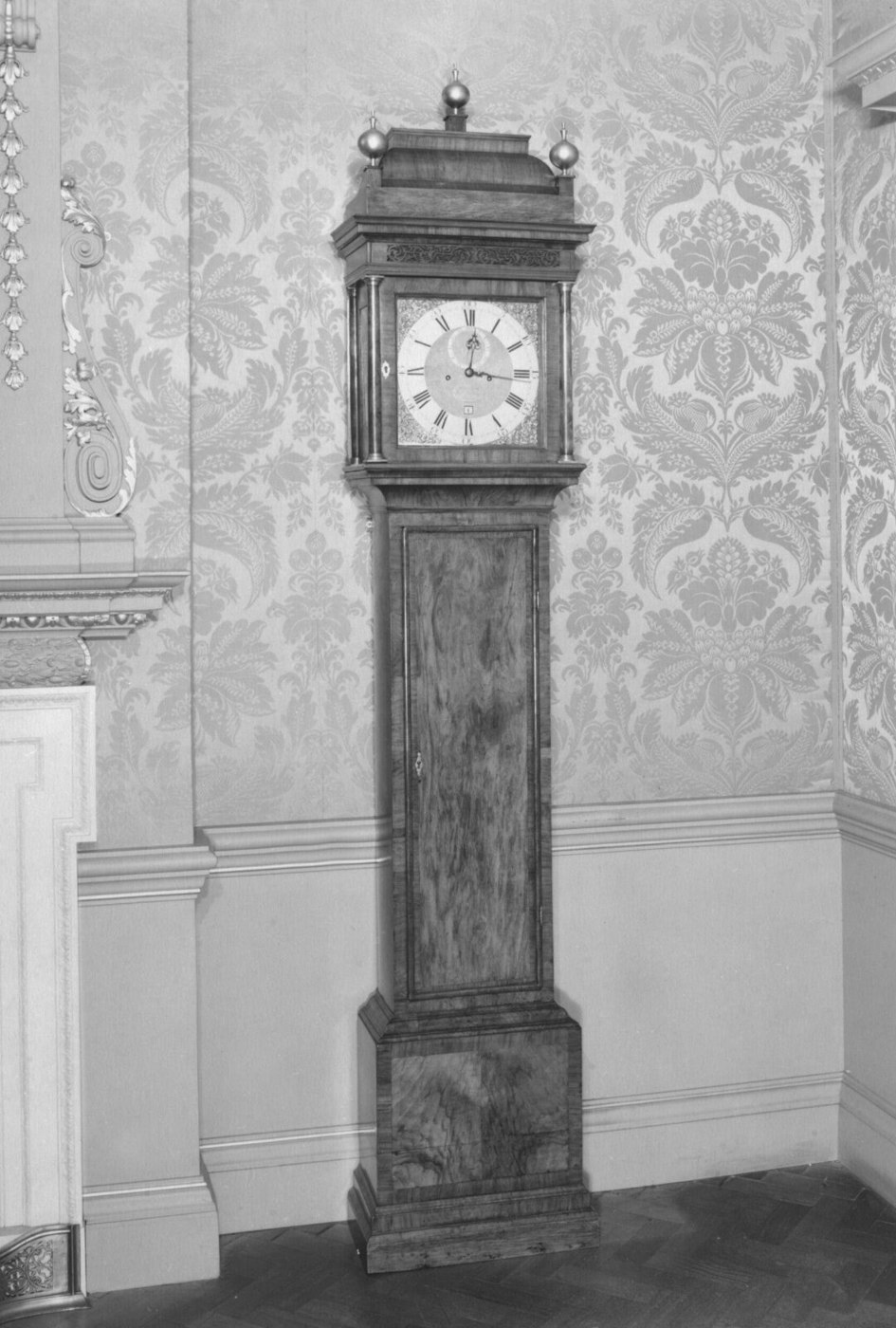
This long case clock, signed by Benjamin Gray and Just Vulliamy, dates to approximately 1730. Housed in a case of figured walnut, it features a sliding hood with a caddy top and gilded wood finials. The dial is brass, measuring 12 inches square with a matted center, a silvered brass chapter ring, and a subsidiary seconds ring. It includes a calendar aperture located below the engraved signature plaque. The movement is weight-driven and 8-day in duration, featuring an hour striking mechanism on a bell controlled by a snail and rack, and a recoil escapement. The clock displays various construction details such as a latched front plate, crossed-out cannon and minute wheels, and a pendulum with an engraved rating nut.

Front view of the long case clock showing the dial and walnut case.
Front view of the long case clock showing the dial and walnut case. — V&A Museum. Rights pending — permission not yet requested. Original source

Catalogue identity

Source
collections.vam.ac.uk
Category
Clock · Long case clock
Maker / attribution
Benjamin Gray and Just Vulliamy
Reference
Not recorded
Catalogue / lot identifier
W.65:1 to 6-1929
Source-reported date
c.1730
Source-reported place
London

Source-reported attribution and specifications are not independent authentication. A listing does not establish present ownership, current display, availability or permission to reproduce.

Object description

Case and Exterior Design

The clock is encased in figured walnut. It incorporates a rectangular trunk door adorned with convex molding at the edges, secured by internal decorative brass hinges. The hood is a sliding design topped with a caddy structure, flanked by two gilded wood finials on pedestals, with a third centered atop.

Below the hood, the case features concave molding. The base is rectangular and sits on a double plinth. The hood houses a hinged square glazed door with applied brass-capped columns in front, matching quarter columns to the rear, and glazed side apertures. A fretwork panel backed with textile sits at the front of the frieze.

Evidence for this section
  • “Figured walnut. Rectangular trunk door with convex moulding to edge”
  • “Sliding hood with caddy top flanked by gilded wood finials”
  • “Concave moulding below hood.”
  • “Front of frieze with textile backed frets.”

Dial and Hands

The 12-inch square brass dial features a matted center. A silvered brass chapter ring is pinned to the plate, displaying an engraved minute band with Arabic numerals at five-minute intervals and Roman numerals for hours. A subsidiary seconds ring, also of silvered brass, is positioned below the 'XII' mark.

A calendar aperture is present with beveled edges, situated below the central oval plaque engraved with the makers' names. Female head designs decorate the spandrels at the dial corners. The hands consist of pierced steel hour and minute hands, and a plain steel seconds hand.

Evidence for this section
  • “Brass, 12 inches square. Centre matted.”
  • “Pinned to the dial plate is the silvered brass chapter ring”
  • “subsidiary seconds ring of silvered brass”
  • “Female head in foliage spandrels each secured by a single screw to dial corners.”

Movement and Mechanism

The brass and steel movement is weight-driven and provides 8-day duration, utilizing a recoil escapement and pendulum regulation. It features five pillars with central knops, with four pinned to the front plate and the fifth, lower-centered pillar, being latched.

Striking is controlled via a snail and rack system, with the rack tail locked by a pallet. The train wheels are brass with four semicircular crossings. Additional features include a substantial backcock and steel barrel ratchet clicks with carved detailing and beveled edges. The pendulum bob is supported by an engraved, frustum-shaped rating nut.

Evidence for this section
  • “weight driven, hour striking of 8-day duration with recoil escapement”
  • “Five pillars each with a central knop”
  • “Hour striking on bell controlled by snail and rack”
  • “Brass-faced pendulum bob is supported on a frustum-shaped rating nut”

Open research questions

  • What is the specific significance of the third central finial in relation to the caddy top construction?
  • Are there archival documents that confirm the specific origin of the movement components for this piece?

Source evidence

Recorded claims and source quotations for Long case clock by Benjamin Gray and Just Vulliamy
FieldSource-reported valueSource quotation
MakerBenjamin Gray and Just Vulliamy“Benj: Gray and Just: Vulliamy, London”
Datec.1730“made in about 1730”
MaterialFigured walnut“Figured walnut”
Dial dimensions12 inches square“Brass, 12 inches square.”
Movement typeWeight driven, 8-day duration“weight driven, hour striking of 8-day duration”
Accession numberW.65:1 to 6-1929“W.65:1 to 6-1929”

Visible details

  • Case features a rectangular trunk door with convex molding.
  • Dial includes a silvered brass chapter ring with Roman hour numerals.
  • Movement includes five pillars with central knops.
  • Pendulum bob is supported on a frustum-shaped rating nut.

Research qualifications

  • The minute hand is assumed to be a replacement.
  • Precise dating of the clock is considered difficult due to the longevity of this design style.

Photograph identity and source facts were screened before import; rights clearance remains pending.

Consulted source

Clock, long case, Benjamin Gray and Just Vulliamy, London, 1730

Reviewed 2026-11-02 · Record b74c010504

Terms in this record

Glossary explanations for terms named in this object’s record.