
Skip to content
The Encyclopedia of Horology

Clock · Long case clock

Henry Buxton Long Case Clock

Partially verified

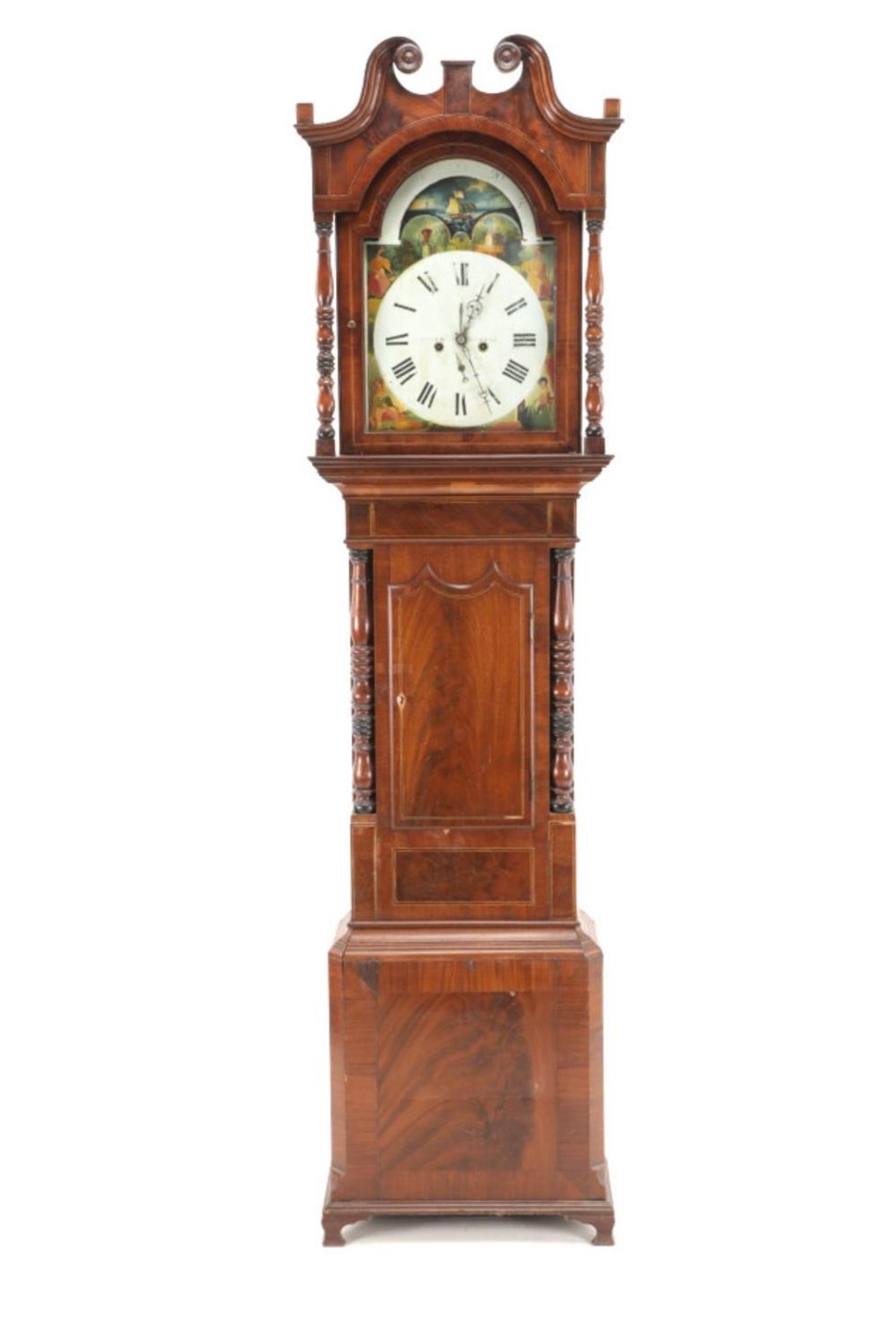
This long case clock is attributed to Henry Buxton, a maker who worked in Wolverhampton, England, between 1748 and 1775. The mahogany case features carved block and vase style turnings and is topped by a bonnet. The clock face is painted with a white background, black Roman numerals, and figurative elements including four women located in the corners, a farmhouse, and a vase. A rotating ocean scene, purportedly painted on a segment of a saw blade, occupies the top of the dial. According to the provided description, the movement is marked on the back with the inscription "Buxton Wolverhampton Year 1752," while the dial bears the signature "Power Buxton." The clock measures approximately 87 1/2 inches in height. It has not been tested for functional operation and exhibits signs of age-related wear, though no significant structural damage is reported.

Full view of the mahogany long case clock showing the bonnet, dial, and trunk.
Full view of the mahogany long case clock showing the bonnet, dial, and trunk. — North American Auction Company (via Invaluable). Rights pending — permission not yet requested. Original source

Catalogue identity

Source
www.invaluable.com
Category
Clock · Long case clock
Maker / attribution
Henry Buxton
Reference
Not recorded
Catalogue / lot identifier
412
Source-reported date
1752
Source-reported place
England

Source-reported attribution and specifications are not independent authentication. A listing does not establish present ownership, current display, availability or permission to reproduce.

Object description

Case Construction and Exterior

The clock is housed in a mahogany case characterized by decorative turnings. The sides of the case incorporate carved block and vase style elements, providing ornamental detail to the upright structure. The top of the case features a bonnet-style design, a common architectural choice for clocks of this configuration.

The exterior appearance shows traces of age and long-term use. The dimensions are recorded as 9 9/16 inches in length, 23 1/16 inches in width, and 87 1/2 inches in height.

Evidence for this section
  • “The clock shows a mahogany construction with intricately carved block and vase style turnings on the sides of the case.”
  • “The top of the clock shows a beautiful bonnet top”
  • “The clock measures 9 9/16" L x 23 1/16" W x 87 1/2" H.”

Dial and Rotating Ornament

The clock face is a painted surface featuring a white background with black Roman numerals. The artistic decoration includes four women situated in the corners, a farmhouse on the top right, and a vase on the top left. The top portion of the dial contains a rotating ocean scene.

The auction description notes an observation regarding the construction of the rotating element, stating that it appears to have been painted on a salvaged piece of a saw blade. The dial itself bears the name "Power Buxton," which differs from the maker's name "Henry Buxton" noted in the movement inscription.

Evidence for this section
  • “The face of the clock reads, "Power Buxton".”
  • “The very top of the clock face is painted with an ocean scene and rotates as the clock ticks.”
  • “Appears that moon face is a saw blade.”

Movement and Attribution

The clock is attributed to Henry Buxton of Wolverhampton, who is noted as active in that location from 1748 until 1775. The movement itself carries a specific marking on the back, which confirms the location and the year of manufacture.

The identification relies on the inscription found on the movement, which links the object to the specified maker and year.

Evidence for this section
  • “Henry Buxton was born in Wolverhampton and operated there from 1748 to 1775.”
  • “The back of the movement is marked, "Buxton Wolverhampton Year 1752".”
  • “The clock has not been tested for functionality.”

Open research questions

  • What is the relationship between the name 'Power Buxton' on the dial and the maker 'Henry Buxton'?
  • Can the use of a saw blade for the moon-phase disk be verified as a period-appropriate technique or a later modification?

Source evidence

Recorded claims and source quotations for Henry Buxton Long Case Clock
FieldSource-reported valueSource quotation
MakerHenry Buxton“made by Henry Buxton in Wolverhampton, England”
Date1752“1752 Henry Buxton English Long Case Clock”
Movement InscriptionBuxton Wolverhampton Year 1752“The back of the movement is marked, "Buxton Wolverhampton Year 1752”
Dial InscriptionPower Buxton“The face of the clock reads, "Power Buxton”
Dimensions87 1/2 inches height“87 1/2" H”
Case MaterialMahogany“The clock shows a mahogany construction”
ConditionWear from age“Overall the clock shows good condition with wear from its age and use over the many years”

Visible details

  • The clock face features a painted scene with four female figures
  • The case includes turned decorative elements on the side pillars
  • The bonnet top houses a rotating dial component
  • The dial displays Roman numerals for the hour track

Research qualifications

  • The exact identity of the signature "Power Buxton" versus "Henry Buxton" is not resolved by the provided text
  • The description speculates that the moon-phase disk is fashioned from a repurposed saw blade

Photograph identity and source facts were screened before import; rights clearance remains pending.

Consulted source

1752 Henry Buxton English Long Case Clock

Reviewed 2026-10-26 · Record 077ae2493a

Terms in this record

Glossary explanations for terms named in this object’s record.

Other long case clock records