
Skip to content
The Encyclopedia of Horology

Clock · Long case clock

Louis XV Long Case Clock by Antoine Thiout

Partially verified

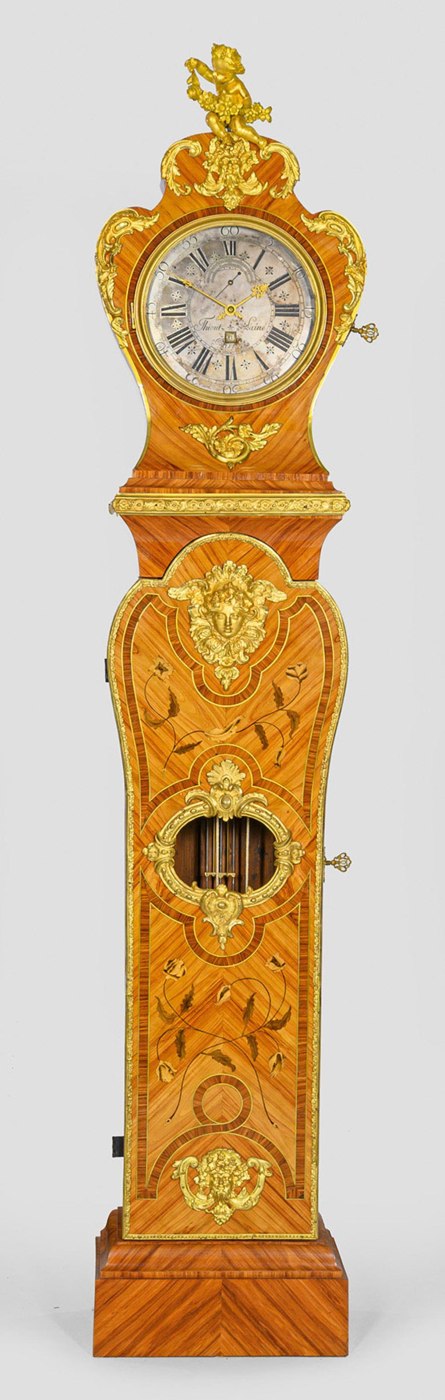
This French long case clock is attributed to Antoine Thiout (1694-1761), a clockmaker who was active in Paris and served as horologist to the Duke of Orleans. The case is constructed from rosewood veneer featuring marquetry of varied exotic woods and mounted with gilded bronze applications. The clock stands on a profile-edged base, supporting a baluster-shaped body with a single door containing a pendulum window. The upper section houses the dial and is topped by a figural putto finial. The dial includes indications for the date and a double 30-second sector for seconds, bearing the signature "Thiout L'ainé, Paris." The mechanical movement is configured to strike on the half-hour using a bell. The auction description reports that the object has undergone restoration and includes later additions. The provenance is documented as the liquidation of a private collection.

Front view of the Louis XV long case clock by Antoine Thiout, showing the rosewood veneer, marquetry, and bronze mounts.
Front view of the Louis XV long case clock by Antoine Thiout, showing the rosewood veneer, marquetry, and bronze mounts. — Kunstauktionshaus Schloss Ahlden (via Invaluable). Rights pending — permission not yet requested. Original source

Catalogue identity

Source
www.invaluable.com
Category
Clock · Long case clock
Maker / attribution
Antoine Thiout
Reference
Not recorded
Catalogue / lot identifier
1535
Source-reported date
18th century
Source-reported place
France

Source-reported attribution and specifications are not independent authentication. A listing does not establish present ownership, current display, availability or permission to reproduce.

Object description

Case and Aesthetic Features

The clock is housed in a rosewood-veneered case that follows the aesthetic conventions of the Louis XV period. It is designed with a baluster-shaped body resting upon a profile-edged base, incorporating marquetry work produced from a selection of exotic woods. The case features gilded bronze decorative elements, including a cast figure of a putto that serves as a finial for the hood.

The central portion of the clock body is fitted with a single door, which contains an integrated window providing a view of the pendulum. This frame and the surrounding marquetry serve as the primary decorative surface for the trunk of the clock.

Evidence for this section
  • “Rosenholz, furniert sowie Einlagen aus unterschiedlichen Edelhölzern und Applikationen aus vergoldeter Bronze.”
  • “Über gekantetem Profilsockel balusterförmiger, eintüriger Korpus mit profilgerahmtem Pendelfenster.”
  • “Korrespondierender Uhrenkopf mit plastischer Puttenbekrönung”

Movement and Dial Details

The dial is protected by glazing and is designed with specific timekeeping and auxiliary indicators. It includes a display for the date and a seconds hand, the latter utilizing a double 30-second sector. The dial bears the signature "Thiout L'ainé, Paris," identifying the maker who was active as a master in Paris from 1724.

The clock operates via a mechanical movement capable of striking the hour and the half-hour. The strike mechanism utilizes a bell mounted within the upper housing. Rear access to the movement confirms its current configuration and mounting within the wooden case structure.

Evidence for this section
  • “verglastem Zifferblatt mit Datumsanzeige sowie Sekundenanzeige mit einem doppelten 30-Sekunden-Sektor, bez. Thiout L'ainé, Paris.”
  • “Mechanisches Werk mit Halbstundenschlag auf Glocke.”

Maker and Provenance

Antoine Thiout, specifically referred to as Thiout l'ainé (the Elder) to distinguish his work from his sons, was a recognized horologist of the mid-18th century. He was appointed clockmaker to the Duke of Orleans in 1751.

The auction house reports that the object has undergone restoration and incorporates later additions.

Evidence for this section
  • “Der hauptsächlich für seine Großuhren bekannte Antoine Thiout (1694-1761) wurde 1724 Meister in Paris und 1751 Hofuhrmacher des Herzogs von Orleans.”
  • “Provenienz: Auflösung einer bedeutenden deutschen Privatsammlung - Teil III.”
  • “Rest. mit Erg.”

Open research questions

  • Which specific components of the movement or case are considered 'later additions'?
  • Can the specific marquetry patterns be attributed to a known workshop or decorative style beyond the generalLouis XV attribution?

Source evidence

Recorded claims and source quotations for Louis XV Long Case Clock by Antoine Thiout
FieldSource-reported valueSource quotation
MakerAntoine Thiout (1694-1761)“Antoine Thiout (1694-1761)”
SignatureThiout L'ainé, Paris“bez. Thiout L'ainé, Paris.”
MaterialsRosewood veneer, exotic woods, gilded bronze“Rosenholz, furniert sowie Einlagen aus unterschiedlichen Edelhölzern und Applikationen aus vergoldeter Bronze.”
DimensionsHeight 208 cm“H. 208 cm.”
StrikingHalf-hour strike on a bell“Mechanisches Werk mit Halbstundenschlag auf Glocke.”
ConditionRestored with later additions“Rest. mit Erg.”
Dating18th century“18. Jh.”

Visible details

  • Gilded bronze putto finial at the apex of the hood
  • Pendulum window framed by decorative bronze and inlay
  • Dial signed "Thiout L'ainé, Paris" with date aperture
  • Movement mechanism with bell strike visible from the rear

Research qualifications

  • The auction house reports the clock has been restored with later additions
  • The extent of the later additions is not specified

Photograph identity and source facts were screened before import; rights clearance remains pending.

Consulted source

Höfische Louis XV-Bodenstanduhr von Antoine Thiout

Reviewed 2026-10-26 · Record eff88f3c48

Terms in this record

Glossary explanations for terms named in this object’s record.

Other long case clock records