
Skip to content
The Encyclopedia of Horology

Pocket watch · Split-seconds pocket chronometer

L. Leroy & Cie Oversized Pocket Chronometer No. 18902

Partially verified

This L. Leroy & Cie pocket chronometer, movement number 18902, is an oversized, keyless-winding scientific instrument featuring a split-seconds chronograph and an instantaneous 30-minute counter. Constructed with a 66.3 mm silver open-face case, the watch contains a 21-ligne gilded brass movement with a straight-line lever escapement and a bimetallic compensated Guillaume balance with gold poising screws. The watch was adjusted by Albert Dessay and holds a First Class Bulletin de marche from the Astronomical Observatory of Besançon for the 1939 competition in the category A, "Chronométrie Epreuves Sportives." It was delivered in 1941 to the Institute of Meteorology and Physics of the Globe of Algeria, serving as a tool for seismic and geophysical study. The watch is presented with a copy of its Observatory bulletin, a maker's archive extract, and a custom wooden box.

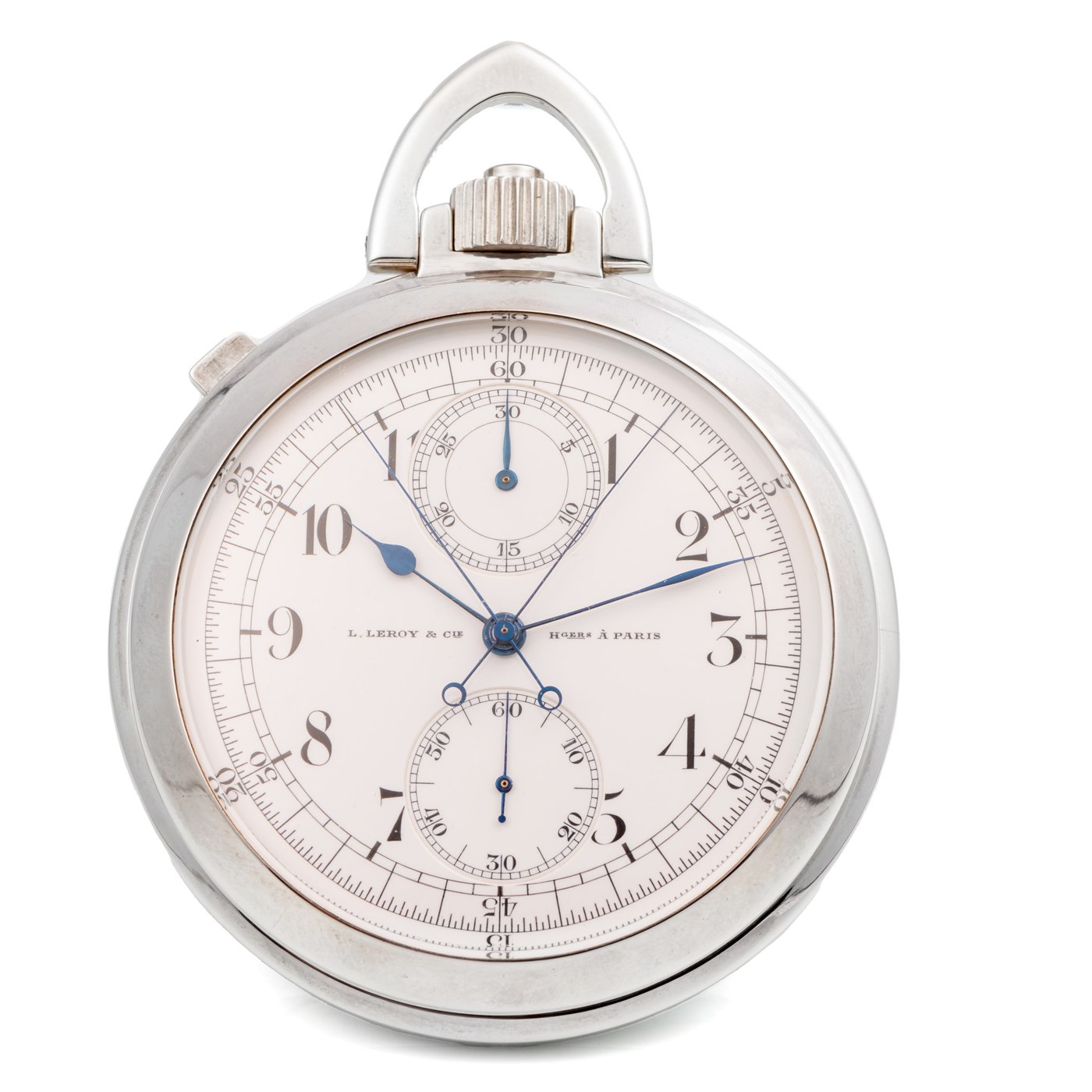
Front view of the L. Leroy & Cie oversized pocket chronometer showing the enamel dial with split-seconds and 30-minute counter registers.
Front view of the L. Leroy & Cie oversized pocket chronometer showing the enamel dial with split-seconds and 30-minute counter registers. — Antiquorum. Rights pending — permission not yet requested. Original source

Catalogue identity

Source
catalog.antiquorum.swiss
Category
Pocket watch · Split-seconds pocket chronometer
Maker / attribution
L. Leroy & Cie
Reference
Not recorded
Catalogue / lot identifier
355-260
Source-reported date
1939
Source-reported place
France
Source-reported serial
18902

Source-reported attribution and specifications are not independent authentication. A listing does not establish present ownership, current display, availability or permission to reproduce.

Object description

Case and Dial

The timepiece is housed in a 66.3 mm silver open-face case. The dial is white enamel and displays suspended Arabic numerals with blued steel "Spade" hands. A 30-minute register is positioned at the 12 o'clock marker, while constant seconds are tracked in a subsidiary dial at the 6 o'clock position.

A round-shaped push-piece for the chronograph function is integrated into the winding crown. A secondary, rectangular-shaped push-piece on the case band at the 10:30 position controls the split-seconds function. The watch includes a snap-on case back and an engraved cuvette featuring the movement's technical specifications.

Evidence for this section
  • “Silver, open-face, keyless-winding, round-shaped, oversized pocket chronometer especially made for scientific purposes”
  • “1/10 second chronograph (activated by the single round-shaped push-piece located on the winding-crown) · Split-seconds (activated by the rectangular-shaped push-piece located on the case-band at 10:30)”

Movement and Chronometry

The 21-ligne gilded brass movement is fitted with a straight-line lever escapement and a Guillaume balance, which uses anibal and brass to minimize middle-temperature error. The balance incorporates gold poising screws and a blued steel hairspring with a terminal curve.

The movement was adjusted by the precision timer Albert Dessay of Besançon. The caliber includes a chronograph mechanism on the top plate and split-seconds work located under the dial. It bears the "viper's head" stamp from the Besançon Observatory, signifying it received a First Class Bulletin de marche in the 1939 "Chronométrie Epreuves Sportives" competition.

Evidence for this section
  • “21’’’ movement, gilded brass, going barrel, straight-line lever escapement, cut bimetallic compensated Guillaume balance”
  • “adjusted by the precision timer “régleur” Albert Dessay (1904-2003), Besançon”
  • ““viper’s head” stamp of the Besançon Observatory for a First Class Bulletin de marche.”

Provenance and Documentation

The watch was delivered to the Institute of Meteorology and Physics of the Globe of Algeria on December 18, 1941, for a sum of 10,000 francs. It functioned as a scientific instrument for seismology and geomagnetism research.

The provenance documentation includes a copy of the Bulletin from the Astronomical Observatory of Besançon and an L. Leroy archive extract. The piece also comes with a custom wooden storage box.

Evidence for this section
  • “delivered on December 18, 1941, to the Institute of Meteorology and Physics of the Globe of Algeria”
  • “This timepiece therefore served as a scientific instrument for the meteorologists and calculators of this institution.”
  • “Accessories copy of the Bulletin of the Astronomical Observatory of Besançon, L. Leroy extract from the archive confirming a Gold medal, custom made wooden box”

Open research questions

  • What is the specific nature of the 1940s scientific experiments conducted with this watch at the IMPGA?
  • Does archival evidence clarify the exact Vallée de Joux workshop that provided the ebauche for this movement?

Source evidence

Recorded claims and source quotations for L. Leroy & Cie Oversized Pocket Chronometer No. 18902
FieldSource-reported valueSource quotation
MakerL. Leroy & Cie“L. Leroy & Cie”
Movement Number18902“Movement No. 18 902”
Case Number27205“Case No. 27205”
Complications1/10 second chronograph, split-seconds, 30-minute counter“1/10 second chronograph (activated by the single round-shaped push-piece located on the winding-crown) · Split-seconds (activated by the rectangular-shaped push-piece located on the case-band at 10:30) · Instantaneous 30-minute counter (subsidiary dial at 12 o’clock)”
Movement Type21 ligne gilded brass“21’’’ movement, gilded brass”
BalanceGuillaume balance“cut bimetallic compensated Guillaume balance with gold poising screws”
Date of deliveryDecember 18, 1941“The watch was delivered on December 18, 1941, to the Institute of Meteorology and Physics of the Globe of Algeria”
AdjustmentAlbert Dessay“adjusted by the precision timer “régleur” Albert Dessay (1904-2003), Besançon”

Visible details

  • Case diameter is 66.3 mm.
  • Dial features a subsidiary 30-minute counter at 12 o'clock.
  • Split-seconds pusher is located on the case band at 10:30.
  • Movement features a viper's head observatory stamp.

Research qualifications

  • The exact origin of the ebauche is unconfirmed, though attributed to the Vallée de Joux.
  • The extent of current functionality for the high-frequency complication remains unverified.

Photograph identity and source facts were screened before import; rights clearance remains pending.

Terms in this record

Glossary explanations for terms named in this object’s record.

Other split-seconds pocket chronometer records