
Skip to content
The Encyclopedia of Horology

Pocket watch · Split-seconds pocket chronometer

L. Leroy & Cie. 18K Gold Split-Seconds Pocket Chronometer

Partially verified

This L. Leroy & Cie. pocket chronometer, identified by serial number 1477, dates to circa 1914. The timepiece was produced for the retailer E. Lamarque, located at Florida 335, Buenos Aires. Constructed in 18K gold, the watch features a three-body "Empire" case with a polished finish and a hinged gold cuvette. It is equipped with a split-seconds chronograph and an instantaneous 60-minute recorder. The movement is a 18-ligne caliber in gilt brass, containing 23 jewels and a straight-line lever escapement with a Guillaume balance and a blued-steel balance spring. An Observatory of Besancon mark in the form of a viper's head is present. The watch was accompanied by a Bulletin de Premiere Classe from the Observatoire National de Besancon, dated 1914, which recorded a total of 169.5 marks. The dial bears the signature of L. Leroy & Cie.

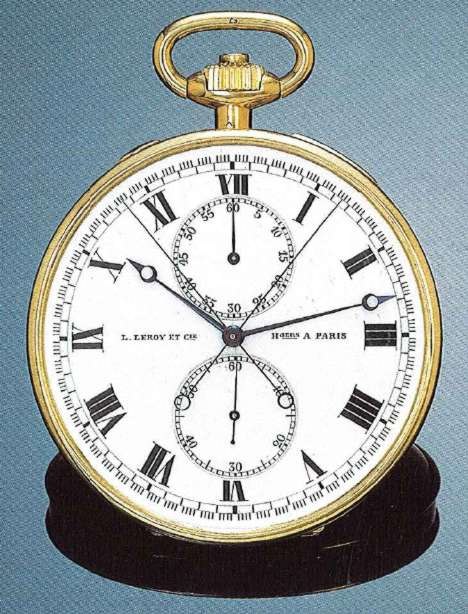
Front view of the L. Leroy & Cie. split-seconds chronometer showing the white enamel dial and subsidiary registers.
Front view of the L. Leroy & Cie. split-seconds chronometer showing the white enamel dial and subsidiary registers. — Antiquorum. Rights pending — permission not yet requested. Original source

Catalogue identity

Source
catalog.antiquorum.swiss
Category
Pocket watch · Split-seconds pocket chronometer
Maker / attribution
L. Leroy & Cie.
Reference
Not recorded
Catalogue / lot identifier
274
Source-reported date
circa 1914
Source-reported place
France
Source-reported serial
1477

Source-reported attribution and specifications are not independent authentication. A listing does not establish present ownership, current display, availability or permission to reproduce.

Object description

Case and Dial

The timepiece is housed in a three-body, polished 18K gold "Empire" case. It features a hinged gold cuvette, which is signed by the maker.

The white enamel dial displays Roman numerals for the hours and includes outer minute and chronograph timing tracks. The layout is completed by sunken subsidiary dials for the seconds and the 60-minute register. The indications are provided by blued-steel Breguet hands.

Evidence for this section
  • “C. Three body, massive, "Empire " , polished.”
  • “Hinged gold cuvette.”
  • “D. White enamel with Roman numerals, outer minutes and chronograph rings, sunk subsidiary seconds and minutes register.”
  • “Blued-steel Breguet hands.”

Movement and Escapement

The movement is an 18-ligne caliber constructed in gilt brass. It features a straight-line lever escapement and a Guillaume balance made of brass and invar. The blued-steel balance spring is regulated with a terminal curve, credited to the work of Quelos.

The functionality includes a split-seconds chronograph system with visible work, operated by a crown-mounted button and a band-mounted push-piece. An additional push-piece is set into the band to pause and release the balance for precise time setting.

Evidence for this section
  • “M. 18 "' , gilt brass with punch-mark in form of a viper's head set by the Observatory of Besancon, 23 jewels”
  • “straight line lever escapement, brass-invar Guillaume balance”
  • “Splitseconds chronograph with visible work, the button on the winding-crown and push piece in the band.”
  • “A small push piece, sunk in the band, enables to stop the balance and to release it, in order to set the time with precision.”

Provenance and Marks

The watch was commissioned for the retailer E. Lamarque, located on Florida Street in Buenos Aires. It successfully underwent testing at the Observatoire National de Besancon, where it received a Bulletin de Premiere Classe certificate in 1914, achieving a score of 169.5 marks.

The movement exhibits the official Besancon mark in the shape of a viper's head. Signed on both the dial and the internal cuvette, the object is documented as having been manufactured by L. Leroy & Cie.

Evidence for this section
  • “for E. Lamarque, Florida 335, Buenos-Aires.”
  • “Bulletin de Premiere Classe de l'Observatoire National de Besancon, No. 10736, in 1914”
  • “punch-mark in form of a viper's head set by the Observatory of Besancon”
  • “Signed on the dial and cuvette.”

Open research questions

  • What specific horological context does the term 'Vieux style' refer to regarding Leroy production?
  • What are the specific details regarding the adjustments credited to Quelos mentioned in the movement description?

Source evidence

Recorded claims and source quotations for L. Leroy & Cie. 18K Gold Split-Seconds Pocket Chronometer
FieldSource-reported valueSource quotation
MakerL. Leroy & Cie.“L. Leroy & Cie., Horlogers de la Marine, Paris”
Serial Number1477“No. 1477”
Case material18K gold“18K gold”
Movement size18 lignes“M. 18 "'”
Observatory CertificationBulletin de Premiere Classe, Besancon, 1914“Bulletin de Premiere Classe de l'Observatoire National de Besancon, No. 10736, in 1914, with a total 169,5 marks.”
Balance typeGuillaume balance“brass-invar Guillaume balance”
RetailerE. Lamarque, Buenos-Aires“for E. Lamarque, Florida 335, Buenos-Aires.”

Visible details

  • White enamel dial with Roman numerals
  • Blued-steel Breguet hands
  • Crown-mounted chronograph button with side push-piece
  • Sunken subsidiary seconds and minutes register

Research qualifications

  • The auction house notes a recommendation for an overhaul
  • The dial is reported to have partial repainting

Photograph identity and source facts were screened before import; rights clearance remains pending.

Terms in this record

Glossary explanations for terms named in this object’s record.

Other split-seconds pocket chronometer records