
Skip to content
The Encyclopedia of Horology

Marine chronometer · Boxed marine chronometer

John Arnold & Son No. 326 Marine Chronometer

Partially verified

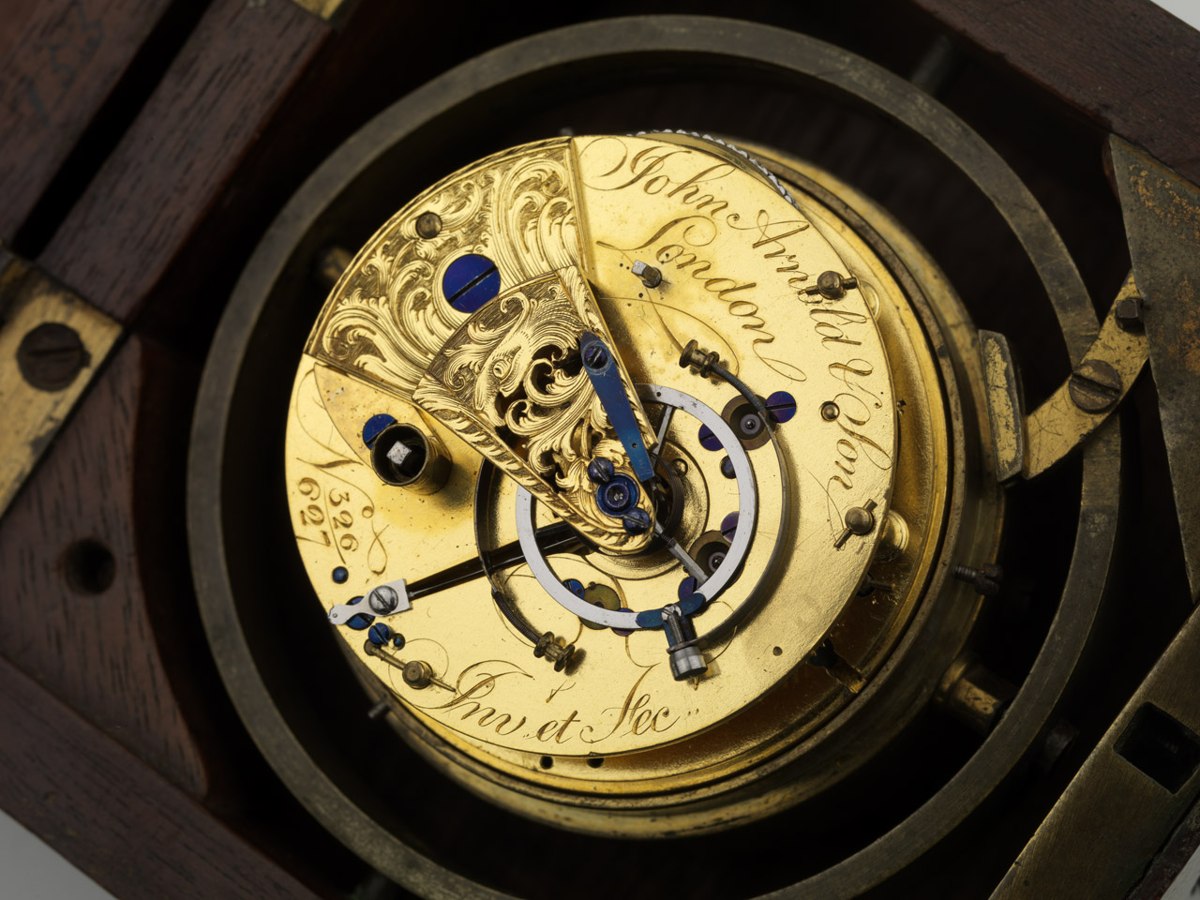
This one-day marine chronometer by John Arnold & Son originated as a pocket chronometer movement before being fitted into a gimballed three-tier mahogany box around 1810. The full-plate gilt brass fusee movement features four pillars, Harrison's maintaining power, an Arnold-type spring detent escapement, and an Arnold OZ-type balance with bimetallic segments and a blued steel helical balance spring. The potence plate is engraved with the maker's signature along with serial and production numbers.

Top view of the gilt brass fusee movement and Arnold balance inside its gimballed brass bowl
Top view of the gilt brass fusee movement and Arnold balance inside its gimballed brass bowl — National Maritime Museum, Greenwich, London, Rev. George Fisher Collection. Rights pending — permission not yet requested. Original source

Catalogue identity

Source
www.rmg.co.uk
Category
Marine chronometer · Boxed marine chronometer
Maker / attribution
John Arnold & Son
Reference
ZAA0067
Catalogue / lot identifier
Source URL identifies the listing
Source-reported date
circa 1788-1810
Country
United Kingdom
Source-reported serial
326/627

Source-reported attribution and specifications are not independent authentication. A listing does not establish present ownership, current display, availability or permission to reproduce.

Object description

Conversion and Provenance

The object originated as a pocket chronometer movement, which was later removed from its original metal casing and fitted into the current gimballed mahogany box around 1810. The box is constructed of mahogany with dovetailed corners and includes ink markings, including one referencing the Reverend G. Fisher.

Internal evidence of the object's history includes a brass poising weight within the gimbal bowl, behind which is trapped a piece of paper marked with the date 'July 22nd 1836', which overwrites a faded inscription containing '1825'.

Evidence for this section
  • “The movement was created as a pocket chronometer and has survived in almost completely original state from that period. It was then removed from its metal (probably silver or gold) case and fitted to the current small mahogany box with gimbals about 1810”
  • “Inside the back of the upper half is marked in ink: “Revd. G.Fisher / 3 (Private)””
  • “there is a brass poising weight, with a small piece of paper trapped behind it, marked in pen: “July 22nd 1836”. , over-writing a faded inscription including “1825”.”

Movement Construction

The full-plate gilt brass movement features four pillars and a fusee with Harrison's maintaining power. The potence plate is engraved with the maker's signature and the serial number 'No. 326/627'. The fusee pipe remains angled on its upper rim, reflecting the geometry of its original pocket-watch casing.

Modifications noted include a plugged hole where the maintaining power spring was previously situated and burrs found under the balance cock foot, which are interpreted as evidence of a new balance staff or repivoting.

Evidence for this section
  • “Full-plate, gilt brass, fusee, pocket chronometer movement, with four pillars”
  • “The potence plate is engraved on its upper surface: “John Arnold & Son / London” and: “No.326/627 Inv.t. et. Fec.t.””
  • “The fusee pipe is angled on its upper rim, to match the curved shape of the original metal case of the pocket chronometer.”
  • “There are burrs raised under the cock foot suggesting the balance has had a new staff or has had it repivoted.”

Escapement and Balance Assembly

The chronometer uses an Arnold-type spring detent escapement. The Arnold OZ-type balance consists of a three-arm steel central wheel and bimetal rim segments made of blued steel and 'Platina' metal. The system includes a blued steel helical balance spring.

Technical anomalies on the potence plate include two small unthreaded holes adjacent to the centre pivot, a drilled dot within a patch of dull gilding, and a small hole in the edge of the three-arm steel wheel, all of which have unknown functions.

Evidence for this section
  • “Arnold-type spring detent escapement with original, grey-finished, foot detent”
  • “The Arnold OZ-type balance has a polished steel, three-arm central wheel, with two bimetal rim segments are fixed to the upper surface of the steel wheel”
  • “There are two small unthreaded holes in the potence plate under the balance, adjacent to the centre pivot, drilled through the gilding, the function of which is uncertain.”
  • “The three-arm steel wheel has a small additional hole in the edge, function unknown”

Open research questions

  • What is the intended function of the two unthreaded holes in the potence plate located adjacent to the centre pivot?
  • What mechanism was originally intended to be clamped in the area of the dull patch of gilding on the potence plate?
  • Do the markings '155' and '1555' on the box relate to a specific inventory or service record?

Source evidence

Recorded claims and source quotations for John Arnold & Son No. 326 Marine Chronometer
FieldSource-reported valueSource quotation
MakerJohn Arnold & Son“The potence plate is engraved on its upper surface: “John Arnold & Son / London””
Serial Number326/627““No.326/627 Inv.t. et. Fec.t.””
EscapementArnold-type spring detent escapement“Arnold-type spring detent escapement with original, grey-finished, foot detent let into a slot in the potence plate”
BalanceArnold OZ-type balance“The Arnold OZ-type balance has a polished steel, three-arm central wheel, with two bimetal rim segments are fixed to the upper surface of the steel wheel”
Dimensions95 x 93 x 92 mm“Three-tier mahogany box measuring 95mm high, 93mm wide, and 92mm deep.”
Dial conditionCracked enamel“The dial enamel is very clean, but with cracks running from ‘V’ to ‘II’ and ‘V’ to ‘60’ on the seconds dial.”
Box dimensions95mm high, 93mm wide, and 92mm deep“Three-tier mahogany box measuring 95mm high, 93mm wide, and 92mm deep.”

Visible details

  • Gilt movement plate with engraved scrolling foliage on the balance cock
  • Engraved inscription reading 'John Arnold & Son London' and 'Inv.t et Fec.t'
  • Engraved serial marking 'No. 326 / 627' on the potence plate
  • Gimballed brass mounting ring set within a wooden casing corner
  • Blued steel balance spring and blued assembly screws visible on the potence plate

Research qualifications

  • The dial and external box exterior are not visible in the provided photo, which shows only the movement in the gimbal bowl.
  • Source notes the chronometer was converted from a pocket chronometer to a boxed marine chronometer circa 1810.

Photograph identity and source facts were screened before import; rights clearance remains pending.

Consulted source

326 | Royal Museums Greenwich

Reviewed 2026-10-25 · Record d971bb60d3

Terms in this record

Glossary explanations for terms named in this object’s record.