
Skip to content
The Encyclopedia of Horology

Marine chronometer · Boxed marine chronometer

Breguet et Fils No. 106 marine chronometer

Partially verified

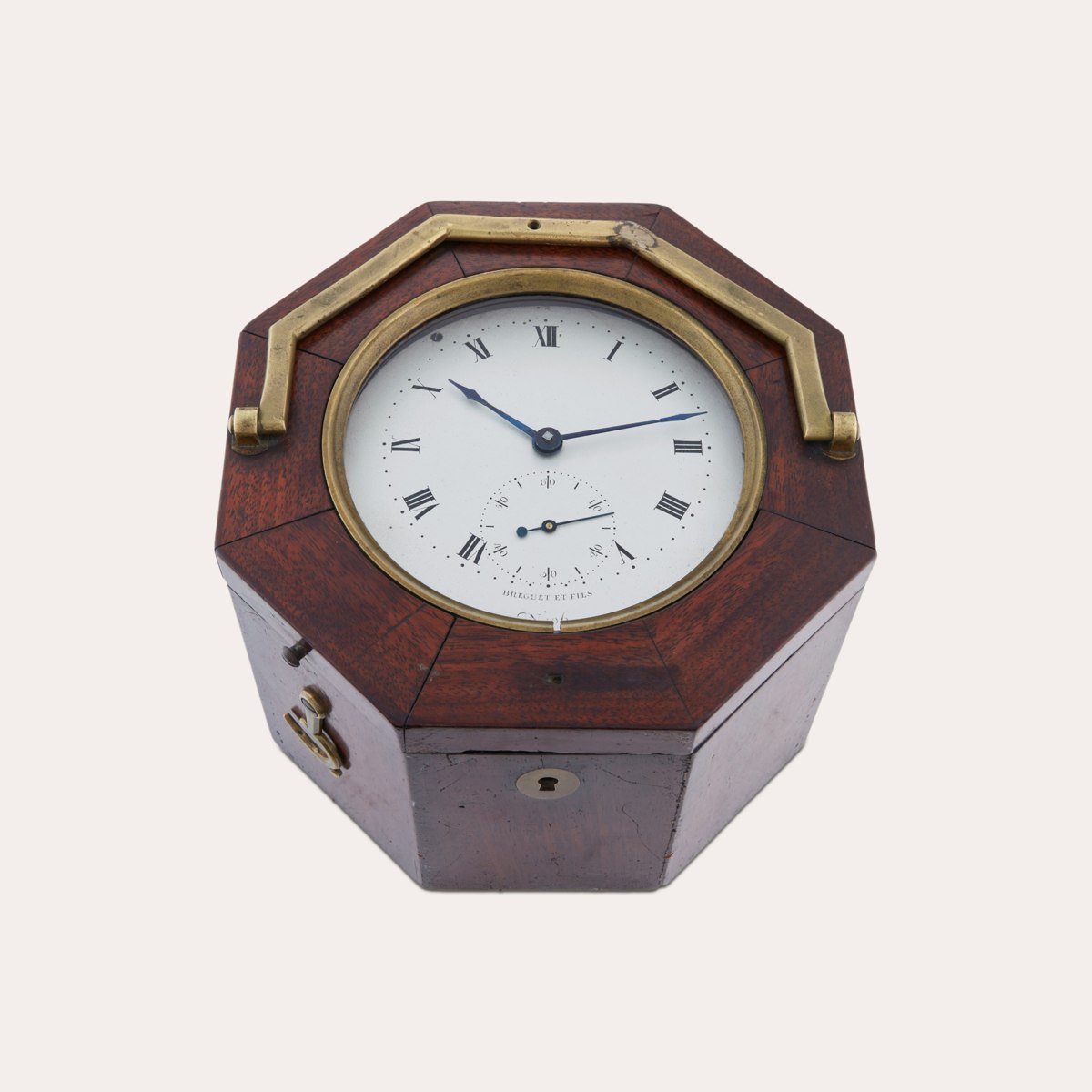
Breguet et Fils No. 106 is an early gilt-brass and octagonal mahogany boxed marine chronometer, representing the maker's earliest recorded sale of a marine chronometer. Sold to Breguet's Bordeaux agent Monsieur Ducom on 11 January 1816, its ébauche is documented by certificate to have been made by Samuel Roy before 1800. The movement features twin barrels turning a single fusee, Harrison's maintaining power, an Earnshaw spring detent escapement on a kidney-shaped plate, and an Arnold three-arm compensation balance with a conical balance spring. The silvered matt dial displays Roman numerals and a large subsidiary seconds dial.

Top-down view of the Breguet No. 106 marine chronometer in its octagonal mahogany box showing the dial, brass bezel, and folding brass handle
Top-down view of the Breguet No. 106 marine chronometer in its octagonal mahogany box showing the dial, brass bezel, and folding brass handle — Sotheby's. Rights pending — permission not yet requested. Original source

Catalogue identity

Source
www.sothebys.com
Category
Marine chronometer · Boxed marine chronometer
Maker / attribution
Breguet et Fils
Reference
Not recorded
Catalogue / lot identifier
28
Source-reported date
Sold 11 January 1816 (ébauche before 1800)
Country
France
Source-reported serial
106

Source-reported attribution and specifications are not independent authentication. A listing does not establish present ownership, current display, availability or permission to reproduce.

Object description

Construction and Housing

The chronometer is housed in an octagonal mahogany box, which features a hinged lid and a glazed brass bezel. A folding brass handle is mounted across the upper frame of the box.

The interior mechanism is described as an openwork brass movement. The primary drive system utilizes twin barrels that turn a single fusee; the mechanism is noted to be wound through the glazed case back.

Evidence for this section
  • “octaongal mahogany box with hinged lid, glazed brass bezel and folding brass handle”
  • “openwork brass movement”
  • “twin barels turning a single fusee, wound through the glazed case back”

Dial and Escapement

The timepiece features a silvered matt dial with Roman numerals and blued steel hands. It includes a large subsidiary seconds dial with Arabic 10-second markers.

The movement employs an Earnshaw spring detent escapement fixed to a kidney-shaped plate. It includes Harrison’s maintaining power and an Arnold three-arm compensation balance, fitted with an undersprung polished conical balance spring incorporating spring clamps and a leveling facility.

Evidence for this section
  • “silvered matt dial, Roman numerals, large subsidiary seconds with Arabic 10-second markers, blued steel hands”
  • “openwork brass movement with Harrison’s maintaining power, Earnshaw spring detent escapement mounted on a kidney-shaped plate, Arnold’s three-arm compensation balance, undersprung polished conical balance spring with spring clamps and levelling facility”

Provenance and Documentation

Breguet et Fils No. 106 was sold to Monsieur Ducom, Breguet’s Bordeaux agent, on 11 January 1816 for 2,000 francs. Records state the ébauche was made by Samuel Roy before 1800.

The chronometer was returned to Monsieur Ducom for service in 1828 and 1847. Following a 2018 sale, the piece underwent conservation and restoration by David Walter.

Evidence for this section
  • “Sold to Monsieur Ducom (Breguet’s Bordeaux Agent) on 11 January 1816 for Fr. 2,000”
  • “The certificate further records that the ébauche was made by Samuel Roy before 1800.”
  • “It was returned twice for the service, in 1828 and 1847, both times by Monsieur Ducom.”

Open research questions

  • What specific components or materials were altered, replaced, or added during the conservation and restoration work performed by David Walter post-2018?
  • What are the specific physical or archival markers that distinguish the ébauche work of Samuel Roy from subsequent assembly by Breguet?
  • To what extent does the internal condition of the movement, not visible in the provided imagery, align with the historical descriptions provided in the auction documentation?

Source evidence

Recorded claims and source quotations for Breguet et Fils No. 106 marine chronometer
FieldSource-reported valueSource quotation
Maker and NumberBreguet et Fils No. 106“Breguet et Fils No. 106 | Sold to Monsieur Ducom (Breguet’s Bordeaux Agent) on 11 January 1816 for Fr. 2,000”
EscapementEarnshaw spring detent escapement“Earnshaw spring detent escapement mounted on a kidney-shaped plate”
BalanceArnold's three-arm compensation balance with conical balance spring“Arnold’s three-arm compensation balance, undersprung polished conical balance spring with spring clamps and levelling facility”
Drive TrainTwin barrels turning a single fusee“twin barels turning a single fusee, wound through the glazed case back”
CaseOctagonal mahogany box“octaongal mahogany box with hinged lid, glazed brass bezel and folding brass handle”
Ebauche MakerSamuel Roy before 1800“The certificate further records that the ébauche was made by Samuel Roy before 1800.”
Dial Diameter105mm“dial diameter 105mm”
Box Width158mm“box width 158mm”

Visible details

  • Octagonal mahogany wooden case with an inset brass keyhole escutcheon on the front facet.
  • Silvered dial with blued steel hands, Roman hour numerals, and a large subsidiary seconds dial.
  • Fitted folding brass carrying handle mounted across the upper frame of the octagonal box.

Research qualifications

  • The internal movement and glazed case back described in the catalogue are not visible in this single exterior top-down photograph.

Photograph identity and source facts were screened before import; rights clearance remains pending.

Consulted source

An extremely rare and early gilt-brass and octagonal mahogany boxed

Reviewed 2026-10-25 · Record 4dd9dedad2

Terms in this record

Glossary explanations for terms named in this object’s record.