
Skip to content
The Encyclopedia of Horology

Marine chronometer · Box marine chronometer

John Arnold Marine Chronometer No. 12

Partially verified

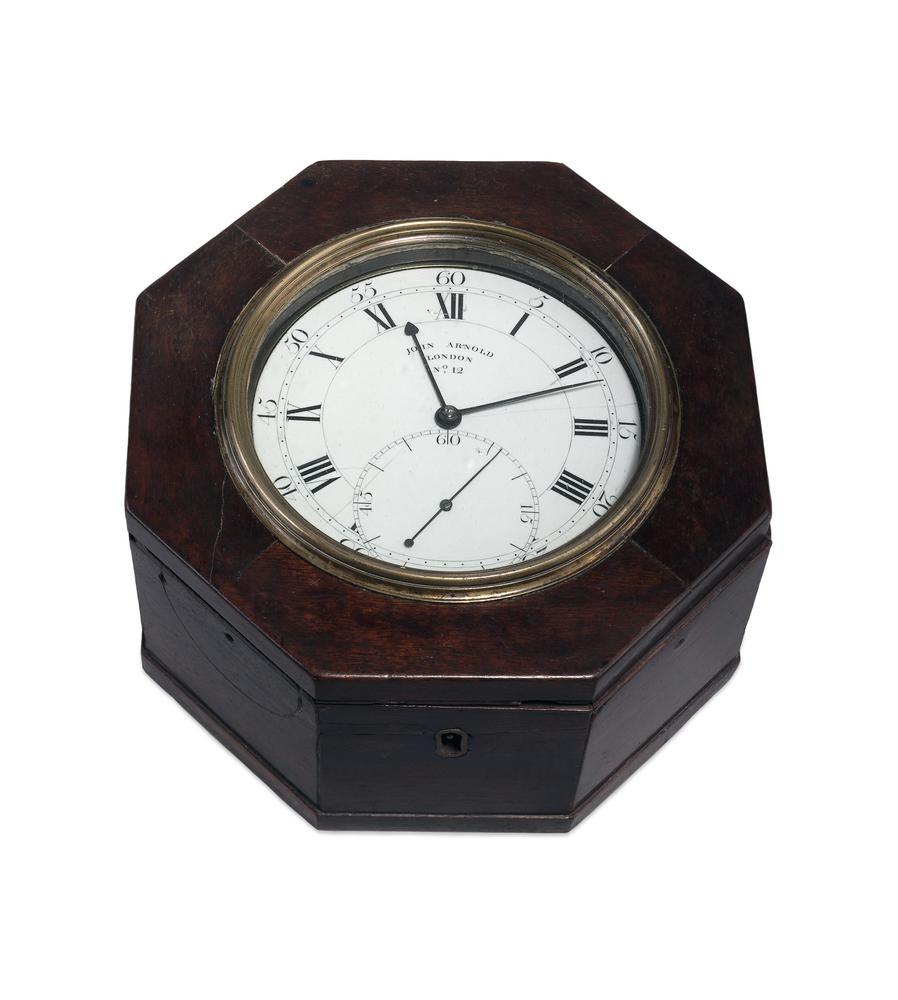
This marine chronometer by John Arnold is housed in an octagonal mahogany box with a glazed brass bezel and lock. Museum documentation dates the piece to 1778, 1779, or 1782 and notes it as likely the first marine chronometer built with Arnold's spring detent escapement and a double-T transverse compensation balance. The movement features a full-plate design with fusee maintaining power, a blued steel helical balance spring, and a white enamel dial signed 'John Arnold, London No 12'. Formerly in the Courtenay Adrian Ilbert Collection, it was donated to the British Museum by Gilbert Edgar in 1958.

Oblique overhead view of John Arnold Marine Chronometer No. 12 in its octagonal mahogany case
Oblique overhead view of John Arnold Marine Chronometer No. 12 in its octagonal mahogany case — British Museum. Rights pending — permission not yet requested. Original source

Catalogue identity

Source
www.britishmuseum.org
Category
Marine chronometer · Box marine chronometer
Maker / attribution
John Arnold
Reference
1958,1006.2067
Catalogue / lot identifier
Source URL identifies the listing
Source-reported date
1778 or 1779 (also dated 1782)
Country
United Kingdom
Source-reported serial
12

Source-reported attribution and specifications are not independent authentication. A listing does not establish present ownership, current display, availability or permission to reproduce.

Object description

Case Construction

The marine chronometer is contained in an octagonal mahogany box. The lid is glazed and secured with a single five-knuckle hinge and a lock. The exterior shows marks indicating previous suspension in gimbals.

The base of the box features a brass-lined winding hole protected by an eccentric shutter. Inside, a brass plate with a projecting tube aligns with a brass dust-excluding cup on the movement's winding square. The glass is noted as likely original, exhibiting a greenish tint and bubbles.

Evidence for this section
  • “Octagonal mahogany box, the glazed lid with a single five-knuckle hinge, and secured by a lock.”
  • “There are marks on the outside of the box indicating that at some time it has been suspended in gimbals.”
  • “The glass, of a greenish colour and with a number of blemishes and air bubbles, is probably original.”
  • “The winding hole in the bottom of the box is brass lined and protected by a shutter with an eccentric key hole, but without a return spring.”

Movement and Escapement

The movement uses a full-plate design with Harrison's maintaining power. Curatorial records indicate the spring detent escapement is a crude, unoriginal replacement. Observations suggest the original layout was intended for a pivoted detent but was altered during early construction.

The escape pinion arbor shows evidence of relocation toward the balance, with holes filled and the potence foot raised with a section of brass. Jewelling on the fourth arbor and balance staff is consistent with nineteenth-century English standards and is considered a later addition.

Evidence for this section
  • “The detent is not original and is crudely made.”
  • “There are signs that in this one the original layout was for a pivoted detent, but was altered to a spring detent at an early stage of construction.”
  • “All the jewelling is similar to ordinary nineteenth-century English jewelling and so was added or altered at a later date”
  • “The escape pinion arbor has apparently been replanted nearer the balance, the holes having been carefully filled in”

Balance and Dial

The balance is a bimetallic two-armed steel design, identified as a 'double T' type. It incorporates bimetallic strips of steel and brass with a corrugated appearance and wire trammels for rod stabilization. Tapped holes for timing screws are present on the rim, though the screws are missing.

The flat white enamel dial features Roman hour numerals and Arabic five-minute markings. It is signed 'John Arnold, London No 12.' The back plate is inscribed 'John Arnold Inv' et Fecit London N° 12'.

Evidence for this section
  • “Probably the first of John Arnold's chronometers to have a 'double T' balance.”
  • “On the dial 'John Arnold, London No 12.'”
  • “On the back plate ' John Arnold Inv' et Fecit London N° 12”
  • “There is provision of two tapped holes in the rim near the ends of the arms for timing screws, now missing.”

Open research questions

  • What specific evidence supports the identification of the spring detent as 'crudely made' in comparison to typical Arnold construction?
  • Are there extant examples of Arnold's pivoted detent mechanisms from this period to contrast with the modified layout of No. 12?

Source evidence

Recorded claims and source quotations for John Arnold Marine Chronometer No. 12
FieldSource-reported valueSource quotation
Dial SignatureJohn Arnold, London No 12.“On the dial 'John Arnold, London No 12.'”
Back Plate SignatureJohn Arnold Inv' et Fecit London N° 12“On the back plate ' John Arnold Inv' et Fecit London N° 12”
Box TypeOctagonal mahogany box“Octagonal mahogany box, the glazed lid with a single five-knuckle hinge, and secured by a lock.”
EscapementSpring detent escapement“Probably the first marine chronometer to have Arnold's spring detent escapement.”
Museum Number1958,1006.2067“Museum number 1958,1006.2067”
ProvenanceCourtenay Adrian Ilbert Collection“Ilbert in his inventory notebook records the acquisition of this chronometer from a Dr Stevens on 25 August 1933 or 1934”

Visible details

  • Octagonal dark mahogany case with front lock keyhole
  • Circular white enamel dial showing hairline cracks, Roman hour numerals, and outer Arabic five-minute numerals
  • Large subsidiary seconds ring at the 6 o'clock position
  • Glazed aperture secured within a turned brass bezel ring
  • Blued steel hands for hours, minutes, and subsidiary seconds

Research qualifications

  • Dating varies in museum records between 1778–1779 and 1782
  • Curatorial comments note the spring detent is an unoriginal replacement and jewelling was added or altered later
  • Internal movement features are not directly visible in the closed exterior view

Photograph identity and source facts were screened before import; rights clearance remains pending.

Consulted source

marine chronometer; clock-case | British Museum

Reviewed 2026-10-25 · Record 19af587c79

Terms in this record

Glossary explanations for terms named in this object’s record.