
Skip to content
The Encyclopedia of Horology

Pocket watch · Half hunting-case key-winding pocket chronometer

James Hornby Pocket Chronometer

Partially verified

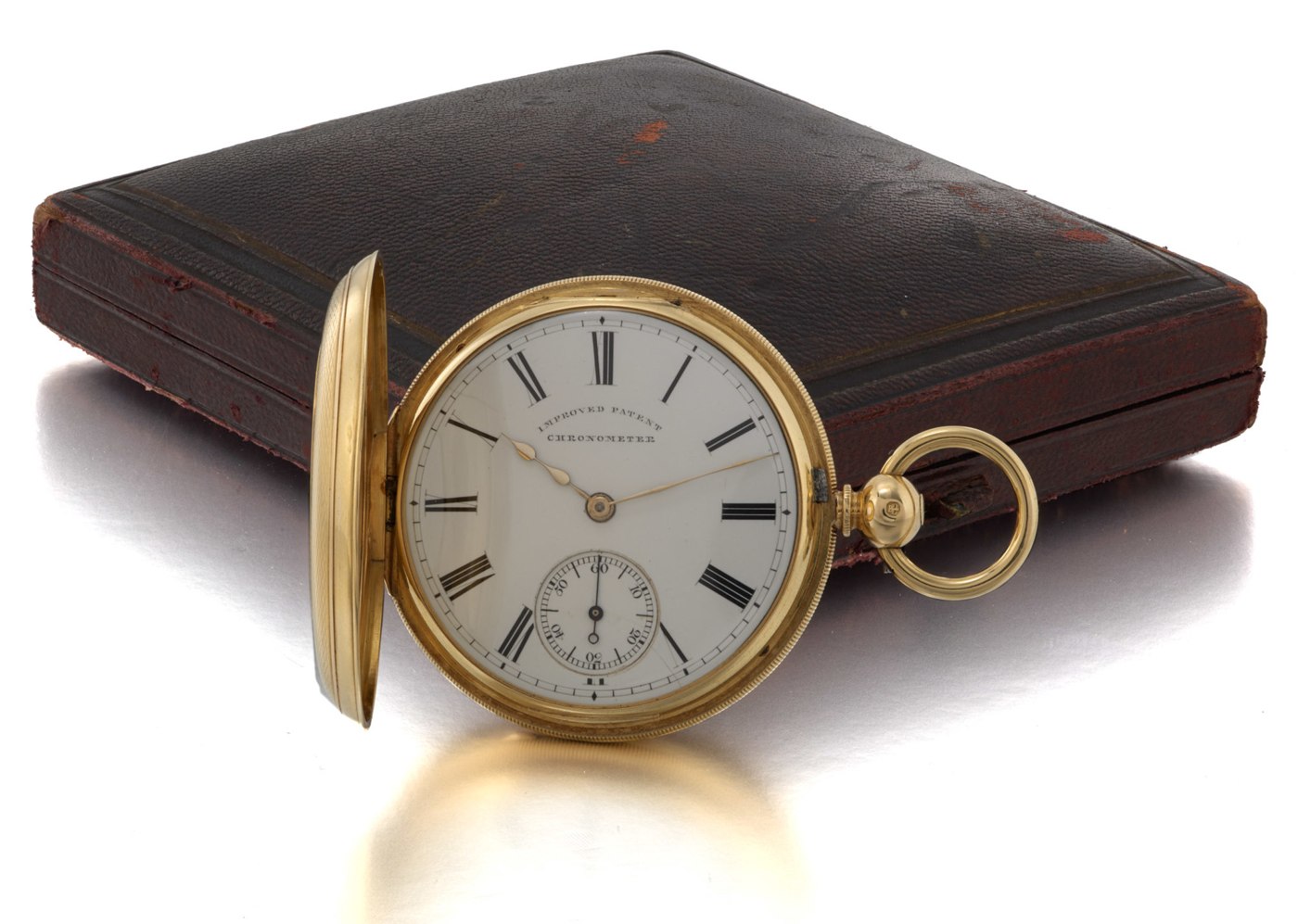
This 18k yellow gold pocket chronometer, created by James Hornby circa 1859-1860, is a half hunting-case, key-winding instrument measuring 49.8 mm. The case features engine-turned (guilloché) decoration on both the cover and the case-back. It utilizes an 18-ligne, 3/4 plate, gilded brass movement with a fusee and chain mechanism. A defining feature is the "improved" Guye spring detent escapement, which is stamped "Guye's Patent / Escapement" on the movement. The caliber includes gold screwed-chatons, a cut bimetallic compensated balance with gold poising screws, a free-sprung cylindrical hairspring with terminal curves, and a diamond end-stone. The white enamel dial displays radial Roman numerals and yellow gold double "Spade" hands, with a subsidiary seconds dial positioned at 6 o'clock. Signatures are present on the dial, case, and movement. The case is marked "H F" and bears a Chester letter-date for 1859-1860.

James Hornby half hunting-case pocket chronometer with enamel dial.
James Hornby half hunting-case pocket chronometer with enamel dial. — Antiquorum. Rights pending — permission not yet requested. Original source

Catalogue identity

Source
catalog.antiquorum.swiss
Category
Pocket watch · Half hunting-case key-winding pocket chronometer
Maker / attribution
James Hornby
Reference
Not recorded
Catalogue / lot identifier
320
Source-reported date
Circa 1859-1860
Source-reported place
England
Source-reported serial
39113

Source-reported attribution and specifications are not independent authentication. A listing does not establish present ownership, current display, availability or permission to reproduce.

Object description

Case and Dial

The watch is housed in an 18k yellow gold half hunting-case measuring 49.8 mm in diameter. The exterior surfaces of the cover and the case-back are finished with a guilloché or engine-turned pattern. The case bears the mark "H F" and includes a Chester letter-date corresponding to the production year of 1859-1860.

The dial is constructed of white enamel and features black radial Roman numerals for the hours. It includes a subsidiary seconds register located at the 6 o'clock position. The time is indicated by yellow gold hands in a double "Spade" style. The auction description notes the presence of a hairline on the enamel dial.

Evidence for this section
  • “18K yellow gold, half hunting-case”
  • “Cover and case-back guilloché (engine-turned)”
  • “White enamel dial with radial Roman numerals”
  • “Hairline”

Movement and Escapement

The timepiece is powered by an 18-ligne, 3/4 plate, gilded brass movement utilizing a traditional fusee and chain mechanism. The movement is fitted with gold screwed-chatons. The regulation system incorporates a cut bimetallic compensated balance with gold poising screws and a free-sprung cylindrical hairspring featuring terminal curves. A diamond end-stone is present within the train.

The watch employs an "improved" Guye spring detent escapement, which is a specific mechanical feature of this chronometer. The movement is explicitly stamped with the text "Guye's Patent / Escapment," identifying the technical basis of the escapement design.

Evidence for this section
  • “Caliber 18''', ¾ plate, gilded brass, fusee and chain”
  • “"IMPROVED" GUYE DETENT ESCAPEMENT”
  • “stamped "Guye's Patent / Escapment”
  • “Overhaul recommended, at buyer's expense”

Signatures and Attribution

The horological object is attributed to the maker James Hornby and dated to the period circa 1859-1860 based on the Chester assay markings found on the case. Signatures verifying the authenticity and identity of the piece are documented by the source as appearing on the dial, the case, and the movement.

The case number is recorded as 14.0 and the movement number as 39113.

Evidence for this section
  • “James Hornby”
  • “Circa 1859-1860”
  • “Signature Dial, case and movement”
  • “Movement No. 39113”

Open research questions

  • What is the historical significance or technical distinction of the "improved" Guye detent escapement?
  • Can the "H F" maker's mark on the case be definitively associated with a specific case maker operating in Chester in 1859?

Source evidence

Recorded claims and source quotations for James Hornby Pocket Chronometer
FieldSource-reported valueSource quotation
MakerJames Hornby“James Hornby”
Movement number39113“Movement No. 39113”
Case number14.0“Case No. 14.0”
Diameter49.8 mm“Dimensions 49.8 mm”
Case material18k yellow gold“18K yellow gold”
Escapement typeImproved Guye detent“"IMPROVED" GUYE DETENT ESCAPEMENT”
Movement caliber18-ligne 3/4 plate“Caliber 18''', ¾ plate”
HallmarksChester 1859-1860“with Chester letter-date for 1859-1860”

Visible details

  • Engine-turned guilloché finish on the case exterior
  • Radial Roman numerals on white enamel dial
  • Subsidiary seconds dial at the 6 o'clock position
  • Yellow gold double 'Spade' hands

Research qualifications

  • The auction description reports a hairline on the enamel dial.
  • The auction description recommends an overhaul at the buyer's expense.

Photograph identity and source facts were screened before import; rights clearance remains pending.

Consulted source

JAMES HORNBY POCKET CHRONOMETER; "IMPROVED" GUYE DETENT ESCAPEMENT; 18K YELLOW GOLD

Reviewed 2026-10-26 · Record 82a7f9326d

Terms in this record

Glossary explanations for terms named in this object’s record.