
Skip to content
The Encyclopedia of Horology

Pocket watch · Quarter repeating pocket watch

Watch case

Partially verified

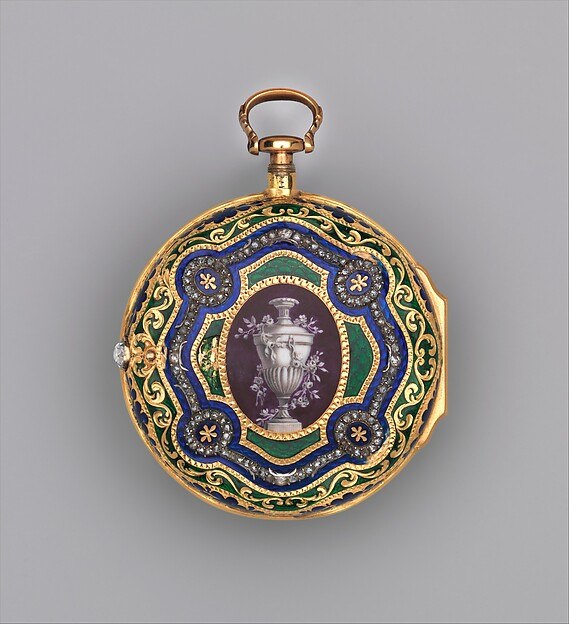
This watch is a quarter-repeater featuring an inner gold case and an ornate outer gold case. The outer case is decorated with translucent green and royal blue basse-taille enamels, diamond chips, and a central panel featuring a flower-draped Neoclassical vase against a chocolate-colored ground. The white enamel dial is marked with Arabic-style numerals for the hours and minutes, indicating its intended market in the Ottoman trade. The movement, signed by Francis Perigal of London and bearing the serial number 17389, is of a gilded brass construction with a cylinder escapement and a worm-and-wheel mainspring setup. It is fitted with a balance cock featuring a diamond endstone. , and .

Back view of the outer gold case showing the enameled Neoclassical vase motif.
Back view of the outer gold case showing the enameled Neoclassical vase motif. — The Metropolitan Museum of Art. Rights pending — permission not yet requested. Original source

Catalogue identity

Source
www.metmuseum.org
Category
Pocket watch · Quarter repeating pocket watch
Maker / attribution
Francis Perigal / George Harrison (case)
Reference
Not recorded
Catalogue / lot identifier
17.190.1568
Source-reported date
18th century
Source-reported place
England
Source-reported serial
17389

Source-reported attribution and specifications are not independent authentication. A listing does not establish present ownership, current display, availability or permission to reproduce.

Object description

Case Design and Ornamentation

The watch features a pair-case construction, though it currently retains only the inner gold case and one outer gold case. The outer case is of a wavy-edged design, chased and ornamented with concentric bands of emerald green and royal blue translucent basse-taille enamels. These bands are punctuated by circles of diamond chips and gold stars, centering on a Neoclassical vase motif enameled in shades of gray and lavender on an oval, chocolate-colored background.

The bezel echoes the outer band ornamentation and is likewise framed with diamond chips. Sound from the repeating mechanism is emitted through openings integrated into the case design. The inner gold case features a chased, openwork scrolling band with a stylized shell motif. Its back is decorated with chased gold and white-enameled lozenges, each with a green enamel six-petal flower, arranged between zigzag patterns of translucent blue enamel.

Evidence for this section
  • “The enameled gold and diamond pair-case quarter-repeating watch in this entry is an excellent example of the type of watch intended to please a luxury-loving Turk.”
  • “the case is made of chased gold ornamented with concentric bands of translucent, basse-taille enamels in emerald green and royal blue”
  • “Hidden within the design, tiny openings allow the sound of the bell for the repeating mechanism to escape.”

Dial and Movement

The dial is composed of white enamel and displays Turkish-style numerals for hours (1–12) and minutes (5–60, in intervals of five). The sculptured silver hands are accented with tiny diamond chips. These features identify the watch as a piece intended for the Ottoman market. The dial is also marked with the maker’s name and location, referencing the Royal Exchange.

The movement consists of two gilded brass plates connected by four cylindrical pillars. It utilizes a cylinder escapement, with the mainspring wound via keyholes located on the back of the inner case and the dust cover. The back plate supports an engraved balance cock with a diamond endstone and a silver figure plate used for adjusting the balance spring.

Evidence for this section
  • “The white enamel dial painted with “Turkish” numerals (1–12) for the hours and the minutes (5–60, by fives) marks it as intended for the Ottoman trade.”
  • “The movement consists of two circular plates of gilded brass held apart by four cylindrical pillars.”
  • “The back plate supports a balance cock with a solid, engraved foot that is screwed to the plate, and a diamond endstone for pivoting the balance staff”

Condition and Provenance

The object entered the Museum’s collection as a gift from J. Pierpont Morgan in 1917. Before its acquisition, the watch was in the possession of Carl H. Marfels. During its history, the outer case became separated and was initially misidentified as French, resulting in separate accession numbers for the components. The outer case is now recognized as English.

Currently, the watch displays several areas of damage, including extensive enamel loss on the outer case, particularly where the green enamel framing the painted vase is missing. There are also smaller losses of enamel on the inner case. The mechanical functionality is compromised as the mainspring is broken, and the fusee chain is detached.

Evidence for this section
  • “The mainspring is unfortunately now broken and the fusee chain has come loose.”
  • “There are numerous losses of enamel on both the outer and the inner cases.”

Open research questions

  • What is the specific provenance of the watch between the Marfels collection and the 1917 Morgan gift?
  • Can the 'GH' mark inside the outer case be definitively linked to a specific workshop or subcontractor?

Source evidence

Recorded claims and source quotations for Watch case
FieldSource-reported valueSource quotation
MakerFrancis Perigal“Fras / Perigal / LONDON”
Serial Number17389“Engraved at the twelve o’clock position is the number 17389.”
Case materialGold and diamond“The enameled gold and diamond pair-case quarter-repeating watch in this entry is an excellent example of the type of watch intended to please a luxury-loving Turk.”
EscapementCylinder“It is quarter repeating and has a cylinder escapement.”
Accession Number17.190.1568“Accession number: 17.190.1568”
MechanismQuarter-repeater“It is quarter repeating and has a cylinder escapement.”

Visible details

  • Outer case features diamond-set borders and translucent enamel panels
  • Dial indicates hours 1-12 and minutes in 5-minute increments
  • Repeating mechanism releases sound through openings in the case design
  • Interior of outer case marked with GH under a coronet

Research qualifications

  • Exact identification of the specific Francis Perigal is speculative based on serial numbers
  • The attribution of work within the Perigal workshop remains uncertain

Photograph identity and source facts were screened before import; rights clearance remains pending.

Consulted source

Watch case

Reviewed 2026-10-26 · Record 9f84650106