
Glossary · Mechanism
Cylinder escapement
A frictional-rest watch escapement in which the escape-wheel teeth act on the rim of a hollow cylinder on the balance staff.
Explanation
In the cylinder escapement, associated with Tompion and perfected by Graham in the 1720s, the balance staff is formed as a hollow cylinder with a section cut away. Escape-wheel teeth enter and leave the cylinder, resting on its rim between impulses, so the wheel is locked for most of the balance's swing — a frictional-rest action. Impulse is given as a tooth slides across the cylinder's lip.
The design allowed much thinner watches than the verge and dominated continental watchmaking through the eighteenth and much of the nineteenth century. Its costs are friction at the rest surfaces, sensitivity to oil condition, and a delicate cylinder that is difficult to make and repair. It does not give the free-swinging balance of a lever or detent escapement, so a cylinder watch is not expected to hold rate like a lever watch of similar appearance.
Identification cues: a flat, toothed escape wheel with slender upright teeth, a balance staff carrying the cylinder, and typically a Swiss or French bar movement. Record the escapement from the movement, not from the case style; many cylinder movements sit in cases that look like lever watches of the same period.
Sources & references
- de Carle, D., Practical Watch Repairing — technical further reading; exact procedures require calibre documentation
- Reymondin et al., The Theory of Horology — construction and terminology further reading
Where sources disagree, the disagreement is stated rather than resolved silently.
Distinctions at a glance
| Feature | Cylinder escapement | Comparison |
|---|---|---|
| Rest action | Frictional rest on the cylinder rim | Lever balance swings free between impulses |
| Impulse | Tooth slides across the cylinder lip | Lever impulses through fork and pin |
| Typical host | Continental bar movements, 18th–19th century | English full plate usually verge or lever |
| Rate expectation | Modest; sensitive to oil and wear | Not comparable to a serviced lever watch |
What to record
- Identify the escapement from the wheel and balance staff, not the case.
- Note cylinder condition as a specialist service item.
- Keep rate expectations appropriate to frictional-rest action.
Never oil or prod the cylinder rim; the lips are thin and the escape-wheel teeth bend easily.
In the object catalogue
Catalogued objects whose own source record mentions “Cylinder escapement”. The quoted line shows where; it is the seller’s or museum’s wording, not independent verification.

Pocket watch
Piguet & Meylan 18K gold, pearl and enamel-set quarter repeating 'Barking Dog' automaton watch
“This openface pocket watch by Isaac Daniel Piguet and Philippe Meylan features a quarter-repeating barking mechanism with round bellows and whistle activated through the pendant…”
Pocket watch
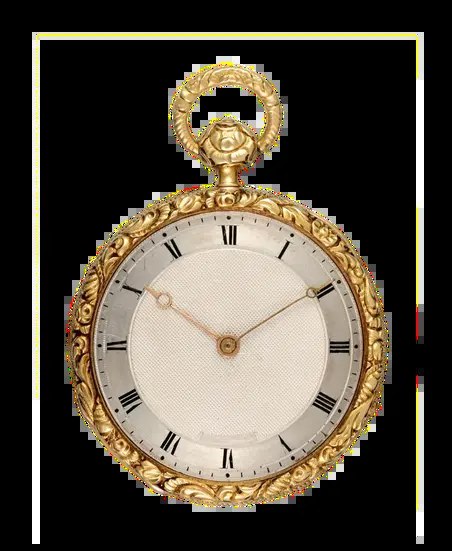
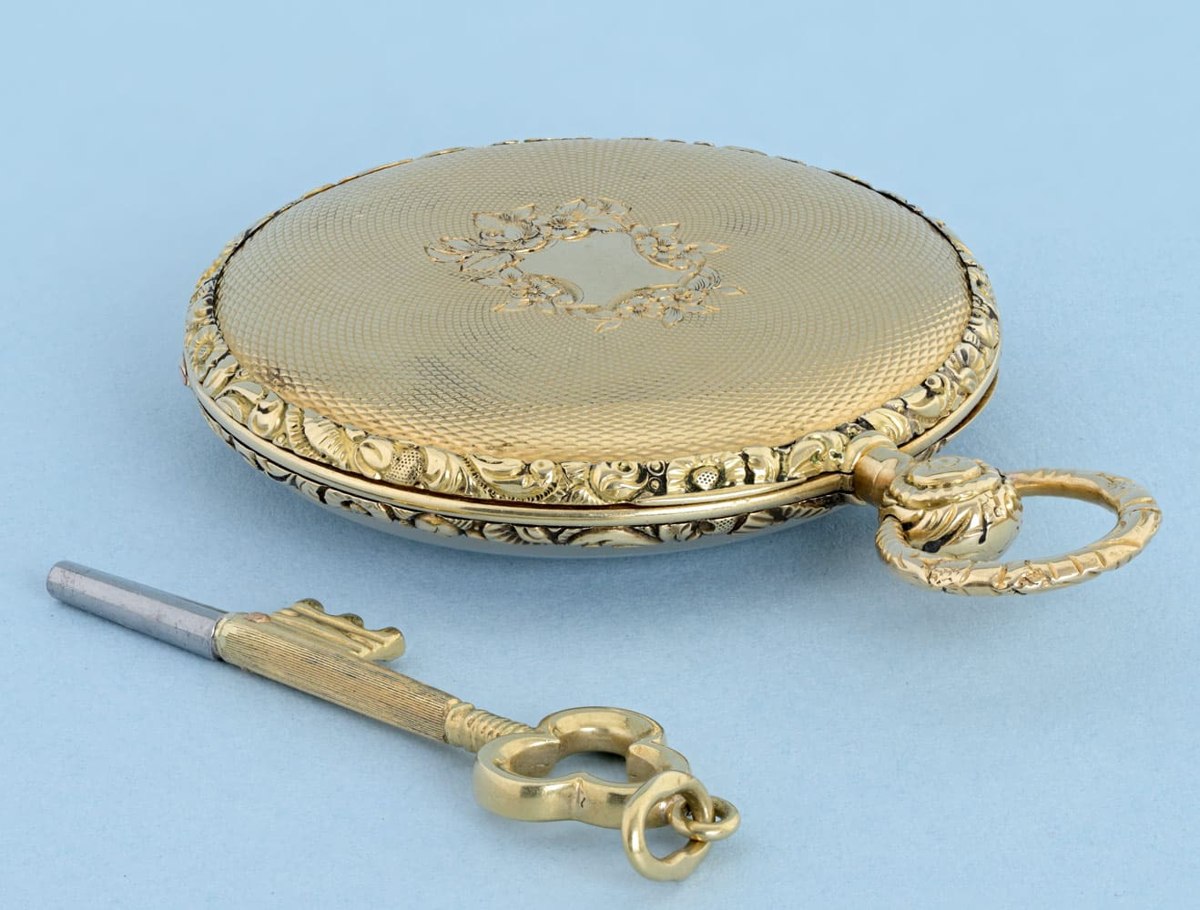
J F Bautte et Cie Swiss Quarter Repeating Cylinder Pocket Watch
“Reported by the source as dating to circa 1830 and signed by J F Bautte et Cie a Geneve, this open-face pocket watch features a 36 mm 18-carat gold case with heavily chased and …”
Pocket watch
Vacheron & Constantin Gold Quarter Repeating Pocket Watch
“According to the source, this Swiss open-face pocket watch dates to circa 1840 and is signed by Vacheron & Constantin, Geneva. The 42 mm 18-carat gold case features an engine-tu…”
Pocket watch
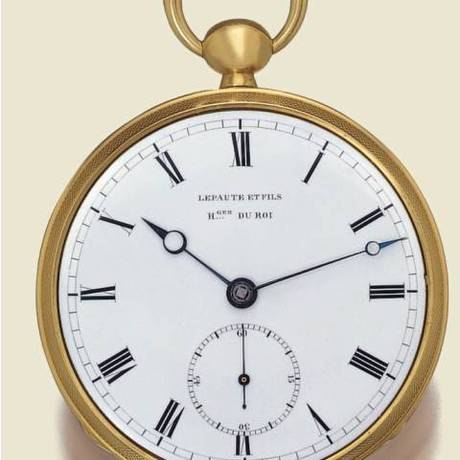
Lepaute et Fils à Paris 18K gold pocket watch with stop feature, No. 3433 + 36
“This circa 1830 French pocket watch by Lepaute et Fils à Paris features a 52 mm four-body 18K gold case in 'bassine et filets' form, decorated with engine turning along the back…”
Clock
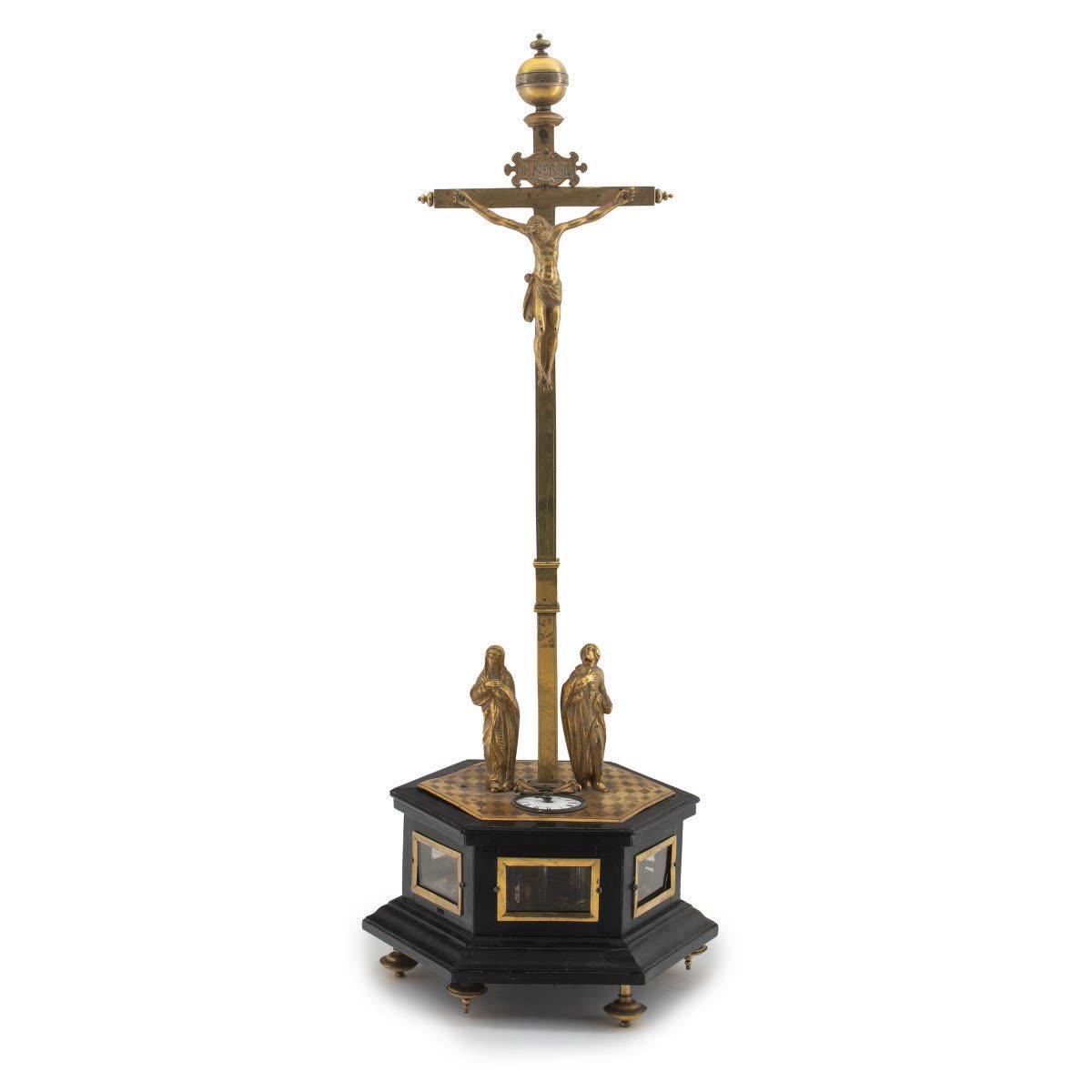
Horloge de table en forme de crucifix, Ilario Allodi à Parme
“This crucifix-form table clock features a movement signed by Ilario Allodi of Parma. The structure consists of an ebonized hexagonal wooden base fitted with six framed glazed vi…”
Movement
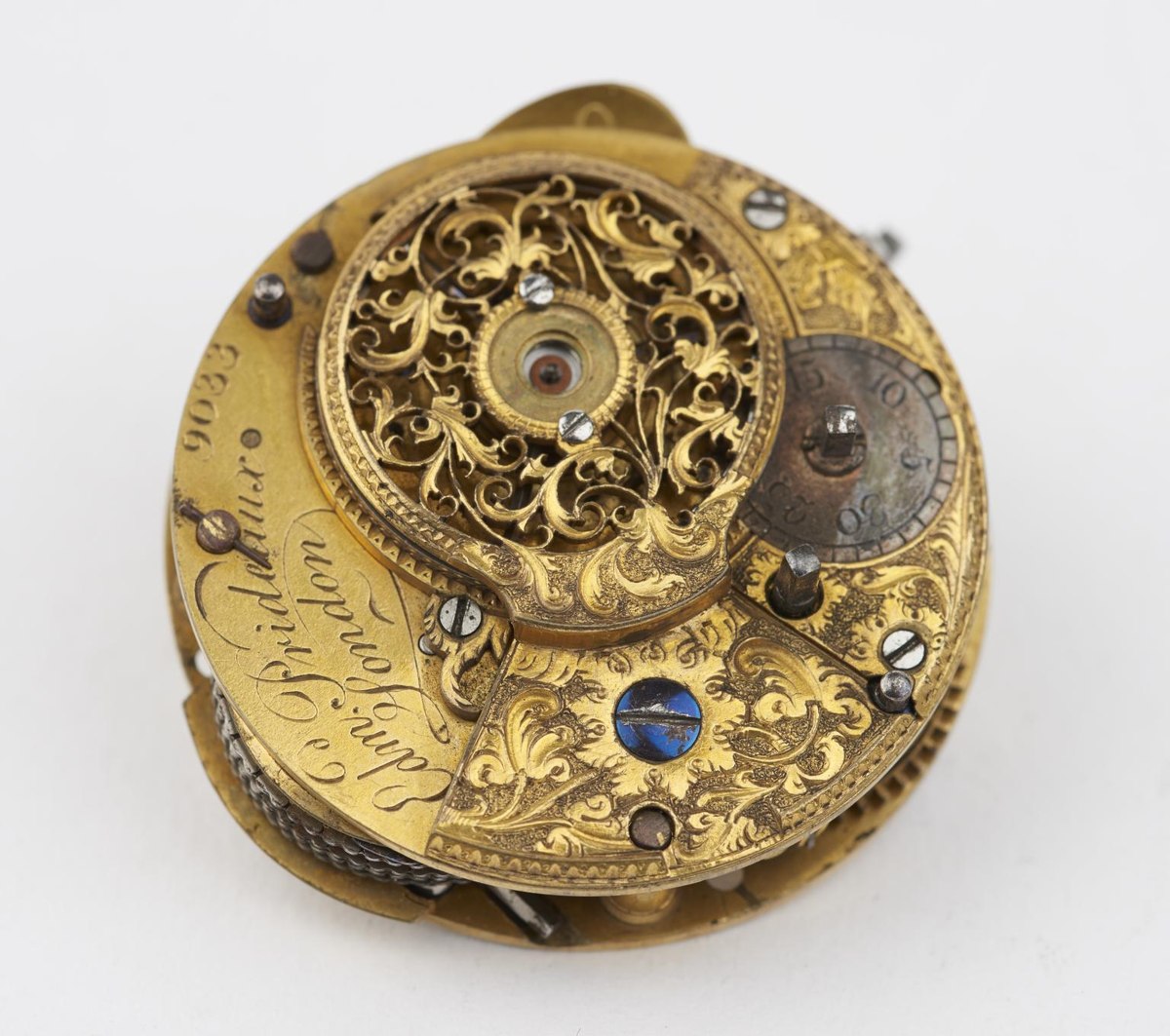
Cylinder watch movement by E. Prideaux
“Maker and Type: Cylinder escapement, steel wheel, centre seconds, by E. Prideaux”