
Skip to content
The Encyclopedia of Horology

Pocket watch · Verge pocket watch

Verge pocket watch

Partially verified

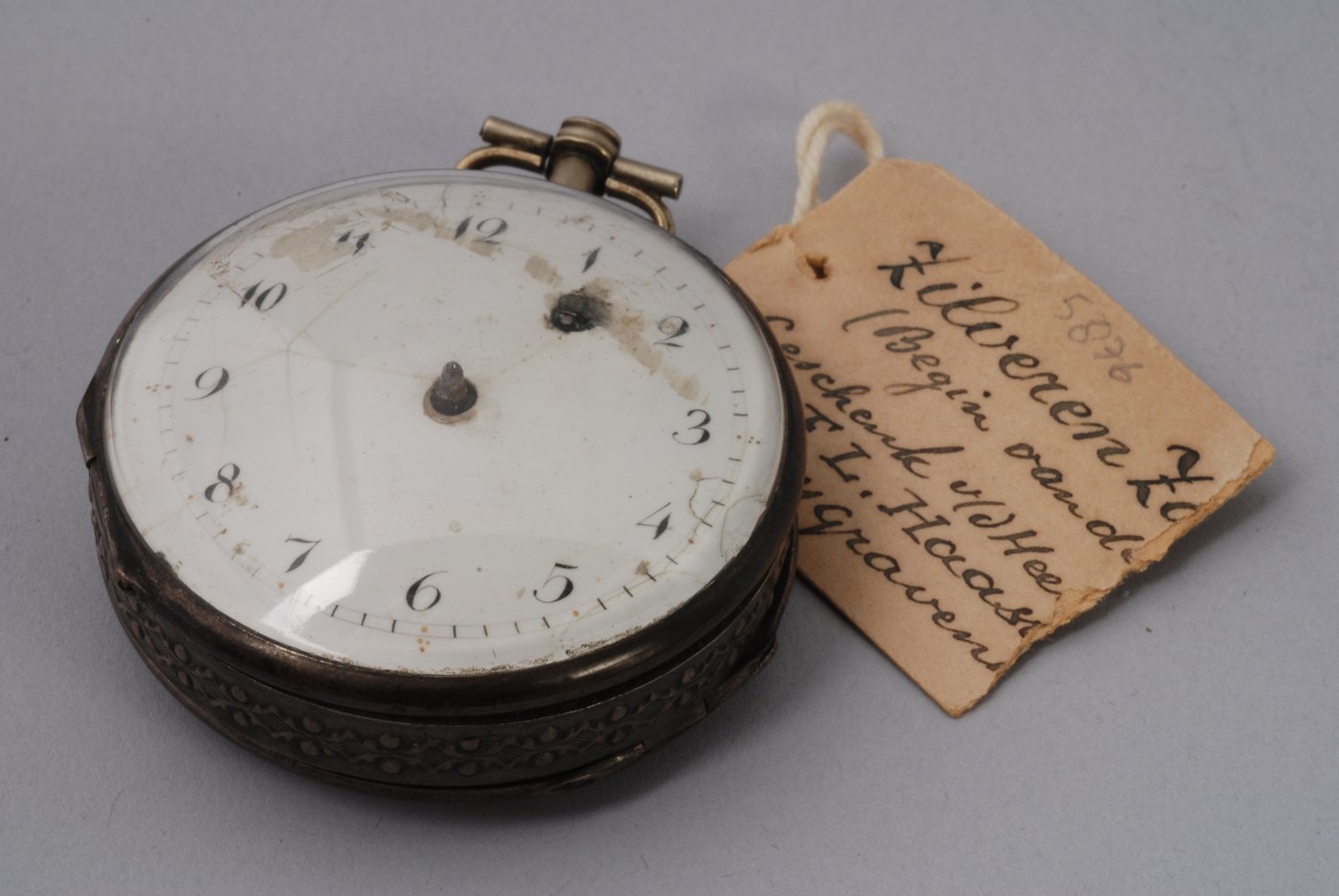
This verge pocket watch, currently held by Museum Rotterdam, dates to circa 1790. It features a flat white enamel dial marked with Arabic numerals and includes an integrated winding hole on the dial face. The watch is housed in a double-hinged case, which incorporates a convex crystal and a flattened convex back cover. The exterior rim of the case is decorated with a continuous motif. Internally, the mechanism is powered by a fusee and utilizes a verge escapement with angular pillars. Further movement details include a brass pierced bridge located on the back plate and a three-spoke balance. A square blued pin serves as a regulator, positioned within a silver regulator disc that features the engraved letters "R" and "A". The object is constructed from a combination of brass, silver, steel, glass, and enamel.

A verge pocket watch in a double-hinged case with a damaged white enamel dial, accompanied by an archival paper tag.
A verge pocket watch in a double-hinged case with a damaged white enamel dial, accompanied by an archival paper tag. — Museum Rotterdam via Europeana. Rights pending — permission not yet requested. Original source

Catalogue identity

Source
orbiscollectibles.com
Category
Pocket watch · Verge pocket watch
Maker / attribution
Not established
Reference
Not recorded
Catalogue / lot identifier
/700/europeana_fashion_5876_A_D
Source-reported date
1790
Source-reported place
Not established

Source-reported attribution and specifications are not independent authentication. A listing does not establish present ownership, current display, availability or permission to reproduce.

Object description

Case and Dial Construction

The watch is presented in a double-hinged case designed with a flattened convex back and a convex glass covering the dial. The casing is characterized by a flat rim adorned with a continuous decorative motif, adding texture to the silhouette.

The dial is composed of white enamel and displays Arabic numerals for time indication. A functional feature of this configuration is the inclusion of a winding hole directly in the dial, which allows for access to the movement without removing the watch from its case. The dial shows signs of age, with visible surface damage present.

Evidence for this section
  • “In a double-hinged case with convex glass, flattened convex back cover and flat rim with continuous motif.”
  • “Pocket watch with flat white enamel dial with Arabic numerals.”
  • “winding hole in the dial”

Movement and Escapement

The interior movement is constructed using angular pillars to support the main assembly, reflecting the mechanical standards of the late 18th century. It operates using a fusee drive to regulate power delivery to the train, leading to a verge escapement mechanism. This classic configuration relies on a crown wheel and pallet engagement to track time.

The balance assembly features a three-spoke design. Regulation is managed via a square, blued pin mounted on a silver regulator disc. This disc is clearly marked with the letters 'R' and 'A', indicating the direction for adjustment. A brass pierced bridge is situated on the back plate, providing both protection and aesthetic detailing to the movement structure.

Evidence for this section
  • “The movement with verge escapement, with fusee.”
  • “Angular pillars. On the back plate a brass pierced bridge.”
  • “Behind it a three-spoke balance.”
  • “square blued pin for regulation in a silver regulator disc with letters "R" and "A".”

Documentation and Provenance

This object is catalogued as part of the Museum Rotterdam collection and is registered under the Europeana database. The documentation confirms its date of 1790, though the identity of the maker remains unrecorded and is listed as unknown. Its physical measurements are recorded as 6.8cm in height, 5cm in width, and 2cm in depth.

While the museum record provides technical specifications regarding the movement and case, broader historical context or maker attribution remains unavailable in the provided data. The object's status as a museum-held piece offers a verified institutional record for its technical specifications and general physical profile.

Evidence for this section
  • “dated 1790, attributed to unknown.”
  • “measurements 6.8cm hg; 5cm br; 2cm dp.”
  • “Europeana id /700/europeana_fashion_5876_A_D”

Open research questions

  • Can a maker or workshop be identified through the movement architecture or the specific case decoration pattern?
  • What is the origin of the handwritten paper tag attached to the watch in the museum photograph?

Source evidence

Recorded claims and source quotations for Verge pocket watch
FieldSource-reported valueSource quotation
Holding InstitutionMuseum Rotterdam“held by Museum Rotterdam (Netherlands)”
Date1790“dated 1790”
DialWhite enamel with Arabic numerals“Pocket watch with flat white enamel dial with Arabic numerals.”
EscapementVerge with fusee“The movement with verge escapement, with fusee.”
Movement componentsAngular pillars, pierced bridge, and three-spoke balance“Angular pillars. On the back plate a brass pierced bridge. Behind it a three-spoke balance.”
RegulationSquare blued pin in a silver disc“Next to the balance cock a square blued pin for regulation in a silver regulator disc with letters "R" and "A".”
CaseDouble-hinged with decorative rim“In a double-hinged case with convex glass, flattened convex back cover and flat rim with continuous motif.”

Visible details

  • The dial displays visible hairline cracks and degradation near the winding aperture.
  • The case band exhibits a repeating engraved decorative pattern around its circumference.
  • A paper tag with handwritten Dutch text remains attached to the pendant of the watch.

Research qualifications

  • The maker of the watch is identified only as unknown.
  • The exact manufacture location is not documented beyond its current institutional custody.

Photograph identity and source facts were screened before import; rights clearance remains pending.

Terms in this record

Glossary explanations for terms named in this object’s record.