
Skip to content
The Encyclopedia of Horology

Clock · Turret clock

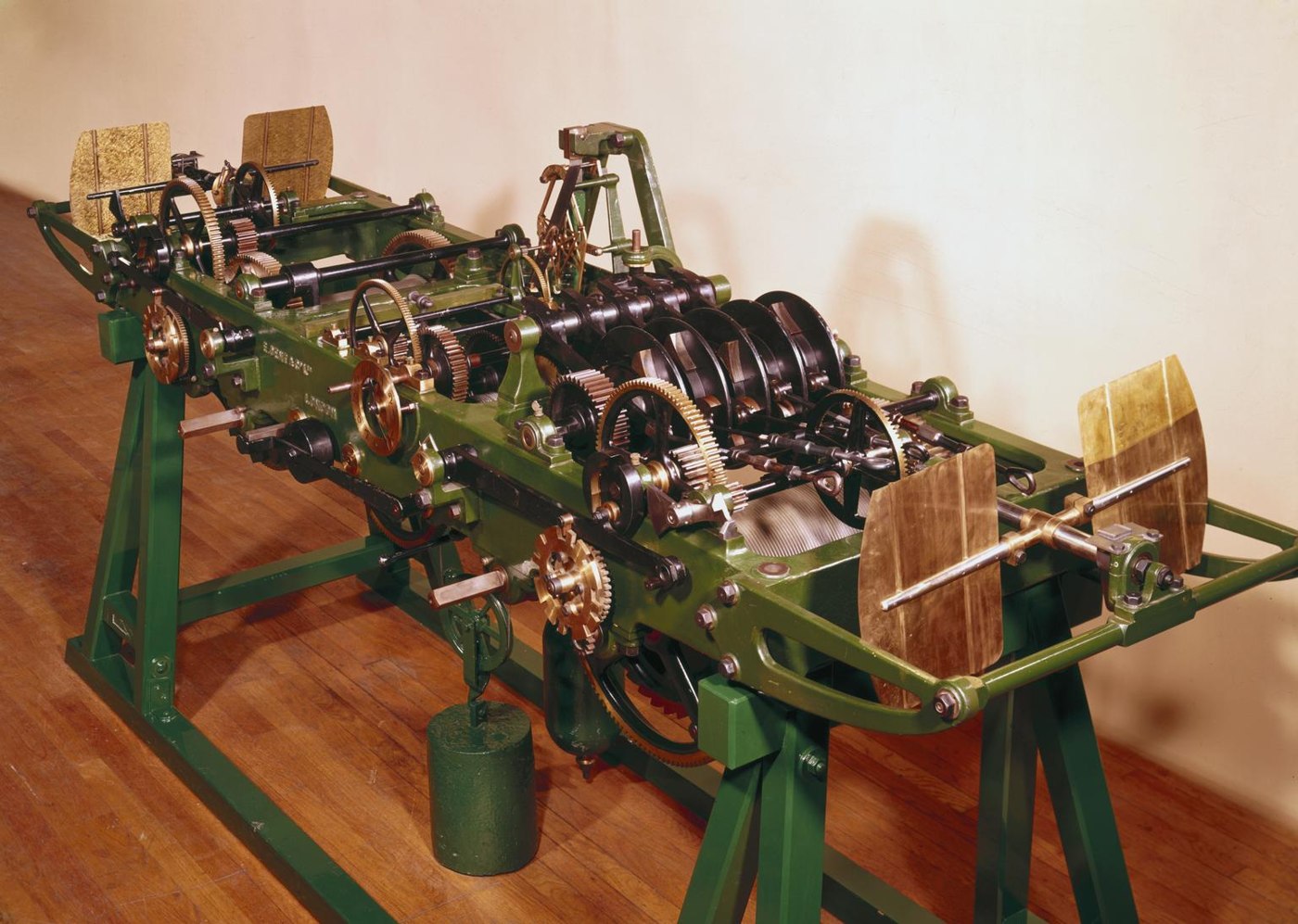
Three-train flatbed turret clock movement

Partially verified

This is a three-train turret clock movement produced by E. Dent and Co. Ltd, dating to approximately 1939. The mechanism is designed as a weight-driven system mounted on a flatbed double-trestle frame. The clock features a going train equipped with a double three-legged gravity escapement, a design associated with Edmund Beckett, Baron Grimthorpe. The movement integrates separate trains for timekeeping, striking, and the Westminster quarters. Both the striking and quarter-chime trains are regulated by locking plates. The construction is robust, intended for installation in a tower or turret, and is supported by a significant framework to maintain the alignment of the gear trains. It is operated using a 1 1/2 second pendulum.

A side-angle view of the E. Dent & Co. turret clock movement, showing the flatbed frame, gear trains, and gravity escapement.
A side-angle view of the E. Dent & Co. turret clock movement, showing the flatbed frame, gear trains, and gravity escapement. — Science Museum Group. Rights pending — permission not yet requested. Original source

Catalogue identity

Source
collection.sciencemuseumgroup.org.uk
Category
Clock · Turret clock
Maker / attribution
E. Dent and Co. Ltd
Reference
Not recorded
Catalogue / lot identifier
1969-513
Source-reported date
1939
Source-reported place
United Kingdom

Source-reported attribution and specifications are not independent authentication. A listing does not establish present ownership, current display, availability or permission to reproduce.

Object description

Movement Architecture

The movement is constructed as a three-train flatbed turret clock, providing power for timekeeping, striking, and the Westminster quarters. The entire assembly is mounted upon a double-trestle frame, designed to provide the necessary stability for a large weight-driven mechanism.

The going train employs a double three-legged gravity escapement, a design specifically credited to Lord Grimthorpe. This escapement mechanism is a prominent feature of the going train, and the chime and strike functions are managed through the use of traditional locking plate systems.

Evidence for this section
  • “Movement of a 3-train turret clock by E. Dent and Co.”
  • “the going train has Grimthorpe's double 3-legged gravity escapement”
  • “the striking train and Westminster quarters are controlled by locking plates”
  • “double trestle frame for support”

Technical Specification

The timekeeping component of the clock is regulated by a 1 1/2 second pendulum.

The clock is a weight-driven mechanism, which requires substantial vertical clearance for the drive weights. The flatbed layout allows for modular maintenance of each train, as all gear sequences are accessible across the horizontal plane of the cast-iron bed.

Evidence for this section
  • “with 1 1/2 second pendulum and double trestle frame for support”

Origin and Attribution

The movement is attributed to the firm of E. Dent and Co. Ltd, London. Records indicate a date of manufacture around 1939. The machine incorporates the mechanical concepts of Edmund Beckett, Baron Grimthorpe, who was a significant figure in the development of turret clock designs in the 19th and early 20th centuries.

The item is catalogued by the Science Museum Group with the accession number 1969-513, which documents its survival as an example of late-era turret clock engineering produced in the United Kingdom.

Evidence for this section
  • “E.Dent and Co.Ltd”
  • “Grimthorpe, Edmund Beckett, Baron, 1816-1905”
  • “made about 1939”
  • “1969-513”

Open research questions

  • What tower was this specific movement originally intended for, given its late 1939 date?
  • Are there specific serial numbers stamped on the frame that correlate with E. Dent factory records?

Source evidence

Recorded claims and source quotations for Three-train flatbed turret clock movement
FieldSource-reported valueSource quotation
MakerE. Dent and Co. Ltd“E.Dent and Co.Ltd”
Date1939“made about 1939”
Accession Number1969-513“1969-513”
EscapementDouble three-legged gravity escapement“Grimthorpe's double 3-legged gravity escapement”
Support FrameDouble trestle frame“double trestle frame for support”
RegulationLocking plates“striking train and Westminster quarters are controlled by locking plates”
Pendulum1 1/2 second pendulum“1 1/2 second pendulum”

Visible details

  • Large green painted cast iron flatbed frame
  • Visible locking plates for chime and strike trains
  • Distinct double three-legged gravity escapement assembly
  • Four brass air-brake vanes mounted at the rear and side

Research qualifications

  • Exact installation location not specified in source
  • Extent of original factory finish versus museum restoration is not clarified

Photograph identity and source facts were screened before import; rights clearance remains pending.

Terms in this record

Glossary explanations for terms named in this object’s record.