
Skip to content
The Encyclopedia of Horology

Clock · Turret clock

Turret clock by J. Smith & Sons

Partially verified

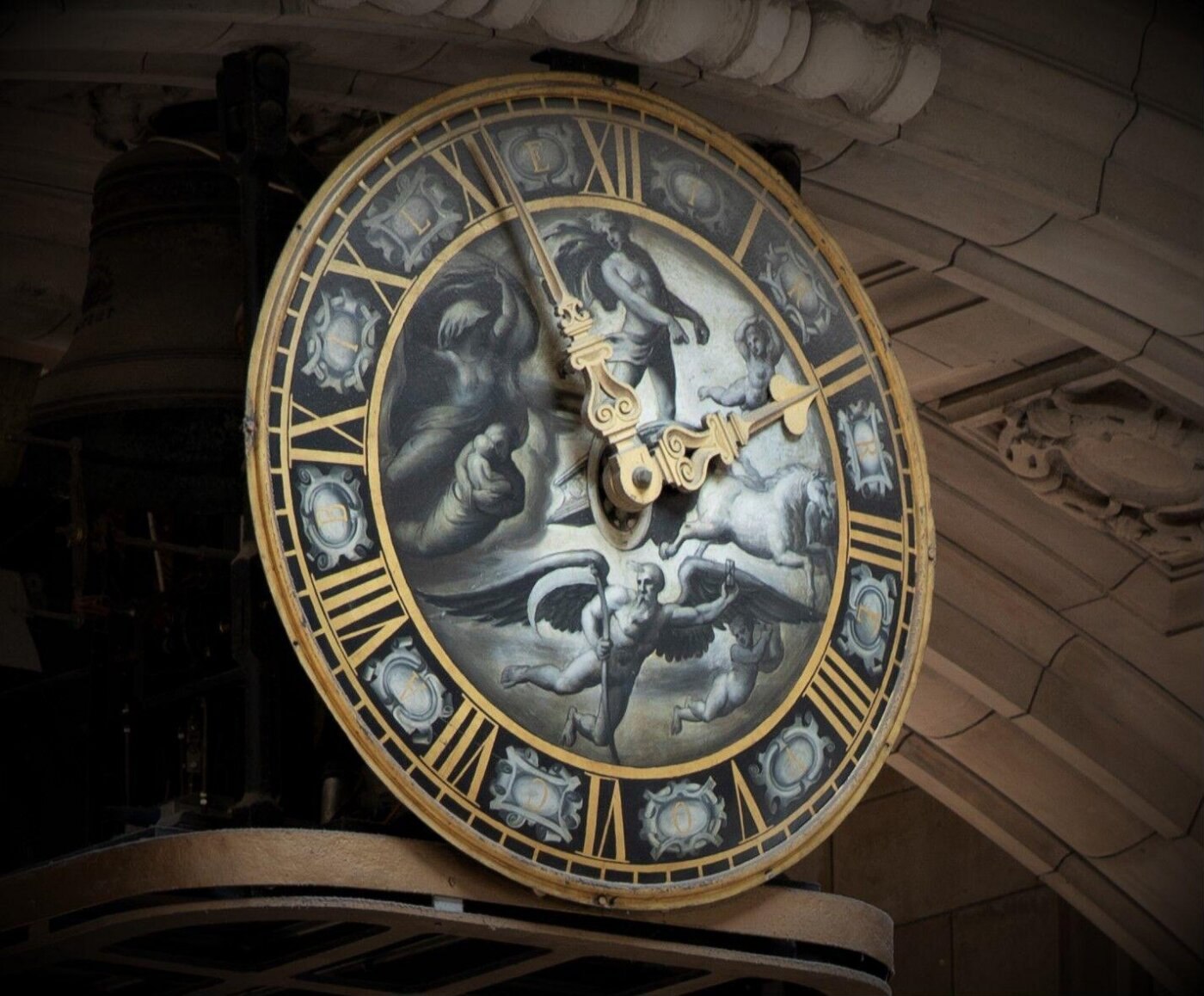
This eight-day turret clock was manufactured in Clerkenwell by J. Smith & Sons between 1857 and 1862. Commissioned by the Department of Science and Art for the South Kensington Museum (now the Victoria and Albert Museum), it features two dials designed by the artist Francis Wollaston Moody. These dials depict allegorical figures of Day and Night, with the figure of Time and the word 'IRREVOCABLE' integrated into the design. The movement is constructed with iron frames, gun-metal wheels and bosses, and wrought-steel pinions. It utilizes a deadbeat escapement and a pendulum with a rod of varnished, polished pine. A striking mechanism on the repeating principle is included. Originally maintained by hand-winding, the clock was decommissioned in 1951, later restored, and equipped with an automatic electric winding mechanism in 1983-84 to allow for its continued operation in the museum's main entrance.

Detail of the decorative turret clock face featuring allegorical figures of Day and Night designed by F.W. Moody.
Detail of the decorative turret clock face featuring allegorical figures of Day and Night designed by F.W. Moody. — Victoria and Albert Museum. Rights pending — permission not yet requested. Original source

Catalogue identity

Source
collections.vam.ac.uk
Category
Clock · Turret clock
Maker / attribution
J. Smith & Sons
Reference
Not recorded
Catalogue / lot identifier
M.159-1984
Source-reported date
1857-62
Source-reported place
Clerkenwell, London

Source-reported attribution and specifications are not independent authentication. A listing does not establish present ownership, current display, availability or permission to reproduce.

Object description

Construction and Mechanism

The movement of the clock is built for heavy-duty use, utilizing iron frames configured to allow for individual component removal during maintenance without dismantling the entire assembly. The gear train employs wheels and pivot bosses crafted from gun metal, specifically chosen for its durability in ordnance bearings. Pinions are machined from wrought steel, with both wheels and pinions finished to facilitate accuracy.

The regulation of the clock is managed via an escapement following the principle of Graham's deadbeat, incorporating adjustable steel pads set in turned grooves. The pendulum features a heavy spherical ball suspended by a varnished and French-polished pine rod to mitigate the effects of humidity and temperature. The striking train utilizes a repeating principle to prevent errors in the hour count.

Evidence for this section
  • “The wheels and bosses for the pivots to act in are of gun metal”
  • “the pinions of wrought steel, cut and finished in an engine as well as the wheels”
  • “The escapement is on the principle of Graham's deadbeat”
  • “The striking apparatus is on the repeating principle”

Design and Ornamentation

The visual presentation of the clock is defined by two identical round faces designed by Francis Wollaston Moody. These faces incorporate complex allegorical imagery, featuring a central chariot representing Day and a figure representing Night. The figure of Time, complete with scythe and hourglass, occupies the lower portion of the design.

The numerals on the dial are Roman, with the individual letters of the Latin word 'IRREVOCABLE' positioned between them. The hands currently installed are later additions made of wood, featuring a scrolled design and a gold-colored finish.

Evidence for this section
  • “Highly decorated faces depicting bearing the same design, executed by F.W. Moody”
  • “The irrevocability of Time is represented by the letters of the Latin word IRREVOCABLE spaced out between the Roman numerals”
  • “The hands, a later addition, of wood are scrolled and gold in colour.”

History and Provenance

Following the completion of the Aston Webb building, the clock was relocated to the main entrance in 1909.

Operational issues, primarily regarding the manual winding process, led to the clock being silenced in the mid-20th century and eventually removed in 1969. In 1983-84, the clock underwent restoration. To facilitate its continued functionality without the necessity of manual winding, an automatic electric mechanism was added to the original movement.

Evidence for this section
  • “originally bought by the Science and Art Department (later the Department of Education and Science) for the South Kensington Museum”
  • “An automatic electric winding mechanism has been installed to overcome the earlier difficulties of winding it by hand”

Open research questions

  • What specific adjustments were made to the original mechanical train when the electric winding system was installed in 1983-84?
  • Where is the duplicate clock presented at the 1862 International Exhibition currently located?

Source evidence

Recorded claims and source quotations for Turret clock by J. Smith & Sons
FieldSource-reported valueSource quotation
MakerJ. Smith & Sons“J. Smith & Sons (maker)”
Date1857-62“1857-62”
ArtistFrancis Wollaston Moody“Highly decorated faces depicting bearing the same design, executed by F.W. Moody”
EscapementGraham's deadbeat“The escapement is on the principle of Graham's deadbeat”
Accession NumberM.159-1984“M.159-1984”
Weight1305 kg“Weight: 1305 kg”

Visible details

  • Decorative dials featuring allegorical figures of Day and Night
  • Wooden, scrolled hour and minute hands
  • Two cylindrical weights suspended from the movement frame
  • Pendulum with a large spherical bob and a wooden rod

Research qualifications

  • The hands are noted as later additions
  • Original mechanism modified with electric winding system

Photograph identity and source facts were screened before import; rights clearance remains pending.

Consulted source

Clock

Reviewed 2026-10-26 · Record f2a7771e68

Terms in this record

Glossary explanations for terms named in this object’s record.