
Skip to content
The Encyclopedia of Horology

Clock · Turret clock

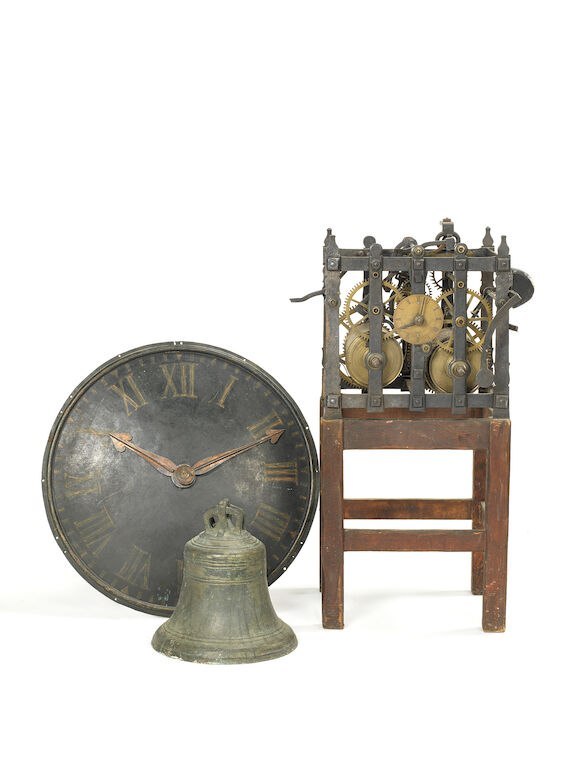
A late 18th century turret clock movement with dial and bell

Partially verified

The source reports this late eighteenth-century two-train turret clock movement is attributed to Ainsworth Thwaites based on comparison with an example in Isleworth Church. Built in a wrought iron birdcage frame with corner inverted baluster finials and three pairs of splayed uprights secured by square-headed nuts, the mechanism features six-crossing wheelwork, ring-turned bushes, maintaining power, and a deadbeat escapement with jewelled pallets. Accompanying items listed by the source include a convex 34.25-inch black painted brass Roman dial with gilt copper heart hands, a cast bronze bell, a four-legged wooden stand, and an eight-foot three-inch steel pendulum rod with an iron-cased lenticular bob.

Overall view showing the turret clock movement on its wooden stand, accompanied by the dial and bell
Overall view showing the turret clock movement on its wooden stand, accompanied by the dial and bell — Bonhams. Rights pending — permission not yet requested. Original source

Catalogue identity

Source
www.bonhams.com
Category
Clock · Turret clock
Maker / attribution
Ainsworth Thwaites (attributed to)
Reference
Not recorded
Catalogue / lot identifier
75
Source-reported date
late 18th century
Country
United Kingdom

Source-reported attribution and specifications are not independent authentication. A listing does not establish present ownership, current display, availability or permission to reproduce.

Object description

Frame and Structural Configuration

The turret movement is housed in a wrought iron open birdcage frame described as having inverted baluster finials at the corners and three pairs of uprights splayed toward the base, which are secured with square-headed nuts. The catalogued dimensions for the frame are 58 cm (23 in) high by 55 cm (21.75 in) wide.

Observation of the lot shows the wrought iron birdcage structure mounted on a four-legged wooden stand. The turned baluster-shaped finials are positioned atop the four outer corner posts.

Evidence for this section
  • “The wrought iron frame with inverted balluster finials to the corners, supporting three pairs of uprights, each splayed toward the base and secured by square headed nuts”
  • “The frame 58cm (23in) high by 55cm (21.75in)”
  • “Wrought iron open birdcage movement sitting on a four-legged wooden stand”
  • “Turned baluster-shaped finials mounted atop the frame corner posts”

Movement Mechanism and Escapement

The cataloguer records the movement as a two-train mechanism fitted with six-crossing wheelwork, maintaining power, and substantial ring-turned bushes. The escapement is catalogued as deadbeat with jewelled pallets.

The accompanying pendulum components listed by the source include an 8-foot 3-inch steel pendulum rod and an iron-cased lenticular bob. However, the full length of the pendulum rod and the lenticular bob are not fully shown in the primary photograph.

Evidence for this section
  • “supporting the two train movement, with six-crossing wheel work, maintaining power and substantial ring turned bushes, the deadbeat escapement with jewelled pallets”
  • “together with the 8 feet three inch steel pendulum rod, iron cased lenticular bob”

Dial, Hands, and Associated Accessories

The lot includes a convex 34.25-inch black painted brass dial displaying Roman numerals, fitted with gilt copper heart hands. Visual observation confirms the large black circular convex Roman dial leaning behind a cast bronze bell, with gilt heart-shaped hands affixed at the center.

In addition to the dial, the source lists a cast bronze bell and a wooden stand among the accompanying components presented with the movement.

Evidence for this section
  • “convex 34.25 inch black painted brass Roman dial, gilt copper heart hands, wooden stand and cast bronze bell.”
  • “Large black circular convex Roman dial leaning behind a cast bronze bell”
  • “Gilt heart-shaped hands affixed to the center of the dial”

Attribution and Comparative Context

The movement is attributed to Ainsworth Thwaites based on comparative analysis rather than a recorded maker's signature. A footnote compiled with the assistance of Christopher McKay notes a very similar movement by Ainsworth Thwaites in Isleworth Church, dated to circa 1775.

The cited similarities between this lot and the Isleworth Church example include the shaped finials, six-crossing wheelwork, jewelled pallets, brass bushes, and maintaining power. The original commissioning location or previous installation site for this movement is not recorded in the source.

Evidence for this section
  • “Attributed to Ainsworth Thwaites”
  • “A very similar example by Ainsworth Thwaites exists in Isleworth Church, dated to circa 1775 with similar shaped finials, six crossing wheelwork, jewelled pallets, brass bushes and maintaining power.”
  • “With thanks to Christopher McKay for his help in compiling this footnote.”

Open research questions

  • Are there any maker's marks, batch numerals, or inscriptions stamped on the wrought iron uprights, arbors, or dial reverse?
  • What specific architectural or church setting did this movement, dial, and bell occupy prior to its appearance at auction in 2013?
  • How closely do the gear pitch and wheel dimensions correspond to the documented circa 1775 Ainsworth Thwaites clock at Isleworth Church?

Source evidence

Recorded claims and source quotations for A late 18th century turret clock movement with dial and bell
FieldSource-reported valueSource quotation
EscapementDeadbeat escapement with jewelled pallets“the deadbeat escapement with jewelled pallets”
Frame ConstructionWrought iron frame with inverted balluster finials“The wrought iron frame with inverted balluster finials to the corners”
Dial DescriptionConvex 34.25 inch black painted brass Roman dial“convex 34.25 inch black painted brass Roman dial”
HandsGilt copper heart hands“gilt copper heart hands”
Frame Dimensions58cm high by 55cm“The frame 58cm (23in) high by 55cm (21.75in)”
Pendulum Specifications8 feet 3 inch steel pendulum rod with iron-cased lenticular bob“8 feet three inch steel pendulum rod, iron cased lenticular bob”
Sale Price£2,500 inc. premium“Sold for £2,500 inc. premium”
Auction DetailsBonhams Fine Clocks, London, New Bond Street, 9 July 2013, Lot 75“Fine Clocks 9 July 2013, 14:00 BST London, New Bond Street”

Visible details

  • Wrought iron open birdcage movement sitting on a four-legged wooden stand
  • Large black circular convex Roman dial leaning behind a cast bronze bell
  • Gilt heart-shaped hands affixed to the center of the dial
  • Turned baluster-shaped finials mounted atop the frame corner posts

Research qualifications

  • Maker attribution to Ainsworth Thwaites is traditional and comparative rather than signed on the movement.
  • The 8-foot 3-inch pendulum rod and iron lenticular bob mentioned in the text are not fully displayed in the photograph.

Photograph identity and source facts were screened before import; rights clearance remains pending.

Terms in this record

Glossary explanations for terms named in this object’s record.

Other turret clock records