
Skip to content
The Encyclopedia of Horology

Clock · Turret clock

Iron turret clock in wooden frame

Partially verified

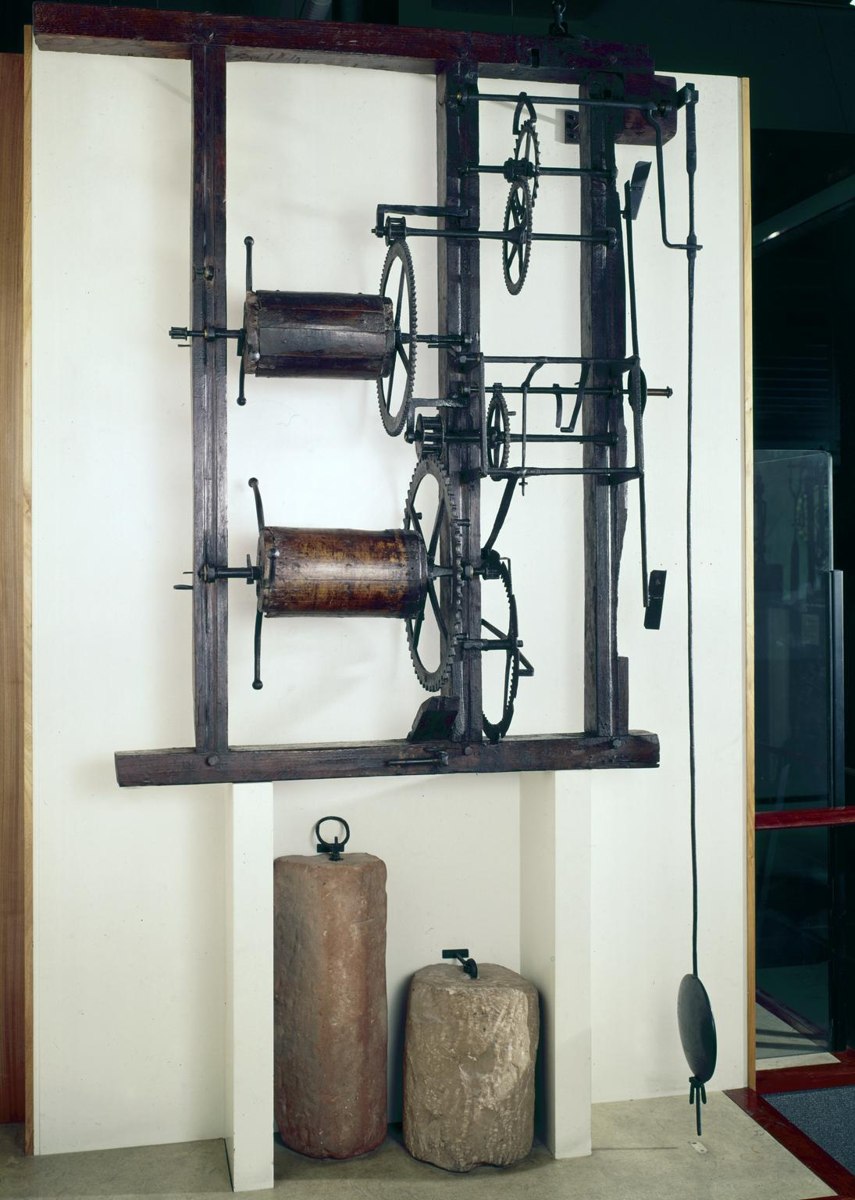
This weight-driven English iron turret clock movement in a wooden frame dates to circa 1675–1685. According to the Science Museum Group, the clock was constructed by an unknown maker and removed from St Peter's Church in Martley, Worcestershire, England. The installation incorporates wooden winding barrels, iron wheelwork, a long pendulum, and rough-hewn sandstone weights. Museum records register the main wooden frame height at 1545 mm and a total height over the pendulum of 2290 mm, with the overall weight of the clock, frame, pendulum, and drive weights totaling 155.5 kg.

Full view of the iron turret clock mounted in its wooden frame with stone weights and pendulum
Full view of the iron turret clock mounted in its wooden frame with stone weights and pendulum — The Board of Trustees of the Science Museum. Rights pending — permission not yet requested. Original source

Catalogue identity

Source
collection.sciencemuseumgroup.org.uk
Category
Clock · Turret clock
Maker / attribution
Not established
Reference
Not recorded
Catalogue / lot identifier
1963-41
Source-reported date
1675-1685
Country
England

Source-reported attribution and specifications are not independent authentication. A listing does not establish present ownership, current display, availability or permission to reproduce.

Object description

Object Identity and Provenance

This English turret clock movement is catalogued under object number 1963-41 by the Science Museum Group, where it is classified both as a tower clock and a weight-driven pendulum clock. The maker is unrecorded, with production dated between 1675 and 1685 in England. Collection records state that the assembly was removed from St Peter's Church in Martley, Worcestershire, England.

The museum records an acquisition credit to Canon J. S. Leatherbarrow. While the principal movement and timber frame survive together, the museum inventories the object across nine component parts (Pt1 through Pt9), cataloguing the frame, wheelwork, drive weights, pendulum rod, pulleys, and associated hardware.

Evidence for this section
  • “Iron turret clock in wooden frame Made: 1675-1685 in England maker: Unknown”
  • “Removed from St Peter' Church, Martley, Worcestershire, England.”
  • “credit: Canon J. S. Leatherbarrow.”

Frame Construction and Visible Assembly

Direct observation of the display shows an open rectangular timber frame supporting iron wheelwork and horizontal shafts, along with two horizontally mounted cylindrical wooden winding barrels on the left side of the frame. Suspended from the upper right is a long iron pendulum rod terminating in a disc-shaped bob, accompanied by two large freestanding sandstone weights with top iron mounting rings set beneath the movement assembly.

Museum metrics document the primary frame height at 1545 mm and a total height over the pendulum of 2290 mm. The main frame and movement component (1963-41 Pt1) measures 1550 mm by 1395 mm by 520 mm with a weight of 55 kg, while the combined weight of the clock, frame, pendulum, and drive weights is recorded as 155.5 kg.

Evidence for this section
  • “Open rectangular timber frame supporting iron wheelwork and horizontal shafts”
  • “Two cylindrical wooden winding barrels mounted horizontally on the left side of the frame”
  • “overall: 1550 mm x 1395 mm x 520 mm, 55 kg Materials: wood (unidentified) and iron Object Number: 1963-41 Pt1”
  • “frame height: 1545 mm total height over pendulum: 2290 mm overall (clock, frame, pendulum and weights): 155.5 kg”

Associated Weights and Peripheral Hardware

The driving weights include sandstone elements catalogued with a combined weight of 100.5 kg across Pt8 and Pt9. Part Pt8 is described as a sandstone weight measuring 385 mm by 280 mm by 280 mm and weighing 43.5 kg, while Part Pt9 is entered under the title 'Pendulum Rod for Iron Turret Clock in Wooden Frame' but measured at 665 mm by 240 mm by 180 mm and 38.5 kg. Part Pt4 descriptions note measurements for a grey sandstone pendulum (430 mm x 250 mm x 260 mm), an orange sandstone pendulum (670 mm x 250 mm x 185 mm), and an estimated pendulum rod measurement of 2160 mm by 45 mm by 230 mm.

Additional ancillary equipment recorded under the inventory includes three single-block wooden pulleys encased in wrought iron frames (Pt5 weighing 1.580 kg, Pt6 weighing 1.020 kg, and Pt7 weighing 2.841 kg), a detached bell hammer measuring 720 mm by 255 mm (Pt3), and additional metal parts (Pt2).

Evidence for this section
  • “Measurements: overall: 385 mm x 280 mm x 280 mm, 43.5 kg overall (pt8+pt9): 100.5 kg Materials: iron and stone Object Number: 1963-41 Pt8”
  • “Bell hammer for iron turret clock in wooden frame”
  • “Wooden pulley, single block with iron frame, one of three for iron turret clock in wooden frame”
  • “Measurements: overall (grey sand stone pendulum): 430 mm x 250 mm x 260 mm, overall (orange sandstone pendulum): 670 mm x 250 mm x 185 mm, overall (estimate) - Pendulum Rod: 2160 mm x 45 mm x 230 mm, Materials: iron and stone Object Number: 1963-41 Pt4”

Open research questions

  • What escapement mechanism is fitted to the movement, and does physical evidence indicate conversion or alterations from its original 1675-1685 construction?
  • Why are both Pt4 and Pt9 titled 'Pendulum Rod for Iron Turret Clock in Wooden Frame' while also listing sandstone dimensions and weights?
  • What specific species of timber constitutes the wooden frame and barrels, which are catalogued in museum records as wood (unidentified)?

Source evidence

Recorded claims and source quotations for Iron turret clock in wooden frame
FieldSource-reported valueSource quotation
Date1675-1685“Made: 1675-1685 in England”
Origin churchSt Peter' Church, Martley, Worcestershire, England“Removed from St Peter' Church, Martley, Worcestershire, England.”
Object Number1963-41“Object Number: 1963-41”
Total weight155.5 kg“overall (clock, frame, pendulum and weights): 155.5 kg”
Total height over pendulum2290 mm“total height over pendulum: 2290 mm”
Movement frame dimensions1550 mm x 1395 mm x 520 mm“overall: 1550 mm x 1395 mm x 520 mm, 55 kg”
Bell hammer dimensions720 mm x 255 mm“Measurements: overall: 720 mm x 255 mm Object Number: 1963-41 Pt3”
Combined weight of sandstone drive weights (Pt8 + Pt9)100.5 kg“overall (pt8+pt9): 100.5 kg”

Visible details

  • Open rectangular timber frame supporting iron wheelwork and horizontal shafts
  • Two cylindrical wooden winding barrels mounted horizontally on the left side of the frame
  • Long iron pendulum rod suspended from the upper right, extending downward to a disc-shaped pendulum bob
  • Two large freestanding sandstone weights with top iron mounting rings set beneath the movement assembly

Research qualifications

  • Maker is unrecorded and unknown
  • The associated three wooden pulleys and detached bell hammer documented in collection records are not shown in this assembled display photograph

Photograph identity and source facts were screened before import; rights clearance remains pending.

Consulted source

Iron turret clock in wooden frame | Science Museum Group Collection

Reviewed 2026-10-21 · Record 26f5e021a6

Terms in this record

Glossary explanations for terms named in this object’s record.