
Skip to content
The Encyclopedia of Horology

Pocket watch · Pocket watch

Pocket Watch by George Graham, No. 6363

Partially verified

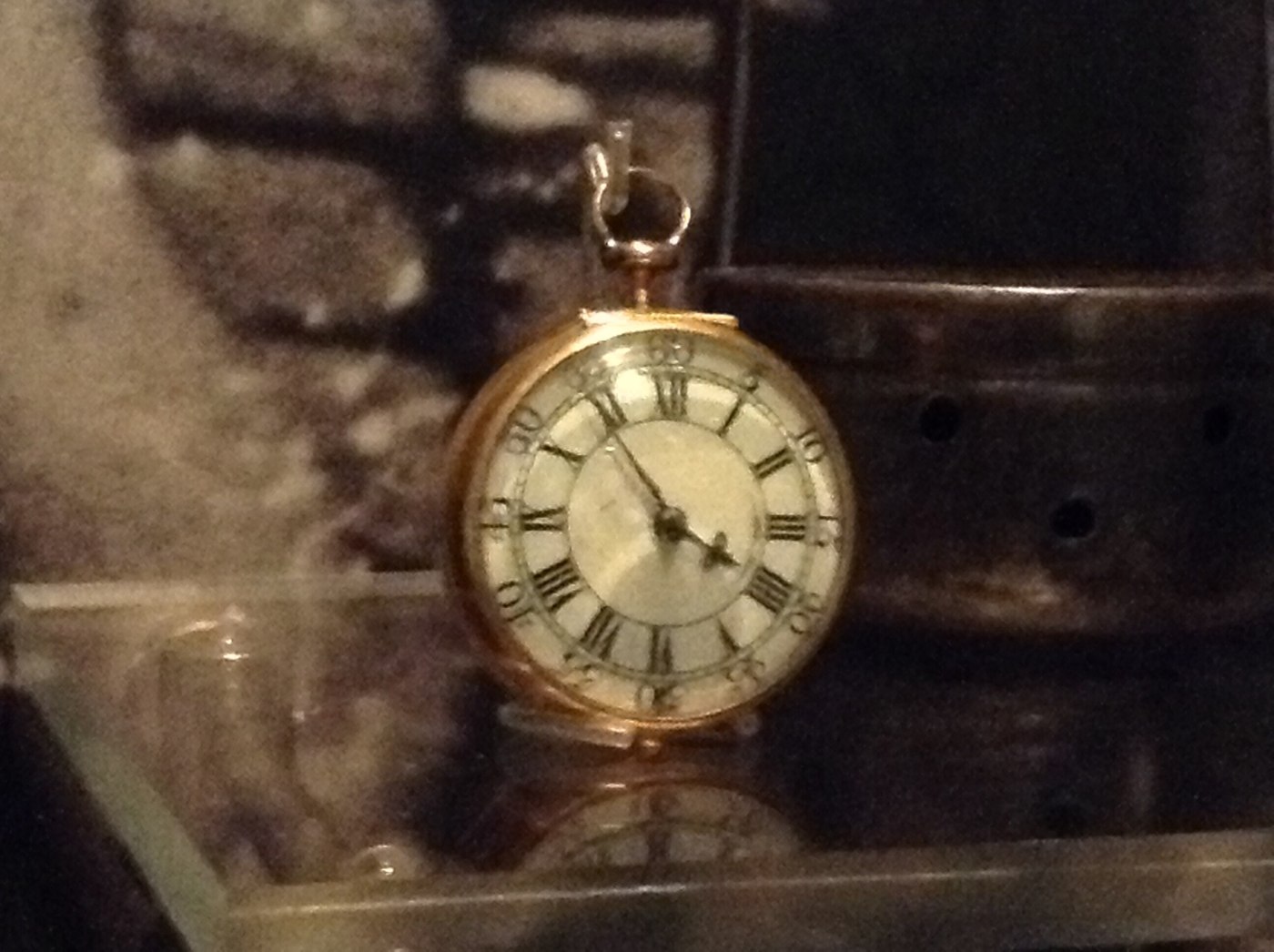
This gold-cased pocket watch, numbered 6363, is attributed to the London maker George Graham and dates to approximately 1747. The timepiece features a white enamel dial marked with black Roman numerals and an outer ring of Arabic numerals calibrated in increments of five. The movement is constructed with a key-wound spring, a fusee and chain mechanism, and a cylinder escapement. The back plate, visible upon opening the case, displays an ornate foliage design and is engraved with the maker's name and serial number. A secondary mark appears on the works cover. The watch, measuring approximately 4.1 cm in outside diameter, was acquired by the museum in 1949 as a donation from Joseph Lowy.

The white enamel dial of the George Graham pocket watch, showing the Roman hour numerals and the outer Arabic minute ring.
The white enamel dial of the George Graham pocket watch, showing the Roman hour numerals and the outer Arabic minute ring. — Museums Victoria. Rights pending — permission not yet requested. Original source

Catalogue identity

Source
collections.museumsvictoria.com.au
Category
Pocket watch · Pocket watch
Maker / attribution
George Graham
Reference
Not recorded
Catalogue / lot identifier
ST 23132
Source-reported date
circa 1747
Source-reported place
England
Source-reported serial
6363

Source-reported attribution and specifications are not independent authentication. A listing does not establish present ownership, current display, availability or permission to reproduce.

Object description

Case and Dial

The watch is housed in a gold case measuring 4.1 cm in diameter. The dial is composed of white enamel and provides a clear display for timekeeping. It features bold black Roman numerals representing the twelve-hour cycle. Encircling the inner hour ring is a secondary track containing black Arabic numerals at intervals of five, specifically "5, 10, 15....60", allowing for precise minute reading.

The external presentation is completed by a pendant loop located at the top of the case. The case itself bears an identifying serial number "6363" and is accompanied by a London gold hallmark, which includes the lion passant.

Evidence for this section
  • “Gold case.”
  • “White enamel dial has black roman numerals and another ring of black arabic numerals "5, 10, 15....60”
  • “Gold case marked "6363 *JW" and has London gold hallmark of lion passant.”

Movement and Mechanism

The technical operation of this watch relies on a key-wound spring. Energy transfer is managed through a fusee and chain, a common arrangement for ensuring constant force in timepieces of this era. The heart of the timekeeping system is a cylinder escapement, which provides the regulation for the watch.

Internal components are protected by a works cover. The back plate, which houses much of the gear train, is decorated with an ornate foliage design. This plate is explicitly marked to identify both the maker and the individual serial number of the unit.

Evidence for this section
  • “Key wound spring; cylinder escapement. Has winding dial and fusee and chain.”
  • “Back plate has ornate foliage design and is marked "GEO. GRAHAM, LONDON, 6363".”

Provenance and Documentation

The watch was acquired by the museum on August 14, 1949, through a donation from Joseph Lowy. Historical details regarding its previous ownership were provided by the donor in a letter dated November 6, 1968. According to Lowy, the watch was purchased at a Joel's auction following the death of a previous owner who had lived in an Old Men's Home.

The donor's account offers a narrative of the watch's movement through private hands before its entry into the museum's collection. While the donor refers to the item as a silver watch, the official museum records identify the casing as gold, confirming the current classification within the museum's science and measurement holdings.

Evidence for this section
  • “Acquisition: Donation from Joseph Lowy, 14 Aug 1949”
  • “A Graham silver pocket watch I gave you over 30 [actually 20?] years ago”
  • “His watches were sold, and I bought one at Joel's auction.”

Open research questions

  • Does the JW maker's mark on the case correspond to a known casemaker working for George Graham in 1747?
  • Is the discrepancy between the donor's description of a silver watch and the museum's identification of a gold case due to an error in the donor's memory or a clerical error in the records?

Source evidence

Recorded claims and source quotations for Pocket Watch by George Graham, No. 6363
FieldSource-reported valueSource quotation
MakerGeorge Graham“Maker, name: George Graham”
Serial Number6363“marked "GEO. GRAHAM, LONDON, 6363”
Datecirca 1747“circa 1747”
Case MaterialGold“Gold case.”
EscapementCylinder escapement“cylinder escapement”
Registration NumberST 23132“Registration number: ST 23132”
Dimensions4.1 cm diameter“4.1 cm (Outside Diameter)”
HallmarksLion passant“London gold hallmark of lion passant”

Visible details

  • White enamel dial with Roman hour numerals
  • Outer chapter ring features Arabic numerals for minutes
  • Pendant loop at the top of the case

Research qualifications

  • The donor's letter mentions a 'silver pocket watch' while the museum record identifies this object as gold
  • The exact date of 1747 is an attribution rather than a documented manufacture date

Photograph identity and source facts were screened before import; rights clearance remains pending.

Consulted source

Pocket Watch - George Graham, No. 6363, circa 1747

Reviewed 2026-10-26 · Record 1152b069a9

Terms in this record

Glossary explanations for terms named in this object’s record.