
Skip to content
The Encyclopedia of Horology

Pocket watch · Pocket watch

Pocket Watch with Pierced Case and Chain

Partially verified

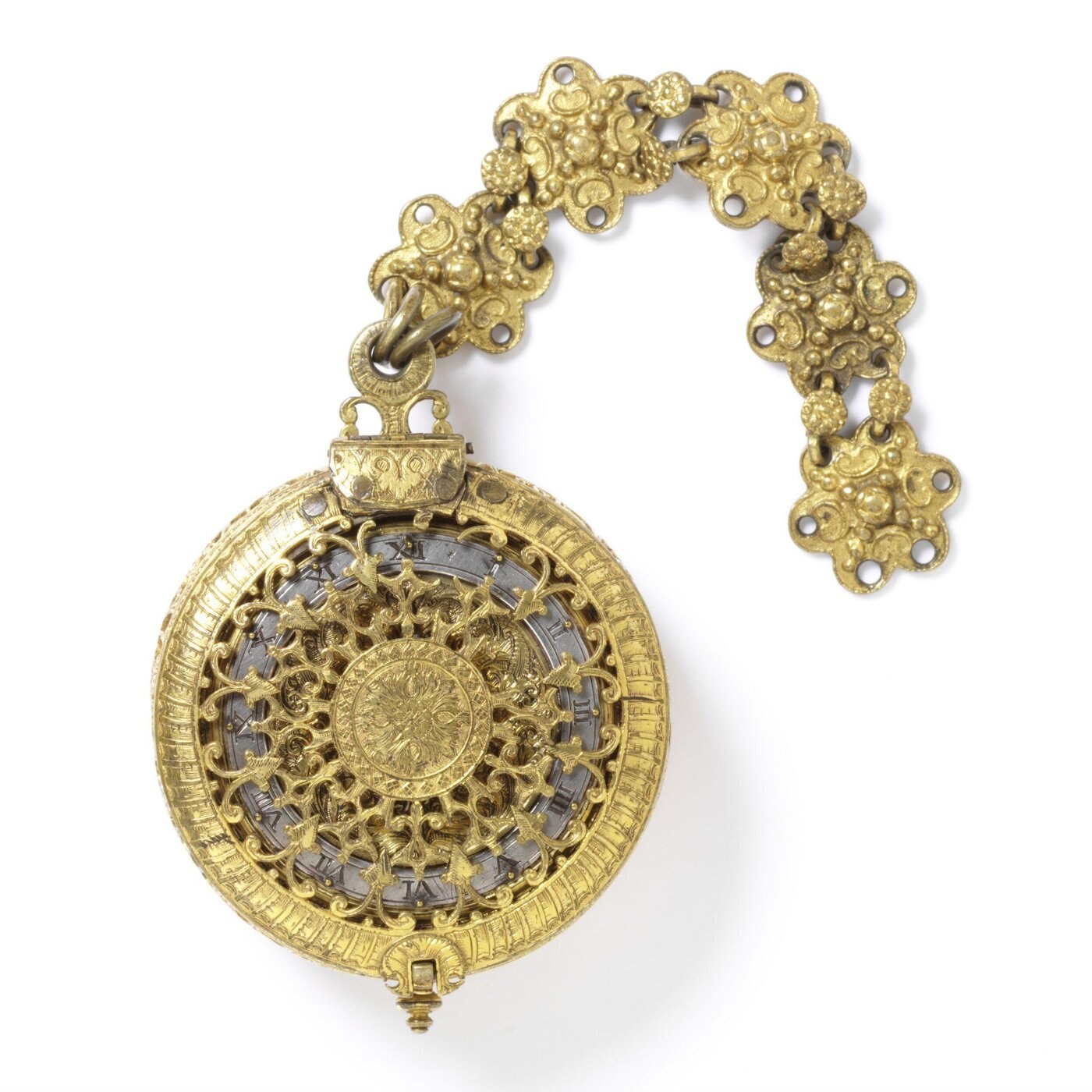
This horological object is a pocket watch comprising an early 17th-century case and a later 17th-century movement. The case, attributed to England circa 1600-1620, is constructed from pierced and engraved brass and includes a silver dial ring. It is decorated with an engraved coat of arms belonging to the families of Stephens of Colchester and Arden, Essex, a grant dating to 1592. A cast gilt brass chain is attached to the case. The movement, which replaced the original, is the work of London maker Edmund Day and is dated to approximately 1695. The watch measures 5.3 cm in diameter with a height of 18.2 cm including the chain. The combination of early case work and a later replacement movement constitutes the current state of the object as catalogued by the V&A museum collection.

Front view showing the pierced brass case and the attached gilt brass chain.
Front view showing the pierced brass case and the attached gilt brass chain. — V&A Museum. Rights pending — permission not yet requested. Original source

Catalogue identity

Source
collections.vam.ac.uk
Category
Pocket watch · Pocket watch
Maker / attribution
Edmund Day
Reference
Not recorded
Catalogue / lot identifier
1137-1905
Source-reported date
ca.1620; ca.1695
Source-reported place
England

Source-reported attribution and specifications are not independent authentication. A listing does not establish present ownership, current display, availability or permission to reproduce.

Object description

Case Construction and Heraldry

The object features a circular case crafted from brass that has been extensively pierced and engraved with decorative scrollwork. The front of the case allows for the visibility of the internal silver dial ring, which is marked with Roman numerals. The exterior of the case is distinguished by the inclusion of an engraved coat of arms associated with the Stephens family of Colchester and Arden, Essex, based on a grant issued in 1592.

A cast gilt brass chain is attached to the upper section of the case, consistent with mid-to-late period accessories. The overall dimensions of the watch include a height of 18.2 cm and a depth of 3.8 cm, with a case diameter of 5.3 cm.

Evidence for this section
  • “watch with a pierced and engraved brass case, silver dial ring, engraved with the arms of Stephens of Colchester and Arden”
  • “Height: 18.2 cm; Width: 5.3 cm; Depth: 3.8 cm; Diameter: 5.3 cm”
  • “engraved with the arms of Stephens (of Colchester and Arden, Essex), granted 1592”

Movement and Replacement

The watch currently contains a movement produced by Edmund Day of London, which is dated to approximately 1695. This movement is not the original mechanism of the watch, but rather a replacement fitted at the end of the 17th century. The movement plate features intricate hand-engraved scrolling patterns across its surface, consistent with decorative practices for London-made pocket watches of this period.

The mechanical assembly includes a visible balance cock and a regulatory dial with Arabic numerals.

Evidence for this section
  • “the movement replaced ca.1695 by Edmund Day of London”
  • “Day, Edmund (movement)”

Attribution and Provenance

Records for this object define its provenance through the combination of its disparate components. The case is cited as English and manufactured circa 1600–1620, while the movement is attributed to Edmund Day of London, circa 1695. These dates and attributions are maintained by the museum’s current documentation.

The object is catalogued under the accession number 1137-1905, indicating its formal status within the collection. The physical descriptions provide a record of the object's construction materials, specifically noting the use of brass, gilt brass, and silver.

Evidence for this section
  • “Place of origin: England (made); London (made)”
  • “Date: ca.1620; ca.1695”
  • “Accession number: 1137-1905”

Open research questions

  • What is the specific mechanical design of Edmund Day's 1695 movement compared to typical 17th-century London movements?
  • Is there further archival evidence regarding the transition of the watch in 1695 and the reasons for the movement replacement?

Source evidence

Recorded claims and source quotations for Pocket Watch with Pierced Case and Chain
FieldSource-reported valueSource quotation
Maker (Movement)Edmund Day“Day, Edmund (movement)”
Date (Case)ca.1620“ca.1620”
Date (Movement)ca.1695“ca.1695”
Country of originEngland“England (made)”
Accession Number1137-1905“1137-1905”
HeraldryStephens of Colchester and Arden“engraved with the arms of Stephens of Colchester and Arden”
Dimensions18.2 cm height“Height: 18.2 cm”

Visible details

  • Case features extensive pierced and engraved scrolling floral patterns
  • Dial includes a silver ring with Roman numeral markers
  • Cast gilt brass chain is composed of repeated floral or foliate link units
  • Internal bridge is engraved with ornate scrollwork
  • Movement includes a regulator wheel with Arabic numerals

Research qualifications

  • The exact provenance of the movement replacement in 1695 is not detailed
  • The original maker of the case remains unidentified in current records

Photograph identity and source facts were screened before import; rights clearance remains pending.

Consulted source

Watch

Reviewed 2026-10-26 · Record f6a724d3b9

Terms in this record

Glossary explanations for terms named in this object’s record.