
Skip to content
The Encyclopedia of Horology

Marine chronometer · Two-day marine chronometer

Marine chronometer by Charles Shepherd

Partially verified

This two-day marine chronometer was made between 1840 and 1850 (dated circa 1845) by Charles Shepherd in London. Preserved in the Worshipful Company of Clockmakers collection (museum number 766), the instrument is mounted in a gimballed wooden box with brass fittings and green baize lining. The movement features a fusee with chain, spring detent escapement, compensated two-arm balance, and helical balance spring. The source reports a silvered brass dial with subsidiary seconds and an up-and-down indicator, signed ‘Charles Shepherd, Leadenhall St. London 390’ with steel hands.

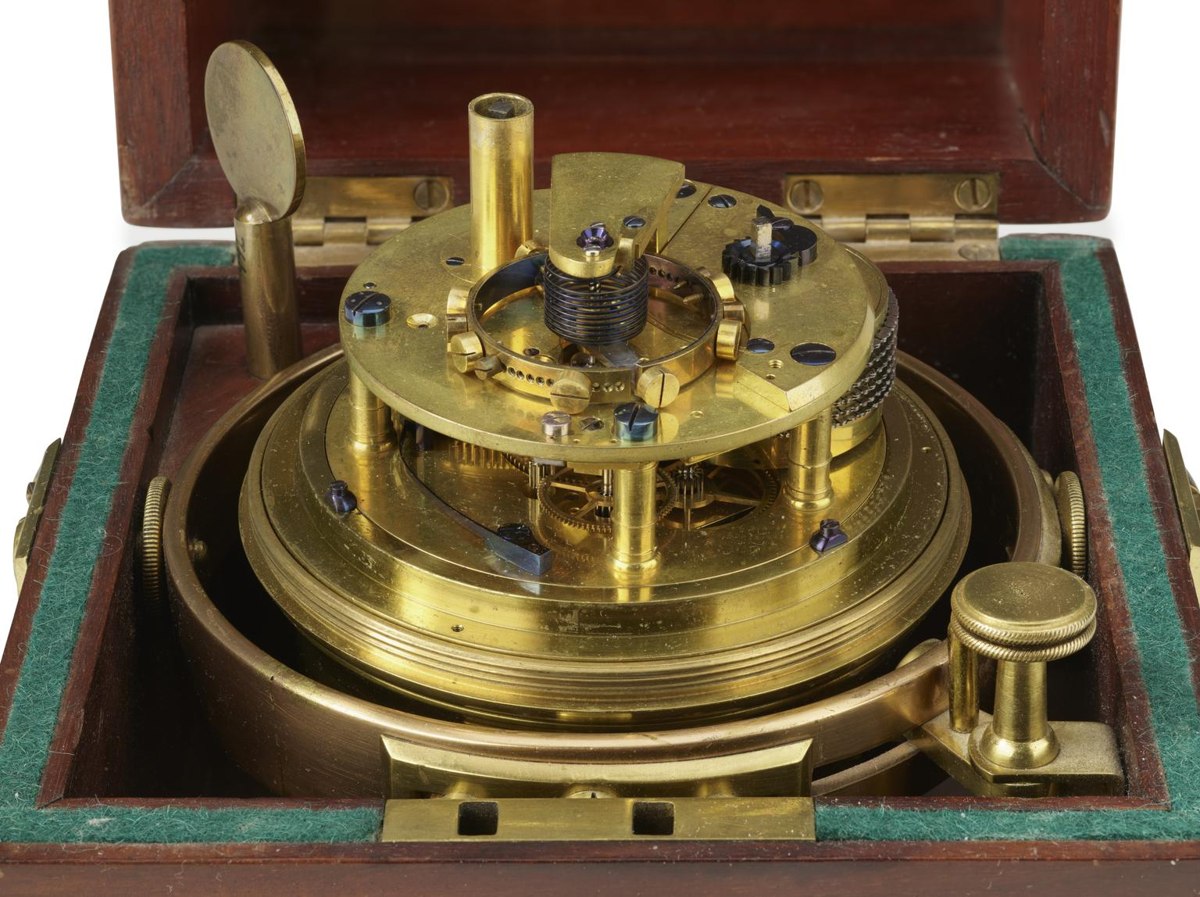
Movement view of the marine chronometer by Charles Shepherd in its gimballed brass bowl and wooden box
Movement view of the marine chronometer by Charles Shepherd in its gimballed brass bowl and wooden box — Science Museum Group/The Clockmakers' Museum © The Board of Trustees of the Science Museum. Rights pending — permission not yet requested. Original source

Catalogue identity

Source
collection.sciencemuseumgroup.org.uk
Category
Marine chronometer · Two-day marine chronometer
Maker / attribution
Shepherd, Charles
Reference
Not recorded
Catalogue / lot identifier
L2015-3640
Source-reported date
c. 1845
Country
United Kingdom
Source-reported serial
390

Source-reported attribution and specifications are not independent authentication. A listing does not establish present ownership, current display, availability or permission to reproduce.

Object description

Object Identity and Documentation

This marine chronometer is catalogued under object number L2015-3640 and Clockmakers' Museum No. 766 in The Worshipful Company of Clockmakers collection. The record attributes the instrument to maker Charles Shepherd in London, dated 1840-1850 (and noted elsewhere as c.1845).

The overall physical dimensions are recorded as 157 mm by 165 mm by 150 mm. The institutional listing specifies materials including mahogany, brass, steel, glass, silvered brass, and diamond, with a stated duration of 2 days.

Evidence for this section
  • “Clockmakers' Museum No. 766”
  • “Made: 1840-1850 in London maker: Shepherd, Charles”
  • “overall: 157 mm x 165 mm x 150 mm”
  • “2 day duration.”

Visible Movement Construction and Mounting

Visual observation of the inverted instrument displays brass movement plates separated by cylindrical pillars, exposing the fusee mechanism and wrapped chain. Blued screws are visible across the top plate and balance cock.

A prominent blued helical balance spring is centered on a compensated balance fitted with brass timing screws and weights. The assembly sits in a gimballed brass mounting ring and bowl fitted within a wooden box lined with green baize, with a winding key resting upright in a corner brass tube fitting.

Evidence for this section
  • “Brass movement plates separated by cylindrical pillars, showing the fusee mechanism and wrapped chain.”
  • “Prominent blued helical balance spring centered on a compensated balance with brass timing screws and weights.”
  • “Gimballed brass mounting ring and bowl fitted inside a mahogany box with green baize lining.”
  • “Winding key resting upright in a corner brass tube fitting within the box.”

Reported Dial and Mechanism Features

According to the museum description, the chronometer features a 'Silvered dial with subsidiary seconds and an up-and-down indicator, signed ‘Charles Shepherd, Leadenhall St. London 390’' with 'Steel hands.' This dial face is turned downward in the movement photograph and is not directly visible.

The movement is catalogued as a 'Fusee movement with spring detent escapement, compensated two-arm balance and helical spring.' While the compensated balance and helical spring are observable, the spring detent itself is not visibly exposed in the photograph.

Evidence for this section
  • “Silvered dial with subsidiary seconds and an up-and-down indicator, signed ‘Charles Shepherd, Leadenhall St. London 390’.”
  • “Steel hands.”
  • “Fusee movement with spring detent escapement, compensated two-arm balance and helical spring.”

Open research questions

  • Where is the diamond component listed in the materials catalog located within the movement (e.g., balance cock endstone)?
  • What is the condition and preservation state of the concealed silvered dial and steel hands?
  • Does the wooden box retain its exterior lid and outer fittings?

Source evidence

Recorded claims and source quotations for Marine chronometer by Charles Shepherd
FieldSource-reported valueSource quotation
Maker and LocationCharles Shepherd, London“Marine chronometer by Charles Shepherd, London, c.1845.”
Dial Signature and SerialCharles Shepherd, Leadenhall St. London 390“signed ‘Charles Shepherd, Leadenhall St. London 390’”
Escapement and Movement DetailsFusee movement with spring detent escapement, compensated two-arm balance and helical spring“Fusee movement with spring detent escapement, compensated two-arm balance and helical spring.”
Duration2 day duration“2 day duration.”
Dimensions157 mm x 165 mm x 150 mm“overall: 157 mm x 165 mm x 150 mm”
Museum NumbersL2015-3640 / Clockmakers' Museum No. 766“Clockmakers' Museum No. 766”
Listed MaterialsMahogany, brass, steel, glass, silvered brass, and diamond“Materials: mahogany (wood) , brass (copper, zinc alloy) , steel (metal) , glass , silvered brass and diamond”
Box MountingGimballed wooden box with brass fittings“Gimballed wooden box with brass fittings.”
Lender CreditLent by the Worshipful Company of Clockmakers“credit: Lent by the Worshipful Company of Clockmakers”

Visible details

  • Prominent blued helical balance spring centered on a compensated balance with brass timing screws and weights.
  • Brass movement plates separated by cylindrical pillars, showing the fusee mechanism and wrapped chain.
  • Gimballed brass mounting ring and bowl fitted inside a mahogany box with green baize lining.
  • Winding key resting upright in a corner brass tube fitting within the box.
  • Blued screws visible across the top plate and balance cock.

Research qualifications

  • The dial and steel hands are positioned downward or enclosed and are not visible in this photograph.
  • The full exterior of the mahogany chronometer box is not depicted.

Photograph identity and source facts were screened before import; rights clearance remains pending.

Consulted source

Marine chronometer by Charles Shepherd | Science Museum Group Collection

Reviewed 2026-10-21 · Record e19e23ae07

Terms in this record

Glossary explanations for terms named in this object’s record.