
Skip to content
The Encyclopedia of Horology

Clock · Table clock

Mahogany striking table clock by Benjamin Maud

Partially verified

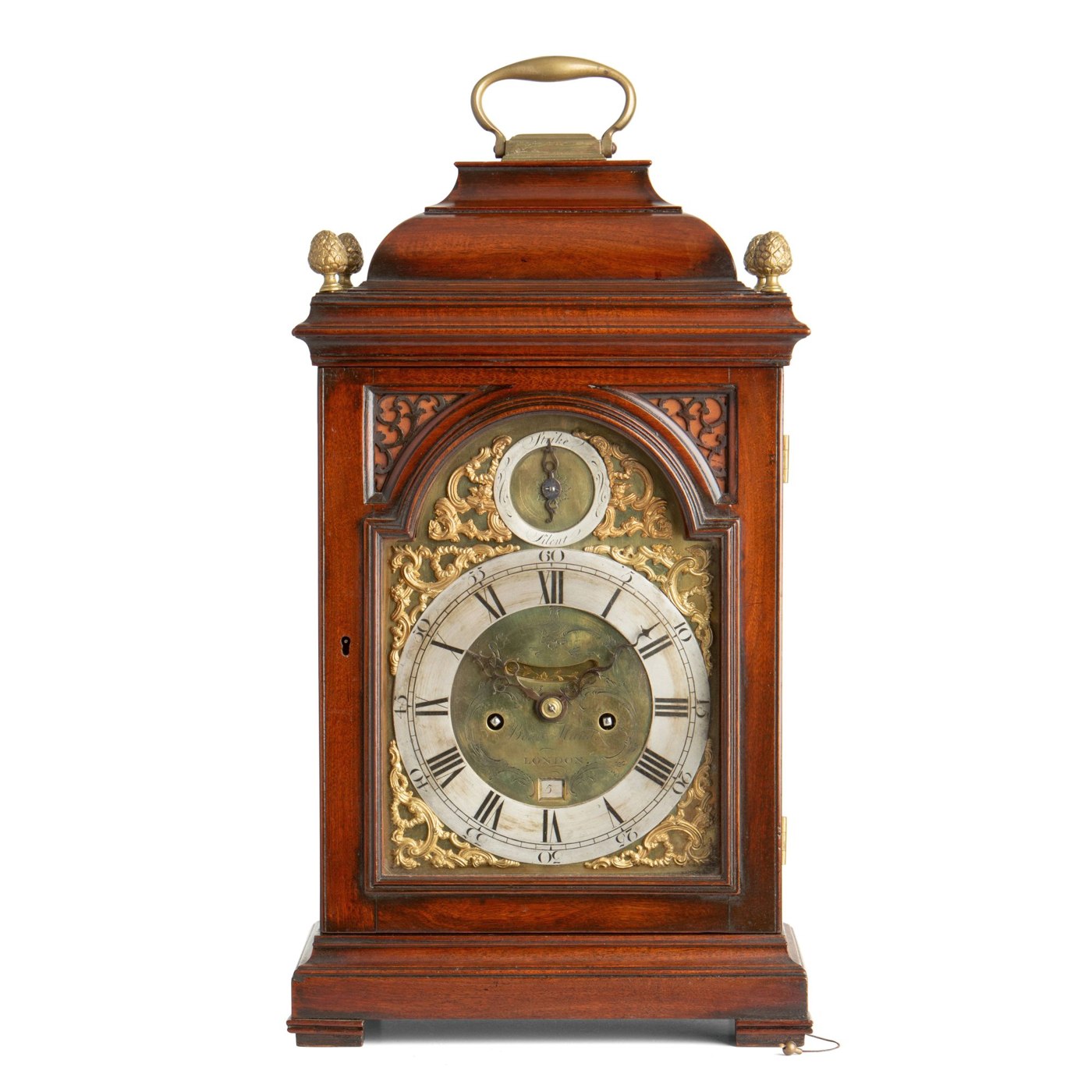
This English spring-driven striking table clock, attributed to circa 1765, is housed in a mahogany bell top case. The clock is signed "Benjamin Maud London" on the dial. The case features arched front and rear doors, brass silk-lined fish-scale frets on the sides, and pierced mahogany corner frets. It is surmounted by a brass carrying handle and pineapple finials, resting on block feet. The dial includes a silvered brass Roman and Arabic chapter ring, an engraved center with a date aperture, a false pendulum, and rococo corner spandrels. A strike/silent subsidiary dial is located in the arch. The eight-day movement is powered by two spring barrels through fusees, featuring an original verge escapement and rack striking on a bell. The mechanism includes a pull-cord repeat function. The back plate is engraved with matching brackets. The total height with the handle raised is 51.5 cm.

Front view of the mahogany striking table clock by Benjamin Maud.
Front view of the mahogany striking table clock by Benjamin Maud. — Dorset Antique Clocks. Rights pending — permission not yet requested. Original source

Catalogue identity

Source
www.dorsetantiqueclocks.co.uk
Category
Clock · Table clock
Maker / attribution
Benjamin Maud
Reference
Not recorded
Catalogue / lot identifier
Source URL identifies the listing
Source-reported date
circa 1765
Source-reported place
England

Source-reported attribution and specifications are not independent authentication. A listing does not establish present ownership, current display, availability or permission to reproduce.

Object description

Case Construction

The clock is housed in a mahogany case of a bell top design. The case includes arched doors positioned at the front and rear, which provide access to the dial and the movement. The aesthetic detailing includes pierced mahogany sound frets placed at the corners, complemented by side panels featuring brass, silk-lined fish-scale frets.

The top of the case is fitted with a brass carrying handle and is adorned with four pineapple-shaped finials at each corner.

Evidence for this section
  • “The bell top case is of classical shape for the period, with arched doors to the front and rear, and pierced mahogany sound frets to the corners with brass silk-lined fish-scale frets to both sides.”
  • “The case is embellished with pineapple finials on the four corners and is surmounted by a brass carrying handle, while the clock rests on block feet.”

Dial and Indication

The dial features an arched top containing a subsidiary strike/silent dial. The main chapter ring is constructed of silvered brass, displaying Roman numerals for the hours and Arabic numerals for the minutes.

The center of the dial is engraved and signed by the maker. Additional functional elements include a date aperture and a false pendulum. The corners of the arched dial are decorated with rococo-style gilt brass spandrels.

Evidence for this section
  • “The corners of the arched dial are embellished by rococo spandrels around a silvered brass Roman and Arabic chapter ring, with an engraved centre signed “Benjamin Maud London”, date aperture and false pendulum.”
  • “In the arch, there is a strike/silent subsidiary dial.”

Movement

The timepiece is powered by an eight-day movement featuring two spring barrels regulated by fusees. It utilizes an original verge escapement for timekeeping and incorporates a rack striking system that sounds the hours on an internal bell.

The clock includes a repeat mechanism, allowing the user to restrike the last hour by operating a cord located on the side. The back plate of the movement is decorated with engraved patterns that match the brackets on the dial.

Evidence for this section
  • “It consists of going work with original verge escapement, rack hour striking on a bell. The last hour struck can be repeated at will by pulling a cord to the side of the clock.”
  • “The back plate of the clock is beautifully engraved with matching brackets.”

Open research questions

  • What is the specific relationship between Benjamin Maud and other London makers of the 1760s?
  • Are the pineapple finials original to the case or later additions consistent with the clock's maintenance history?

Source evidence

Recorded claims and source quotations for Mahogany striking table clock by Benjamin Maud
FieldSource-reported valueSource quotation
MakerBenjamin Maud“signed on the dial “Benjamin Maud London””
EscapementVerge“original verge escapement”
Dimensions51.5 cm“Height: 20 ¼″ or 51.5cm (Handle up)”
Movement typeEight-day, spring-driven“The eight-day movement is driven by two spring barrels via fusees.”
Case materialMahogany“mahogany case”
Striking mechanismRack striking on a bell“rack hour striking on a bell”
Datecirca 1765“CIRCA. 1765”

Visible details

  • Case features four pineapple finials
  • Sides have brass, silk-lined fish-scale frets
  • Movement back plate is engraved
  • Dial includes a strike/silent selector

Research qualifications

  • The source notes that the provided images were taken prior to restoration
  • The exact manufacturing date is provided as an approximate period attribution

Photograph identity and source facts were screened before import; rights clearance remains pending.

Consulted source

MAHOGANY STRIKING TABLE CLOCK – BENJAMIN MAUD – LONDON

Reviewed 2026-11-02 · Record d1ff9995fb

Terms in this record

Glossary explanations for terms named in this object’s record.