
Skip to content
The Encyclopedia of Horology

Clock · Table clock

Winterhalder and Hoffmeier late 19th century German oak cased quarter 'ting-tang' striking clock

Partially verified

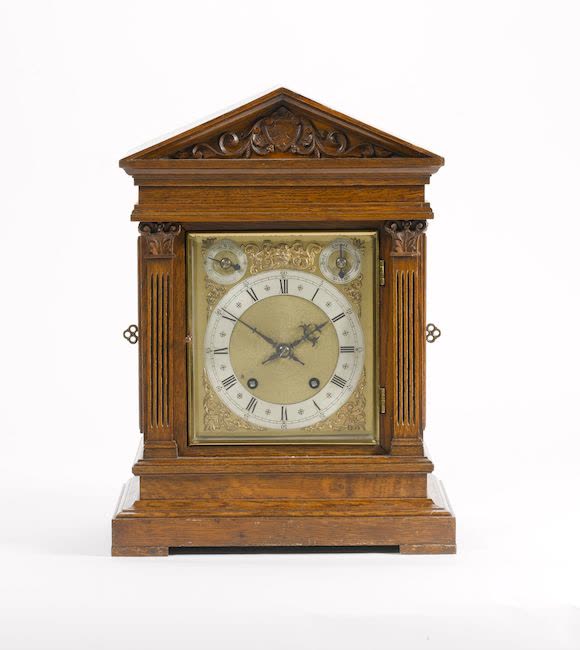
Catalogued under Winterhalder and Hoffmeier, this late 19th-century German table clock features a temple-style carved oak case with an architectural pedimented top. The glazed front door is flanked by reeded Corinthian columns above a moulded plinth supported by block feet. The rectangular dial is fitted with gilt foliate spandrels, a matted centre, Roman numerals, and two subsidiary dials in the upper corners for strike/silent and rise-and-fall regulation. According to the auction source, the interior movement incorporates twin barrels and an anchor escapement that provides quarter 'ting-tang' striking on two gongs.

Front view of the oak-cased architectural quarter-striking table clock
Front view of the oak-cased architectural quarter-striking table clock — Bonhams. Rights pending — permission not yet requested. Original source

Catalogue identity

Source
www.bonhams.com
Category
Clock · Table clock
Maker / attribution
Winterhalder and Hoffmeier
Reference
Not recorded
Catalogue / lot identifier
304
Source-reported date
late 19th century
Country
Germany

Source-reported attribution and specifications are not independent authentication. A listing does not establish present ownership, current display, availability or permission to reproduce.

Object description

Architectural Case and Dimensions

The clock is housed in an oak architectural case standing 41.5cm (16.25in) high. Built in a classical temple style, the superstructure includes an architectural top situated over a glazed door. The front facade is flanked by reeded Corinthian columns that rest upon a moulded plinth terminating in block feet.

According to the auction catalogue, the sides of the case feature opening, pierced sound frets carved in oak to permit sound dissipation from the internal striking mechanism.

Evidence for this section
  • “The temple style carved oak case with architectural top, opening sound pierced oak sound frets to the sides, reeded Corinthian columns on a moulded plinth with block feet”
  • “41.5cm (16.25in) high.”

Dial Configuration

The time display is formed around a 6-inch rectangular dial featuring a matted centre and gilt foliate spandrels mounted in the corners. The dial ring displays both Roman and Arabic chapter markings, with visible winding apertures set in the lower half.

In the upper corners, two subsidiary dials provide controls for mechanical functions: one dial controls strike/silent selection, while the second governs rise-and-fall pendulum regulation.

Evidence for this section
  • “the 6 inch rectangular dial with gilt foliate spandrels, Roman and Arabic chapters, matted centre and subsidiary dials for strike/silent and rise and fall regulation to the upper corners”

Reported Movement and Quarter Striking

The internal mechanism is catalogued by Bonhams as a twin barrel movement with an anchor escapement. It utilizes a rack striking system that produces a quarter 'ting-tang' strike sounding on two gongs.

The clock is attributed in the auction listing to German makers Winterhalder and Hoffmeier and dated to the late 19th century. However, physical maker stamps, trademark insignias, or internal signatures are not recorded in the source text and cannot be seen from the front photograph, as the internal movement is fully enclosed.

Evidence for this section
  • “the twin barrel movement with anchor escapement rack striking on two gongs”
  • “A late 19th century German oak cased quarter 'ting-tang' striking clock Winterhalder and Hoffmeier”

Open research questions

  • Is the backplate of the movement stamped with the trademark 'W&H Sch' mark or other stamps identifying Winterhalder and Hoffmeier?
  • Are the two gongs configured as coiled wire gongs or straight gong rods?
  • Does the case retain any maker or retailer paper labels or assembly numbers on the interior back door?

Source evidence

Recorded claims and source quotations for Winterhalder and Hoffmeier late 19th century German oak cased quarter 'ting-tang' striking clock
FieldSource-reported valueSource quotation
MakerWinterhalder and Hoffmeier“Winterhalder and Hoffmeier”
Case material and designTemple style carved oak case with architectural top“The temple style carved oak case with architectural top, opening sound pierced oak sound frets to the sides, reeded Corinthian columns on a moulded plinth with block feet”
Dial description6 inch rectangular dial with gilt foliate spandrels and subsidiary dials“the 6 inch rectangular dial with gilt foliate spandrels, Roman and Arabic chapters, matted centre and subsidiary dials for strike/silent and rise and fall regulation to the upper corners”
MovementTwin barrel movement with anchor escapement striking on two gongs“the twin barrel movement with anchor escapement rack striking on two gongs”
Height41.5cm (16.25in)“41.5cm (16.25in) high.”
Auction Sale Price£360 inc. premium“Sold for £360 inc. premium”
Sale Date and Location13 March 2007, London, Knightsbridge“13 March 2007, 12:00 GMT London, Knightsbridge”

Visible details

  • Carved pediment over a glazed front door flanked by fluted Corinthian columns
  • Dial features two upper subsidiary dials and two winding arbors in the lower chapter ring
  • Gilt openwork spandrels frame the chapter ring

Research qualifications

  • Movement and interior gong arrangement are concealed within the case and not visible in the photograph
  • Rear and side profiles are not depicted

Photograph identity and source facts were screened before import; rights clearance remains pending.

Terms in this record

Glossary explanations for terms named in this object’s record.