
Skip to content
The Encyclopedia of Horology

Clock · Longcase clock

Mahogany astronomical longcase clock

Partially verified

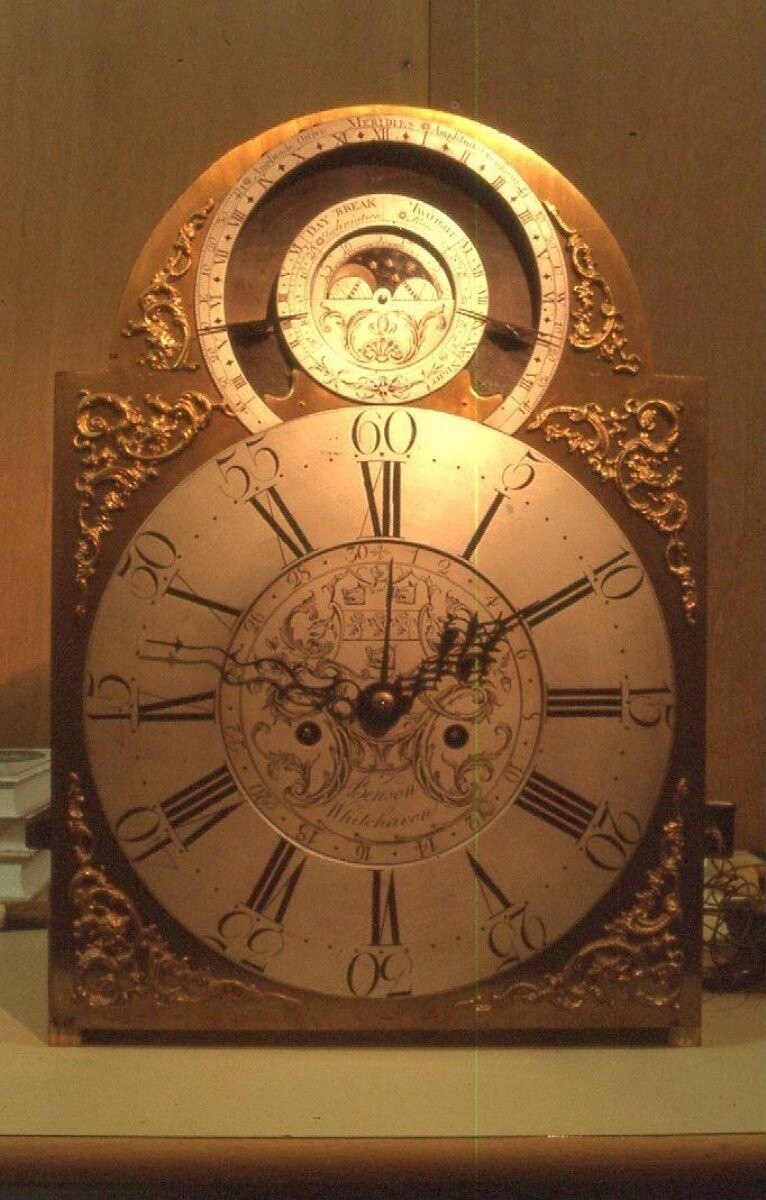
This mahogany astronomical longcase clock was crafted by John Benson in Whitehaven, Cumbria, around 1760. The clock features a break-arch brass dial with a silvered chapter ring, Roman hour numerals, and Arabic minute indicators. The dial center includes a date aperture, and engravings of boar's heads, lions rampant, and a helmet, which are associated with the Hudson family of Preston. Four Rococo-style brass spandrels adorn the main dial, while the arch contains solar and lunar indicators. The weight-driven, two-train brass and steel movement features rack striking on a bell and four bulbous pillars. A complex calendar and astronomical mechanism, driven by a central arbor, powers shutters in the dial arch to indicate sunrise and sunset. The mahogany case is designed in a style influenced by the Lancashire Chippendale tradition. The clock was donated to the Victoria and Albert Museum by Robert N. Shaw.

Front view of the dial, showing the main chapter ring, calendar hand, lunar/solar dial arch display, and Rococo spandrels.
Front view of the dial, showing the main chapter ring, calendar hand, lunar/solar dial arch display, and Rococo spandrels. — Victoria and Albert Museum. Rights pending — permission not yet requested. Original source

Catalogue identity

Source
collections.vam.ac.uk
Category
Clock · Longcase clock
Maker / attribution
John Benson
Reference
Not recorded
Catalogue / lot identifier
W.22:1 to 3-1932
Source-reported date
about 1760
Source-reported place
United Kingdom

Source-reported attribution and specifications are not independent authentication. A listing does not establish present ownership, current display, availability or permission to reproduce.

Object description

Dial and Astronomical Complications

The clock features a break-arch brass dial comprising a silvered chapter ring with Roman hours and Arabic minutes. The central dial area is engraved with calendar numerals, boar's heads, lions rampant, and a helmet. Rococo-style spandrels are applied at the four corners of the main dial, with two additional spandrels positioned in the arch.

The arch contains an astronomical display showing solar and lunar information. The moon work is driven by a separate arbor connected to the minute pinion.

Evidence for this section
  • “the silvered and engraved dial centre carries a narrow band engraved with Arabic numbers for the date”
  • “There are four cast brass corner spandrels of Rococo style on the main dial”
  • “The front of the arms carries shutters thus indicating times of sunrise and sunset throughout the year”

Movement Construction

The movement is a weight-driven, two-train brass and steel mechanism featuring rack striking on a bell. The four pillars are of a bulbous profile with a distinct groove in the center of the swelling. The front plate exhibits circular scribe lines, interpreted as evidence of the layout work performed during the clock's assembly.

The winding barrels are noted for their smooth, ungrooved surfaces. The calendar hand is operated by a ratchet wheel linked to a 24-hour wheel, with an eccentric post that completes a full rotation once per year to drive the astronomical display. The back cock lacks steady pins, and the wheel arbors utilize 'T' shaped collets.

Evidence for this section
  • “The outside front plate retains circular scribe lines to indicate the layout of the wheelwork.”
  • “Both winding barrels are have smooth, brass surfaces”
  • “The back cock is devoid of steady pins.”

Case and Provenance

The mahogany case follows an architectural design from circa 1760, characterized by a scroll pediment, canted corners featuring fluted pilasters, and fretwork on the base. The design is cited as a restrained example of the Lancashire Chippendale style, with potential inspiration drawn from Thomas Chippendale’s Director.

The object was formerly part of the collection of W. Norman Shaw and was subsequently donated by his son, Robert N. Shaw, to the Victoria and Albert Museum in 1932. Inspection records from the time of arrival at the museum noted the case was in a damaged condition, with cracks, chips, and missing portions present.

Evidence for this section
  • “mahogany case of architectural design of about 1760”
  • “The case is a restrained example of the Lancashire Chippendale style”

Open research questions

  • Does the presence of smooth winding barrels definitively link this clock to other known regional makers in Whitehaven or Ireland?
  • Can the provenance of the heraldic devices be verified beyond the family attribution of Hudson of Preston?

Source evidence

Recorded claims and source quotations for Mahogany astronomical longcase clock
FieldSource-reported valueSource quotation
MakerJohn Benson“made by John Benson, Whitehaven, Cumbria, about 1760”
Dateabout 1760“about 1760”
MaterialsMahogany, brass, steel“Mahogany astronomical long case clock”
Accession numberW.22:1 to 3-1932“W.22:1 to 3-1932”
Movement detailsWeight driven two-train with rack striking“Brass and steel weight driven two-train movement with rack striking on bell.”
ProvenanceGift of Robert N. Shaw“Gift of Robert N Shaw, formerly in the collection of his father W Norman Shaw”

Visible details

  • The winding barrels are smooth and lack traditional grooves.
  • The dial engraving includes heraldic motifs of boar's heads and lions.
  • The movement plates retain circular scribe lines from the layout process.

Research qualifications

  • The identification of the coat of arms as belonging to the Hudson family of Preston is considered probable by researchers rather than certain.
  • The purpose of the smooth winding barrels is not fully confirmed, with theories ranging from a local regional style to a specific movement supplier.

Photograph identity and source facts were screened before import; rights clearance remains pending.

Terms in this record

Glossary explanations for terms named in this object’s record.