
Skip to content
The Encyclopedia of Horology

Clock · Longcase clock

George III Mahogany Arch Dial Longcase Clock

Partially verified

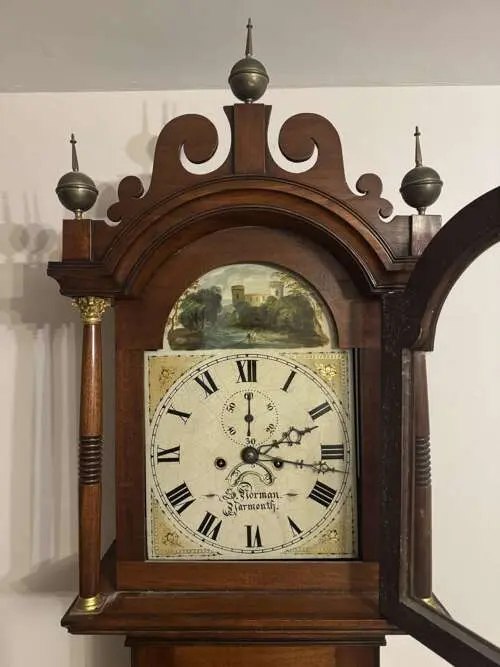
This George III period English longcase clock dates to circa 1800 and is cased in mahogany. The hood features a scroll pediment surmounted by three ball-and-spire finials, flanked by turned columns fitted with gilt metal Corinthian-style capital mounts. An arched painted dial depicts a landscape with a castle in the arch above Roman numeral hour markers, an inner subsidiary seconds register, and a calendar aperture. The lower dial is inscribed 'S. Norman, Yarmouth'. According to the dealer, the clock houses an eight-day movement striking on a bell and retains its pendulum, weights, and winding key.

Hood and painted arch dial of the George III mahogany longcase clock
Hood and painted arch dial of the George III mahogany longcase clock — Unique Antiques by Emma Jade / Antiques Boutique. Rights pending — permission not yet requested. Original source

Catalogue identity

Source
www.antiquesboutique.com
Category
Clock · Longcase clock
Maker / attribution
S. Norman, Yarmouth
Reference
AB-261769
Catalogue / lot identifier
Source URL identifies the listing
Source-reported date
circa 1800
Country
United Kingdom

Source-reported attribution and specifications are not independent authentication. A listing does not establish present ownership, current display, availability or permission to reproduce.

Object description

Dial Composition and Inscription

The clock incorporates an arched painted dial with an architectural landscape scene featuring a castle painted in the arch. Below the arch, the circular dial face features Roman numeral hour markers, winding arbors, and subsidiary dial work.

The painted surface exhibits visible craquelure across the white ground, alongside decorative gilt scroll spandrels in the corners. Directly below the winding arbors, a painted dial signature reads 'S. Norman, Yarmouth'.

Evidence for this section
  • “casing an arched painted dial with a castle scene to the arch above a painted circular dial with Roman numerals”
  • “Arched dial exhibits craquelure throughout the painted face, with gilt scroll spandrel decoration in the corners.”
  • “Painted dial signature beneath the winding arbors reads 'S. Norman, Yarmouth'.”

Case Architecture and Hood Design

The case is constructed from mahogany and measures 230 cm in height, 54 cm in width, and 25 cm in depth. The hood is designed with a scrolled pediment surmounted by three ball-and-spire finials, which the listing text describes as brass.

Turned side columns flank the dial, featuring ribbed centers and gilt metal Corinthian-style capital mounts. According to the seller description, the lower case comprises a long single door with a soft arch to the top set over a square-shaped base, although the trunk and base are not depicted in the available photo.

Evidence for this section
  • “Dimensions W: 54cm (21.3") H: 230cm (90.6") D: 25cm (9.8")”
  • “Hood features a scrolled pediment surmounted by three ball-and-spire finials and turned side columns with ribbed centers and gilt Corinthian-style capitals.”
  • “with a mahogany hood finished with three brass finals above turned columns with gilt metal Corinthian capital mounts”
  • “having a with a long single door with a soft arch to the top above a square shaped base”

Movement Description and Visual Limitations

The dealer description catalogues the clock as having an eight-day movement striking on a bell, supplied with its pendulum, weights, and winding key, and notes that clocks are serviced prior to delivery.

Because the available record is limited to an exterior view of the hood and dial, the movement plates, striking mechanism, bell, and seatboard are not visible and cannot be verified from the photograph. Similarly, the reported pendulum, weights, and key are not illustrated.

Evidence for this section
  • “having an eight day movement striking on a bell”
  • “with the original pendulum, weights and winding key”
  • “All clocks get serviced by our horologist prior to delivery.”

Open research questions

  • Are there horological directory records for a clockmaker named S. Norman working in Yarmouth around 1800?
  • Does inspection behind the dial reveal whether the movement is original to the painted dial and the mahogany case?
  • What are the physical condition and characteristics of the unpictured trunk door, pendulum, and weights?

Source evidence

Recorded claims and source quotations for George III Mahogany Arch Dial Longcase Clock
FieldSource-reported valueSource quotation
Datecirca 1800“D. 1800”
Period19th Century“Period 19th Century”
NationalityEnglish“Nationality English”
MovementEight-day movement striking on a bell“having an eight day movement striking on a bell”
DimensionsW: 54cm (21.3") H: 230cm (90.6") D: 25cm (9.8")“W: 54cm (21.3") H: 230cm (90.6") D: 25cm (9.8")”
Dealer Stated Datecirca 1800“D. 1800”
Finial MaterialBrass“with a mahogany hood finished with three brass finals”
Period and Nationality19th Century, English“Period 19th Century Nationality English”

Visible details

  • Painted dial signature beneath the winding arbors reads 'S. Norman, Yarmouth'.
  • Arched dial exhibits craquelure throughout the painted face, with gilt scroll spandrel decoration in the corners.
  • Hood features a scrolled pediment surmounted by three ball-and-spire finials and turned side columns with ribbed centers and gilt Corinthian-style capitals.

Research qualifications

  • The internal eight-day movement and striking bell are concealed behind the dial and cannot be independently verified from the photograph.
  • The dealer-reported pendulum, weights, and trunk door are not shown in this hood-focused view.

Photograph identity and source facts were screened before import; rights clearance remains pending.

Terms in this record

Glossary explanations for terms named in this object’s record.