
Skip to content
The Encyclopedia of Horology

Clock · Longcase clock

Longcase clock with 8-day movement by Joseph Knibb

Partially verified

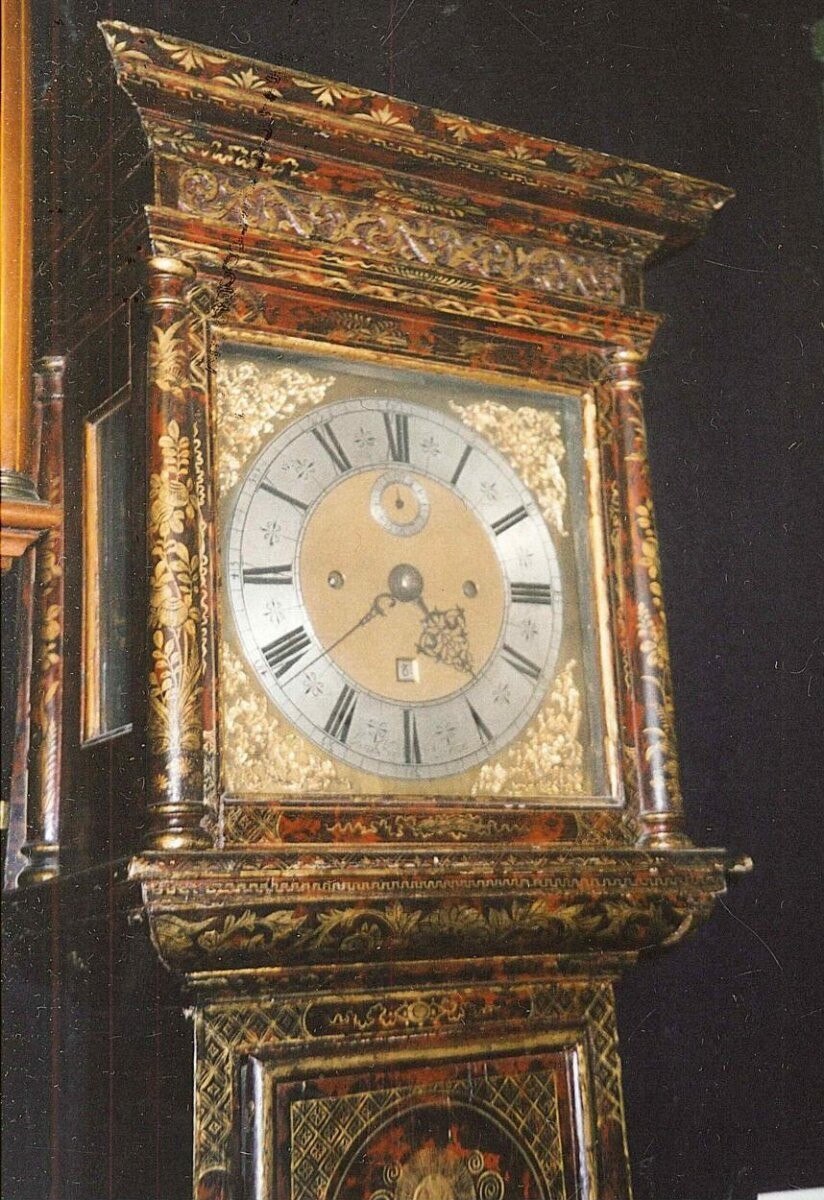
This 8-day longcase clock is attributed to the English maker Joseph Knibb, dating to approximately 1690. The movement is a weight-driven two-train mechanism featuring an anchor recoil escapement and a count wheel striking system on two bells, configured for Roman striking. The clock features a 10-inch square brass dial with a matted center, a silvered chapter ring, and cast brass cherub-head spandrels. The dial includes a subsidiary seconds ring and a calendar aperture. The softwood case is japanned to simulate tortoiseshell and is decorated with 20th-century Chinoiserie gilding. The case stands on a plinth that replaces the original bun feet. This object was bequeathed by Brigadier W.E. Clark.

The upper portion of the longcase clock, showing the hood, the japanned case decoration, and the brass dial with cherub spandrels.
The upper portion of the longcase clock, showing the hood, the japanned case decoration, and the brass dial with cherub spandrels. — Victoria and Albert Museum. Rights pending — permission not yet requested. Original source

Catalogue identity

Source
collections.vam.ac.uk
Category
Clock · Longcase clock
Maker / attribution
Joseph Knibb
Reference
W.15:1 to 3-1970
Catalogue / lot identifier
W.15:1 to 3-1970
Source-reported date
c.1690
Source-reported place
England

Source-reported attribution and specifications are not independent authentication. A listing does not establish present ownership, current display, availability or permission to reproduce.

Object description

Case and Exterior Decoration

The longcase clock features a case constructed of softwood, which has been japanned to simulate tortoiseshell against a red ground. The exterior is finished with elaborate gilded Chinoiserie motifs that depict buildings on the door and figures on horseback on the base.

The form is defined by simple mouldings, with the hood featuring detached columns flanking the square door and supporting an entablature ornamented with raised gesso foliage. The clock currently stands on a low plinth that replaced the original bun feet, evidenced by visible sockets on the underside.

Evidence for this section
  • “Of softwood, japanned in red and black to imitate tortoiseshell”
  • “decorated with Chinoiserie gilded motifs, added later, probably in the early 20th century.”
  • “The plinth has an added lower base in place of the original bun feet.”

Dial and Timekeeping Display

The 10-inch square brass dial is signed by Joseph Knibb and features a matted centre with a chamfered, rectangular calendar aperture. The silvered chapter ring is engraved with Roman hour numerals and Arabic numerals for minutes at five-minute intervals. The dial corners are finished with cast brass spandrels in the form of cherub heads. A silvered subsidiary seconds ring is positioned below the twelve o'clock marker.

A date indicator is provided by a silvered disc located behind the dial, appearing through the aperture. The hands are crafted from pierced steel. The dial is notable for its Roman striking indication, evidenced by the engraving of the four o'clock position as 'IV' rather than the more common 'IIII'.

Evidence for this section
  • “10-inch square brass dial with silvered chapter ring”
  • “The chapter ring has hour four engraved as “IV" instead of “IIII” and this was used by clockmakers to denote this striking arrangement.”
  • “Matted dial centre with chamfered, rectangular calendar aperture.”

Movement and Technical Construction

The clock is powered by an 8-day, weight-driven, two-train movement featuring an anchor recoil escapement. The movement is held together by five finned pillars riveted to the back plate. The striking train operates via a count wheel, which is mounted on the outside of the back plate and works with two bells of differing tones to perform Roman striking.

Technical analysis of the movement notes that several elements, such as the escapement and the fly, display 18th-century characteristics. Plugged holes and cut-outs on the front plate indicate previous repairs or modifications over the clock's history.

Evidence for this section
  • “Brass and steel weight driven two-train movement, with count wheel (or locking plate) striking on two bells”
  • “Anchor recoil escapement.”
  • “The plugged holes around the escapement may suggest some repair/replacement.”

Open research questions

  • To what extent was the workshop of Joseph Knibb involved in the production of this specific dial, given the departure from his standard practices?
  • Can the original appearance of the case prior to the 20th-century gilding be reconstructed through technical analysis of the japanning layers?

Source evidence

Recorded claims and source quotations for Longcase clock with 8-day movement by Joseph Knibb
FieldSource-reported valueSource quotation
MakerJoseph Knibb“the dial signed 'Joseph Knibb, London”
Datec.1690“c.1690”
Accession NumberW.15:1 to 3-1970“W.15:1 to 3-1970”
Case materialSoftwood“the case of softwood, japanned to imitate tortoiseshell”
Striking systemRoman striking“The dial indicates that the clock has so-called Roman Striking.”
Dial size10-inch“10-inch square brass dial”
ProvenanceBrigadier W.E. Clark“Given by Brigadier W.E. Clark CMG, DSO”

Visible details

  • The dial features silvered chapter ring with Roman numerals.
  • Japanned case decoration includes Chinoiserie motifs.
  • The square dial includes cherub head form spandrels.
  • A silvered disc behind the dial indicates the date.

Research qualifications

  • The dial might have been manufactured by a workshop assistant after Knibb left London.
  • The current Chinoiserie gilding was likely added in the early 20th century.
  • The presence of plugged holes on the front plate suggests historical repairs.

Photograph identity and source facts were screened before import; rights clearance remains pending.

Consulted source

Longcase clock with 8-day movement

Reviewed 2026-11-02 · Record 2223cc2a74