
Skip to content
The Encyclopedia of Horology

Clock · Longcase clock

Longcase clock by Daniel Delander

Partially verified

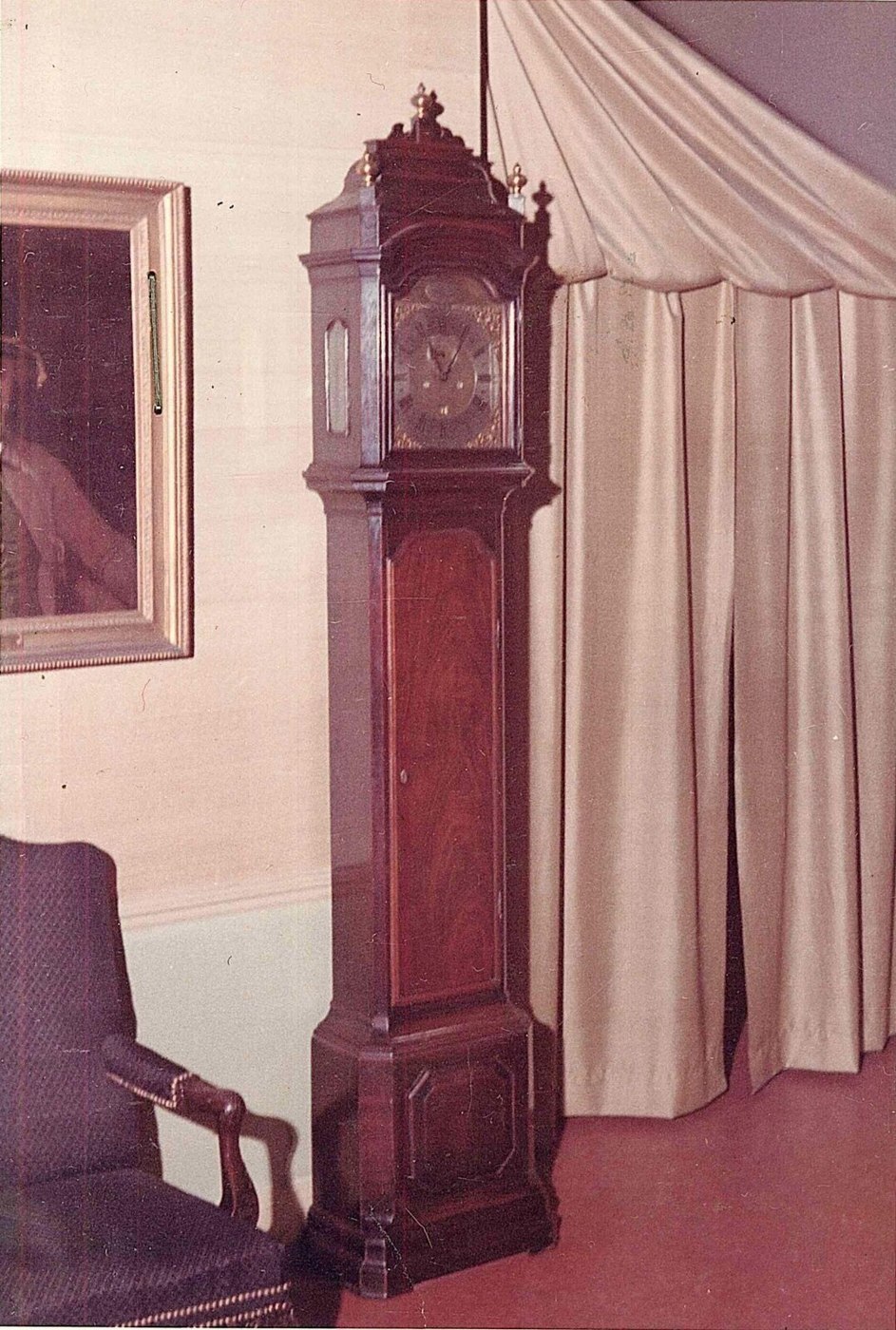
This longcase clock is attributed to Daniel Delander, featuring an 8-day weight-driven movement with a duplex escapement. The mahogany case is designed with canted corners on the plinth, base, trunk, and hood, and includes a caddy top adorned with three brass ball finials. The dial consists of a brass, break-arch plate with matted center, silvered brass chapter ring, and an oval plaque engraved "Delander / London". The movement utilizes a rack striking system for the hours, with a pendulum regulated by a broad, double suspension spring. The interior of the trunk shows scalloping, suggesting modifications to accommodate the pendulum's wide swing.

Full-length view of the longcase clock in a mahogany case.
Full-length view of the longcase clock in a mahogany case. — Victoria and Albert Museum. Rights pending — permission not yet requested. Original source

Catalogue identity

Source
collections.vam.ac.uk
Category
Clock · Longcase clock
Maker / attribution
Daniel Delander
Reference
Not recorded
Catalogue / lot identifier
W.40:1to2-1962
Source-reported date
c. 1740
Source-reported place
London

Source-reported attribution and specifications are not independent authentication. A listing does not establish present ownership, current display, availability or permission to reproduce.

Object description

Case Construction

The clock is housed in a mahogany case characterized by its canted corners, which feature prominently on the plinth, base, trunk, and hood. The hood is topped with a caddy structure supporting three brass ball finials on pedestals. The trunk door has a low break-arch top and sits above a base section containing an octagonal, moulded-edged panel.

The interior of the trunk has been crudely scalloped out on both sides, a modification apparently made to accommodate the significant swing of the pendulum bob. There are indications of previous restoration to the case, as noted by the Antiquarian Horological Society, including missing moulding sections and differences in the trunk door colour compared to the rest of the case.

Evidence for this section
  • “case of mahogany with canted front corners”
  • “The whole surmounted by a caddy top flanked by two finials”
  • “Inside trunk crudely scalloped out on both sides at same height as pendulum bob”

Dial and Hands

The brass dial features a break-arch top with a total height of 14¼ inches. The center is matted and incorporates a square calendar aperture. Winding squares are concealed by shutters. An oval plaque in the arch is engraved "Delander / London".

A silvered brass chapter ring is pinned to the plate, marked with Roman numerals for hours and Arabic numerals for minutes at five-minute intervals. A subsidiary seconds ring sits below the XII position. A secondary silvered brass ring behind the dial displays the date (1-31) via a pulley system. The hands are crafted from pierced and chiselled steel.

Evidence for this section
  • “Brass, low break-arch, total height 14¼ inches”
  • “Centre matted, winding squares concealed by matted shutters”
  • “Pinned to the dial plate is the silvered brass chapter ring”

Movement and Escapement

This mechanism is notable for having the locking wheel mounted outside the backplate on a separate cock, while the impulse wheel is positioned between the plates. The striking mechanism employs a rack system controlled by a near-vertical outside rack.

Component details include brass train wheels with four semicircular crossings and barrel-shaped steel arbors. The pendulum utilizes a broad, double suspension spring leading to a steel-strip main rod and a lead-filled brass bob, which is adjusted by a graduated rating nut.

Evidence for this section
  • “8-day duration with so-called duplex escapement, pendulum regulated”
  • “Escapement locking wheel of large diameter is mounted outside backplate”
  • “Hour striking on bell is controlled by a near vertical outside rack”

Open research questions

  • Does the absence of the name 'Daniel' suggest completion by a different maker, such as Nathaniel Delander?
  • Did the design of the canted-corner case originate with Delander, or is it a shared standard design also used by contemporary makers like Ellicott?

Source evidence

Recorded claims and source quotations for Longcase clock by Daniel Delander
FieldSource-reported valueSource quotation
MakerDaniel Delander“Daniel Delander, London, 1740”
Accession NumberW.40:1to2-1962“W.40:1to2-1962”
MaterialMahogany“case of mahogany”
Dial InscriptionDelander / London“oval plaque engraved: Delander / London in break-arch”
EscapementDuplex“so-called duplex escapement”
Exhibition History1952 Science Museum“exhibited at the Science Museum in 1952 in an exhibition entitled 'British Clockmakers' Heritage', exbn. no. 147.”
ProvenanceClaude Rotch“Bequeathed by Claude Rotch”

Visible details

  • Canted corners on the mahogany case sections
  • Brass dial plate with matted center and foliate spandrels
  • Duplex escapement configuration with a large-diameter locking wheel
  • Scalloped interior trunk walls to clear the pendulum swing

Research qualifications

  • Absence of the Christian name 'Daniel' on the dial is noted as unusual
  • Exact production date is debated between c.1715-1740 or closer to Delander's death in 1733

Photograph identity and source facts were screened before import; rights clearance remains pending.

Consulted source

Longcase clock, Daniel Delander, London, 1740

Reviewed 2026-11-02 · Record 78f1a211c6

Terms in this record

Glossary explanations for terms named in this object’s record.