
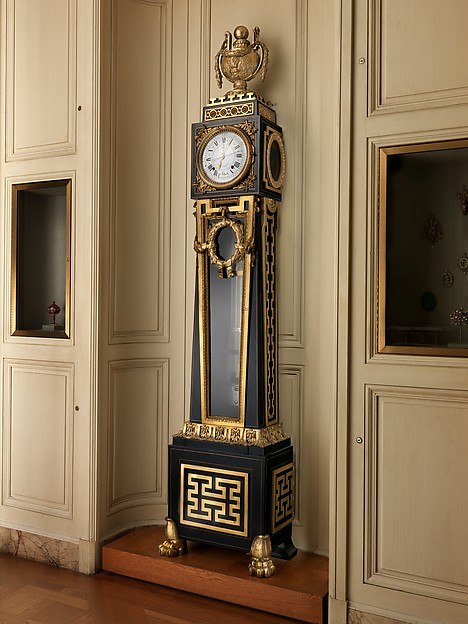
Movement and Functionality
The movement is constructed with two square brass plates held by five cylindrical pillars. It comprises a weight-driven going train featuring maintaining power and a spring-driven striking train. Regulation is provided by a Graham-type dead-beat escapement acting upon a heavy bimetallic gridiron pendulum. The pendulum, designed to compensate for temperature-induced variations, incorporates brass and steel rods.
The regulator is engineered to indicate both mean time and true solar time. An epicyclic equation mechanism, described in the maker's 'Essai sur l’horlogerie', utilizes a kidney-shaped cam mounted behind the calendar dial. A spring-loaded arm follows the cam's profile to regulate the motion of the solar time hand. The clock operates for approximately thirty-four and a half days on a single winding.
Evidence for this section
- “regulated by a Graham-type dead-beat escapement and the heavy gridiron pendulum”
- “The train drives the epicyclic system for the equation mechanism”
- “As the clock has a duration of thirty-four and one half days”